Macro Watch - Global trade and manufacturing keep expanding on AI/tech boom

Global manufacturing PMI climbs to highest level since early 2022. The global AI/tech cycle is lifting all boats. Improvements seen at both the demand and the supply side. Global trade keeps expanding driven by the global AI boom and other special factors. Supply bottlenecks do not show signs of easing.

Global manufacturing PMI climbs to highest level since early 2022
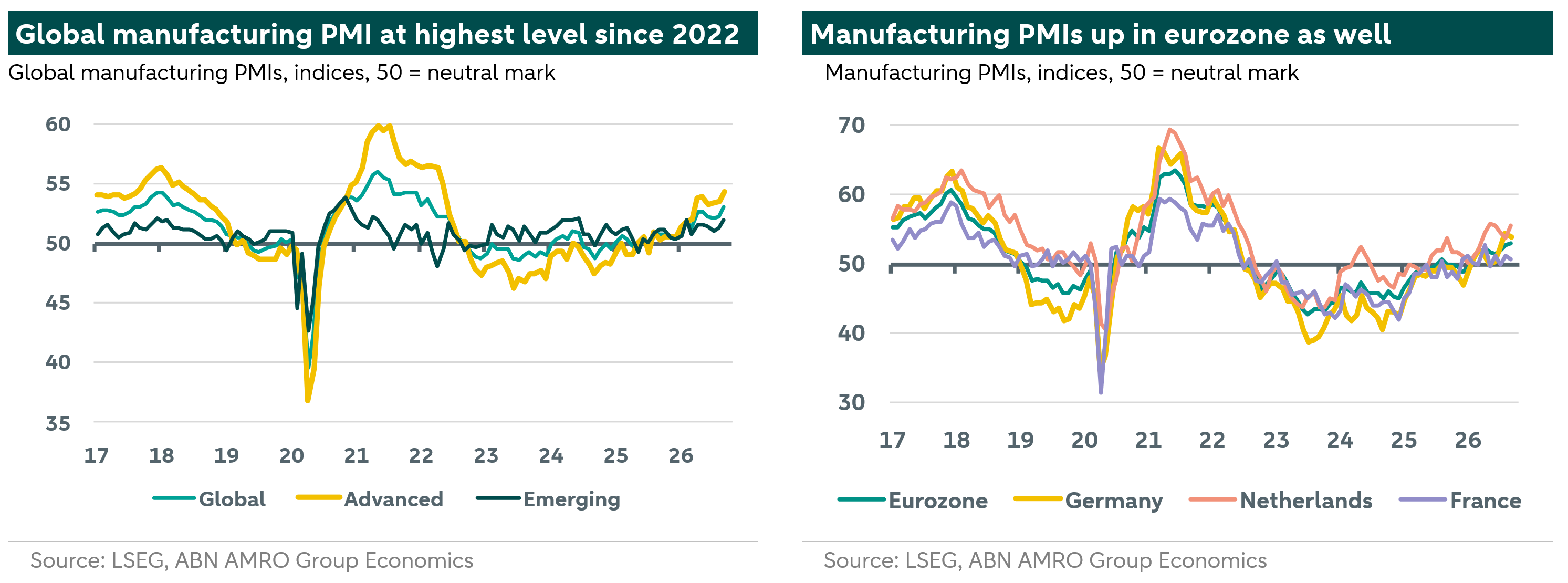
According to the September PMIs published recently, global manufacturing remains in good shape on the back of an ongoing global investment boom led by AI/tech, while shrugging of the impact from the energy crisis, higher inflation, central bank rate hikes and a tightening of credit conditions. The global manufacturing PMI rose by 0.7 points to 53.0, the highest level since the post-pandemic recovery more than four years ago. While the improvement in September was broad-based, advanced economies dominate this picture of manufacturing strength. The average index for advanced economies rose by 0.8 points to 54.3, the strongest reading since May 2022. The average for emerging economies picked up by 0.6 points to 51.9, a 7-month high.
The global AI/tech cycle is lifting all boats
Among the advanced economies, the strongest gains are visible for the US, with S&P Global’s manufacturing PMI rising by two full points to 55.9 in September. Strong readings for countries like Taiwan (56.7) and South Korea (53.9) confirm the impact from the global AI/tech boom. This AI/tech cycle seems to lift all boats, with also readings for Japan (54.1), the eurozone (52.9) and the UK (51.9) well in expansion territory. Within the eurozone, the Netherlands (55.6) remains an outperformer (see here), but also Germany’s index is remarkably strong (53.9). The reading for France – facing pressures on bond markets – dropped back to 50.6, but is still above the neutral mark separating expansion from contraction. We should note that the readings are still flattered by relatively lengthy delivery times; if we correct for this, the indices for the eurozone and the Netherlands would be somewhat lower (52.1 and 55.2, respectively). Meanwhile, the improvement of the EM aggregate is driven by developments in China and India. RatingDog’s manufacturing PMI for China, included in the EM aggregate, rose by 0.6 points to a five-month high of 52.1. The equivalent from China’s statistics agency (NBS) remains much lower at 50.1, although climbing back to expansion territory for the first time since June. India’s manufacturing PMI jumped by 2.3 points in September, to a 7-month high of 55.1.
Improvements seen at both the demand and the supply side
Looking at the various subindices of the global manufacturing PMI, the further improvement was also broad-based, and both visible on the supply as well as the demand side. Both the global output and the global new orders component rose to multiyear highs, of 53.8 (strongest reading since July 2021) and 53.6 (highest since February 2022), respectively. Meanwhile, the global manufacturing PMI’s export sub-index rose for the third month in a row, climbing to a five-year high of 51.9. This fits with the ongoing resilience visible in global trade volumes (see below), although the relationship between global trade volume growth and the global manufacturing PMI’s export component has clearly weakened in recent years.
Global trade keeps expanding driven by the global AI boom and other special factors
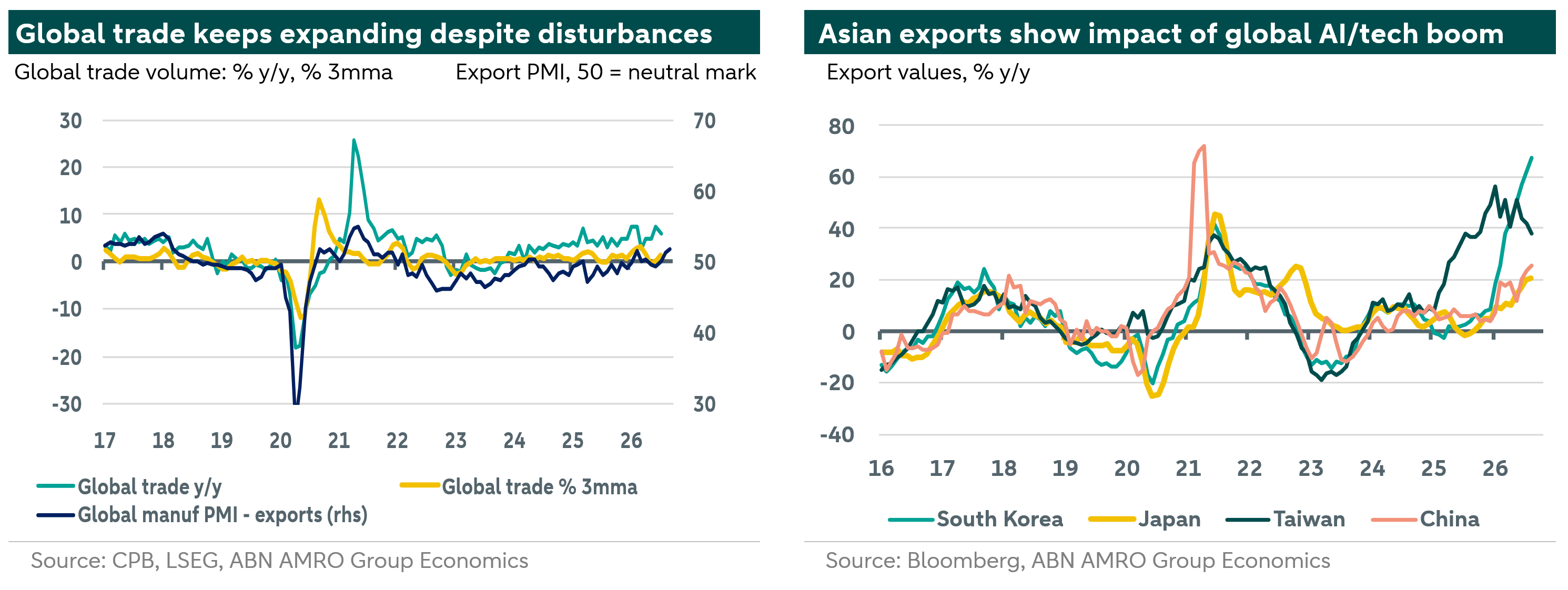
In line with developments seen in global industry, global trade volumes continue to show a remarkable strength so far this year as well, defying earlier expectations of a slowdown from above-trend growth of 4.2% in 2025. The global trade volume index published by the Dutch Centraal Planbureau (CPB) reached a new high in July, expanding by 0.3% m/m and 6.0% y/y. In the first seven months of this year, average growth was a strong 5.8% y/y, despite the drags from the Iran conflict, the related energy crisis and other disturbances. As we argued in our previous update (see here), this remarkable resilience of global trade amidst a wide range of geopolitical and geo-economic risks is based on several factors: (1) the global AI boom and a wider tech/energy/defence capex troika pushing up investment, (2) resilient consumer spending, (3) fading drags from past import tariffs, (4) ongoing trade rerouting and (5) stockpiling following the Iran conflict. The importance of the global AI boom driving world trade is also confirmed by the very strong growth in export values witnessed in Asian economies, particularly for countries like South Korea and Taiwan, although these export values are also impacted by the sharp pick-up in prices for AI-related items such as semiconductors and related products.
Supply bottlenecks do not show signs of easing
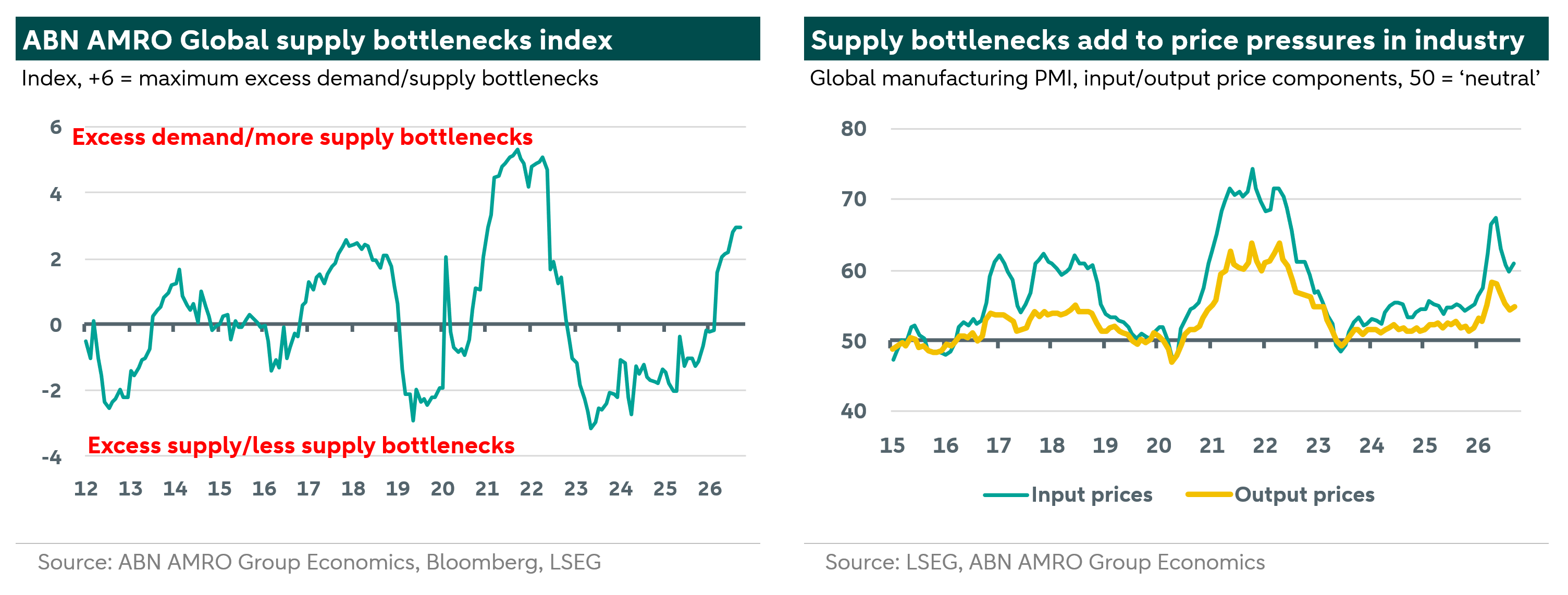
In previous publications, we have pointed at the building up of supply bottlenecks related to the Iran conflict and the ongoing global AI boom, and the inflationary impact thereof. This is also visible in our global supply bottlenecks index, which remains at post-pandemic highs. This is driven by a couple of elements. In the first place, the global PMI delivery times components included in our index still point to longer delivery times, particularly for advanced economies. Note that for the US, for instance, this delivery times component fell to a four-year low in September (lower readings mean longer delivery times). Second, container freight rates included in our index are still at elevated levels, although the global benchmark container tariff has been quite stable in recent months following a sharp rise during Q2. The wide prevalence of global supply bottlenecks is also going hand in hand with price pressures in/from the global manufacturing sector. The global manufacturing PMI’s subindices for input and output prices picked up again in September and are still at elevated levels, although remaining below the recent peak in Q2-2026 and the highs seen during the pandemic/energy crisis in 2021-2022.