Offshore wind energy is growing rapidly, but the business case remains a challenge

Offshore wind energy has grown rapidly over the past ten years. For example, global capacity has increased by 671% since 2015. At the same time, the average cost of electricity from wind energy has fallen by almost 57%. These are impressive figures, but pressure on the sector is mounting. Material and project costs are rising, interest rates remain relatively high, and the supply chain is facing increasing geopolitical instability. Meanwhile, the EU’s targets for offshore wind energy remain ambitious for the coming years. In this analysis, we examine the growth in offshore wind energy in greater depth, including the key challenges, and assess whether the EU targets are still achievable. The potential for growth in offshore wind is high globally. However, the feasibility of projects depends on cost trends, grid infrastructure, financing conditions and policy certainty. These issues are explored in further detail in this analysis.

From a global perspective, China has the largest offshore wind market due to economies of scale, subsidies and a strong domestic supply chain
Offshore wind energy continues to grow and is set to become a key pillar of the future electricity mix, particularly in Europe
The North Sea region has the strongest growth potential in Europe
The EU has ambitious offshore wind targets, but slow planning processes, grid congestion, complex supply chains and financing issues make their feasibility uncertain
Offshore wind remains capital- and material-intensive, meaning that rising raw material prices, interest rates and construction costs keep the Levelised Cost of Energy (LCOE) relatively high
Subsidies, public funding and guarantee schemes can reduce project risks, but long-term regulatory certainty is also crucial to really unlock investment in the EU
Wind energy gains market share
The global electricity mix has shifted significantly over recent decades. Whilst coal, gas and nuclear power had long been dominant since 2000, the share of renewable energy has risen sharply. The share of renewable energy sources has risen from less than 19% in 2000 to nearly 34% in 2025. At the same time, the share of fossil fuels fell from around two-thirds of production to around 57% over the same period. The share of nuclear energy also declined over the course of 25 years.
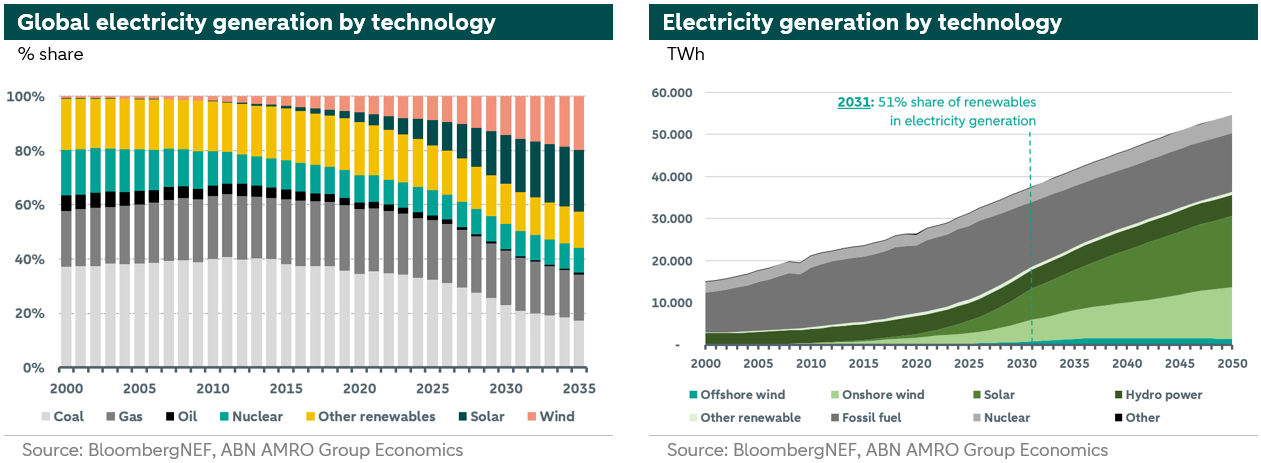
Globally, wind energy accounted for around 9% of total electricity generation in 2025. The majority of this still comes from onshore wind. Offshore wind accounted for around 1% of electricity generation in 2025. However, its importance is set to grow. It is expected that by 2031, most of the global electricity generation will come from renewable energy. By 2031, wind energy is expected to account for 16% of global electricity generation, of which offshore wind energy will account for 2%. Although the share of offshore wind energy is still relatively low, growth forecasts are high, particularly in Europe.
Strong growth in wind energy
According to Bloomberg NEF, wind energy will account for 20% of global electricity generation by 2035. This means that the number of wind projects – both onshore and offshore – will continue to rise in the coming years. In this context, growth in offshore wind energy will outpace that of onshore wind energy, not only because of space constraints on land, but also because offshore wind generates more energy than onshore wind over a given period relative to maximum capacity. This is because, at sea, the wind is less hindered by factors such as buildings. Next to that, the wind at sea is more consistent with more periods of wind. Furthermore, larger wind turbines are also more efficient at sea.
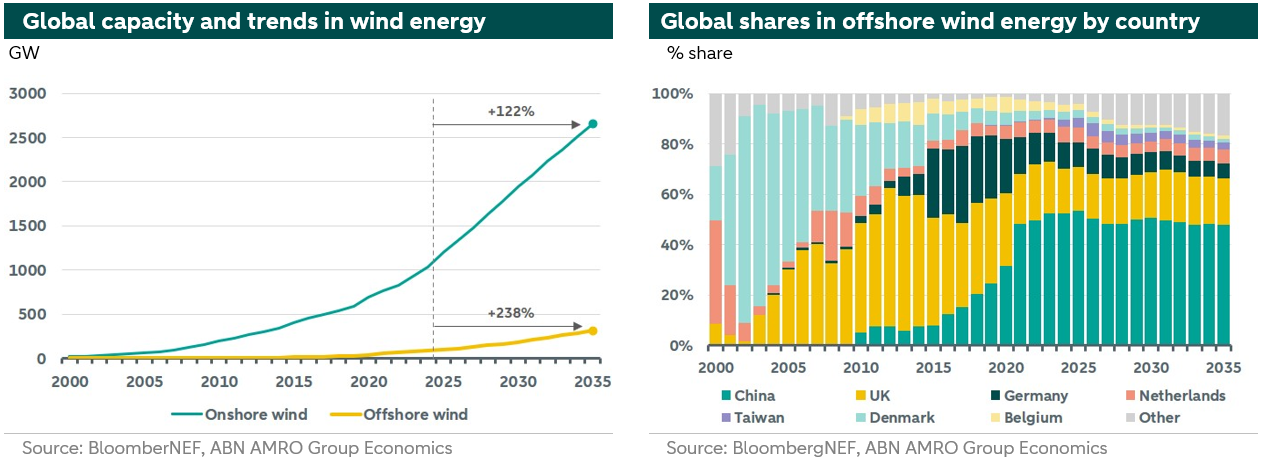
This growth is mainly concentrated in a limited number of markets. The largest markets for offshore wind energy are China, the UK, Germany and the Netherlands. The growth in China has been impressive since 2021. China has regarded offshore wind energy as a key strategic industrial sector and has significantly expanded its dominance in this segment. Subsidies for offshore wind energy have contributed to this growth. China also has a complete domestic supply chain at its disposal, enabling projects to be realised more quickly and cheaply.
Within the EU, the North Sea region is a key area for the development of offshore wind energy. This region currently accounts for approximately 35% to 40% of global operational capacity and has significant potential for further growth. Germany, the Netherlands, Denmark and the UK have substantial offshore wind interests and ongoing projects in this region.
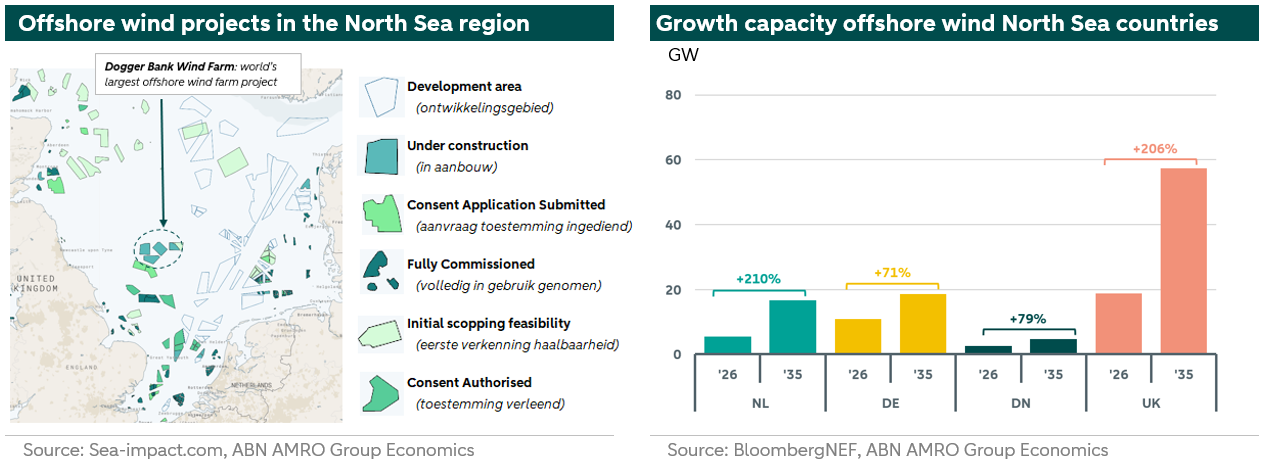
The map in left-hand chart shows that the availability of sites is not the problem. There are currently sufficient projects under development or going through the planning process. There is also still sufficient space for the further development of offshore wind projects. In addition, the Dogger Bank Wind Farm is under construction in this area. This is the largest offshore wind farm in the world, with a capacity of 3.6 GW. Construction is being completed in phases; according to the most recent schedule, the final phase will be completed in 2027. This will ensure that the UK has the largest offshore wind capacity in Europe. The UK’s ambitions are also considerable, as shown in the figure on the right above. If all plans go ahead, the UK will have nearly 60 GW of offshore wind capacity by 2035. This represents a 206% increase compared with the capacity in 2026. In percentage terms, however, the Netherlands is the fastest-growing market. Offshore wind capacity there is expected to increase by around 210% between 2026 and 2035, slightly more than in the UK. By contrast, projected capacity growth in Germany and Denmark is considerably more modest over the same period.
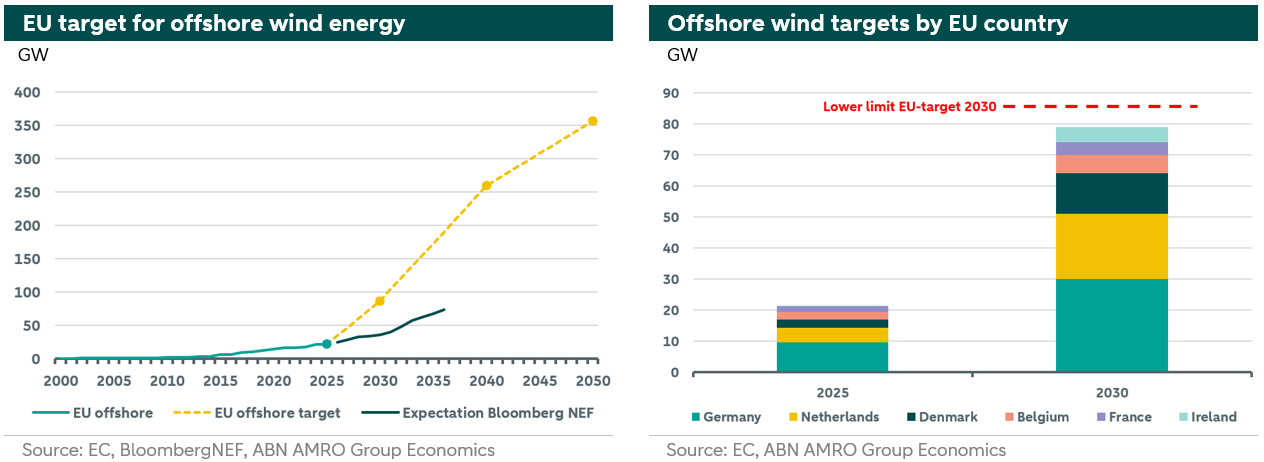
The strong growth of offshore wind energy in the North Sea region is making a significant contribution to the EU’s targets. With the REPowerEU plan, the EU has set itself the target of achieving a cumulative installed capacity of 425 GW from onshore and offshore wind energy by 2030. In line with this target, an ambition has been set for offshore energy of 86–89 GW by 2030 and 355–366 GW by 2050. There is therefore no shortage of EU ambitions in the field of wind energy, with Germany and the Netherlands together accounting for around two-thirds of these. The question, however, is how feasible these targets are. Projections suggest that there is little chance of the current targets being fully achieved. This is evident from both the left-hand and right-hand figures below. The left-hand figure shows the EU target as the yellow dotted line, whilst the dark green line shows BloombergNEF’s (BNEF) projections after 2025. BNEF closely monitors the development of thousands of individual existing and announced wind projects and applies its own calculations to them. These projections imply that additional wind capacity in 2030 will fall 59% short of the EU target. Even if we add up all the offshore wind ambitions of the EU countries – see the figure on the right below – the 2030 target will not be met.
Given the EU’s ambitions, offshore wind energy will remain a key pillar of the EU’s future electricity mix. However, there are still plenty of bottlenecks when it comes to building projects, connecting them to the grid and securing funding. The biggest obstacles are obtaining project permits, expanding the electricity grid and connecting projects to it (see here), and scaling up the supply chain.
Offshore wind projects have high capital intensity
Developing offshore wind projects is cheaper in China than in Europe. The difference is significant. For example, the average cost per GW in Europe is four times higher than in China. Thanks to a fully domestic supply chain, subsidies and lower costs for engineering, procurement and construction, China can deliver offshore wind projects at a much lower cost than Europe. However, this cost advantage may change if subsidies are reduced, labour costs rise or international trade measures affect the supply chain. The differences in installation costs, development costs and operational costs are considerably smaller.
Wind technology is relatively material-intensive due to the use of steel, copper, aluminium and, in some types of turbines, rare earth elements. Steel is used in large volumes, but cement for the foundations is also of great importance. In addition, large quantities of copper are required for cabling, generators and connection to the electricity grid. In offshore wind projects, copper cables must often span long distances to the mainland. In the EU, the average length of these cables is 27 kilometres. The consumption of such large volumes has a significant impact on the total project costs. Furthermore, direct-drive turbines require relatively large quantities of permanent magnets made from rare-earth elements. Prices for steel, cement and copper may remain under upward pressure in the run-up to 2030. Demand for these materials will remain high in the coming years, due to substantial investment in infrastructure. Furthermore, energy-intensive sectors such as steel, cement and copper are facing higher costs, particularly for energy and CO₂.
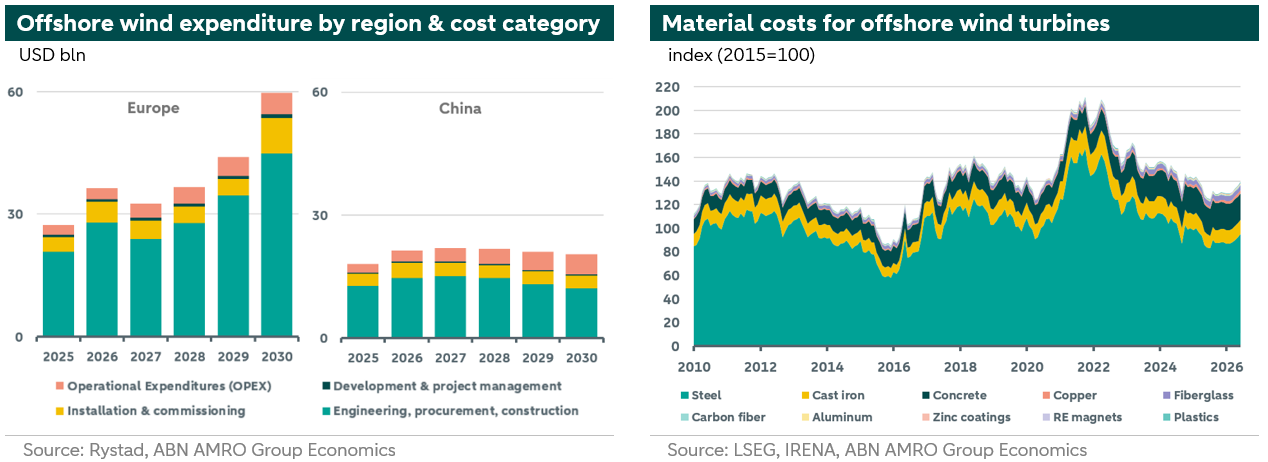
Material costs also influence the Levelised Cost of Energy (LCOE). This is a metric that shows the average cost of generating one kilowatt-hour (kWh) of electricity over the entire lifetime of an energy source. The level of the LCOE is important for developers of offshore wind projects, as a lower LCOE generally indicates a more competitive project. As such, the LCOE provides insight into the economic viability of projects and helps in securing funding. In addition, policymakers use this metric when formulating energy and subsidy policies. The figure on the left below shows the trends in LCOE by technology.
The LCOE of offshore wind is, on average, higher than that of other renewable technologies, as the total costs of development, construction, materials, grid connection and maintenance are considerably higher. This makes offshore wind projects capital-intensive. The difference compared with onshore wind projects is substantial, but also, for example, compared with gas and coal. However, the LCOE for gas and coal can fluctuate and depends heavily on the volatility of gas and coal prices.
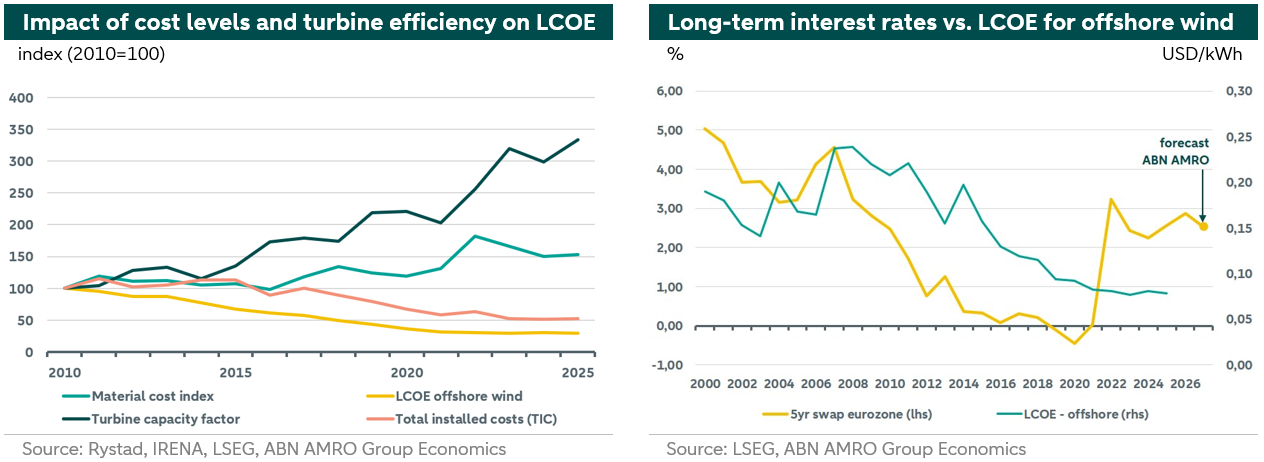
From the figure on the right above, we can see that the average global LCOE for offshore wind is heavily influenced by China. Not only does China have the largest offshore wind capacity, but it is also able to deploy offshore wind capacity at just over half the average cost in the EU, partly due to subsidies. In addition, the capacity factor, construction costs, material costs and interest rates also have an impact on the LCOE. This can be seen in the left-hand figure below.
As wind turbines become more efficient, the cost of the electricity generated (LCOE) falls. The efficiency of a wind farm is measured by the capacity factor. This indicates what proportion of the maximum possible electricity generation is achieved. Since 2015, the capacity factor has improved significantly and increased by 147% up to 2025. As a result, wind farms can generate more electricity with the same amount of installed capacity. At the same time, total installation costs have fallen. However, this is offset by rises in material costs, financing costs and the costs of grid connections. As a result, whilst the LCOE has fallen, the reduction has been less pronounced than might be expected based on technological progress.
Higher interest rates also have a significant impact on the LCOE. Many offshore wind projects rely on debt financing for their initial funding, in some cases up to 70%. Consequently, higher interest rates have a significant impact on total costs. In our projections, interest rates remain relatively high even in 2027. This is illustrated in the figure on the right below.
Reducing the cost of capital is beneficial for offshore wind projects. This can be achieved, for example, through a Green Longer-Term Refinancing Operation (GLTRO). This is a proposed monetary policy instrument whereby the European Central Bank (ECB) provides low-cost loans to commercial banks with the aim of accelerating the energy transition. It reduces financing costs and the risks for banks providing loans for green projects; for offshore wind projects, this translates into lower capital and financing costs. However, a GLTRO is currently a policy proposal and not an existing instrument. Its implementation, if any, is not expected before 2028 according to some sources. Consequently, its practical impact remains uncertain for the time being. More information on the GLTRO and its impact on renewable technologies can be found here.
Another potential area of growth within offshore wind is floating wind energy. However, these projects are more capital-intensive than offshore wind projects with fixed foundations, partly due to the higher standards required in terms of production and design. Furthermore, this niche market is still in its early stages and therefore cannot yet benefit from economies of scale. It is expected that floating wind energy will be viable on a commercial scale by the mid-2030s.
Financing offshore wind projects
For developers of offshore wind projects, securing funding is a crucial step. As offshore wind projects are capital-intensive, they require a significant amount of debt. For financiers, the predictability of future cash flows is particularly important, as this determines whether a project is profitable and financeable in the long term.
To improve the predictability of cash flows, the UK uses the Contract for Difference (CfD) system. This is a government support scheme. Under the CfD scheme, developers receive a guaranteed strike price per megawatt-hour for a period of twenty years. If the electricity price is lower than the strike price, the producer receives compensation; if the market price is higher, the producer repays the difference. CfD schemes are also used in the EU, including in the Netherlands, Germany, Poland and Denmark.
In addition, project financing plays an important role. A consortium of banks provides loans to a special-purpose project company, with 60–80% of the required capital typically financed through debt. In this arrangement, the debt is secured by the project itself rather than by the project developer’s balance sheet. Power Purchase Agreements (PPAs) can also help ensure a secure income stream. This is a long-term contract under which a customer or an energy company commits to purchasing clean electricity directly from the wind farm project.
In some cases, the most innovative projects are also financed with public funds, via the European Investment Bank (EIB) or through special European programmes. Governments thus play an important role in reducing project risks and increasing investment certainty, ensuring that private parties remain willing to finance new capacity.
An earlier special analysis examines planned investments in wind energy, their financing within the EU, and the role of the Dutch government in offshore wind farm projects in greater detail. Among other things, this analysis highlights that if the Netherlands is to meet the desired EU targets by 2030, the government must create an environment in which projects become profitable, and risks for both companies and financiers are reduced.
Market conditions for offshore wind projects have become less favourable in recent years due to higher interest rates, rising material costs and uncertainty in the supply chain caused by geopolitical pressures. Partly as a result, there is growing political backing for additional financial assistance for offshore wind projects. For example, in September 2025, the Dutch government launched the Offshore Wind Energy Action Plan. Under this plan, nearly EUR 1 billion was set aside from the Dutch Climate Fund to enable the deployment of approximately 2 GW of offshore wind capacity by 2026 through subsidised tenders. This reduces the risks for developers and financiers. However, subsidies alone are sometimes not enough. As offshore wind farms have a lifespan of 20 to 30 years, long-term regulatory certainty is at least as important as temporary financial support.
Conclusion
Offshore wind energy is growing rapidly; ambitions are high and, particularly in Europe, offshore wind is seen as an indispensable pillar of a cleaner energy system. However, the technology also has limitations that stand in the way of accelerated growth. High material costs, expensive financing, slow permit-granting processes, geopolitical pressure on supply chains and especially grid congestion are hampering development, particularly in Europe.
At the current rate of capacity growth, the EU’s targets will not be met. The expansion of new offshore wind capacity in Europe must therefore, above all, remain realistic and affordable. Subsidies, public funding and guarantees reduce the risks for developers and financiers in the short term, but greater regulatory certainty over the lifetime of offshore wind projects may be more valuable to stakeholders. Without predictable policy, reliable infrastructure and a financing climate that supports long investment horizons, these high ambitions cannot be realised.
The energy transition and the need for greater energy security call for more offshore wind energy. If the EU wishes to develop offshore wind energy into a key pillar of the electricity mix, it must establish transparent conditions, reduce risks and provide financial support to the sector.