ESG Economist - Renewables are at crossroads
Costs for onshore wind and solar PV have significantly decreased over the past decade but have stabilized recently, while CCS, battery storage, and hydrogen remain relatively expensive. Grid congestion, curtailment, and lower capture prices are becoming key bottlenecks. Batteries are essential for addressing grid constraints and renewable intermittency, enabling energy storage, grid stability, and improved project economics. Oversupply in battery production has resulted in significantly lower prices, but as demand and material prices rise, upward pressure on prices may emerge. The focus is moving from renewable capacity expansion to system integration, requiring investments in storage, grids, and flexible infrastructure for a resilient energy system.


Introduction
The energy transition is encountering challenges as some major economies scale back their climate commitments. Despite this, significant progress has been made in recent years, particularly in the power sector, with record-breaking installations of renewable energy worldwide. These investments have been driven not only by supportive policies and regulations but also by the growing competitiveness of renewable technologies. This competitiveness stems from advancements in materials, designs, manufacturing, and economies of scale, which have led to increased maturity, reduced costs, and higher adoption rates.
However, grid constraints pose a challenge for renewable installations, where high curtailment rates and lower capture prices undermine the financial viability of renewable technologies, especially solar energy. Curtailment rates measure how much potential renewable energy production is not used because the grid cannot absorb it at that moment. As a result, attention is shifting toward flexible solutions like batteries and storage systems, which can address the intermittency of renewable energy, provide grid balancing services, and strengthen the business case for renewables.
This note explores the cost trends of different renewable technologies and the factors driving their movement over time. Additionally, it examines the role of battery technology in the energy transition, emphasizing the connection between cost reductions, commodity prices, and the pace of transition progress.
Cost trends of renewables
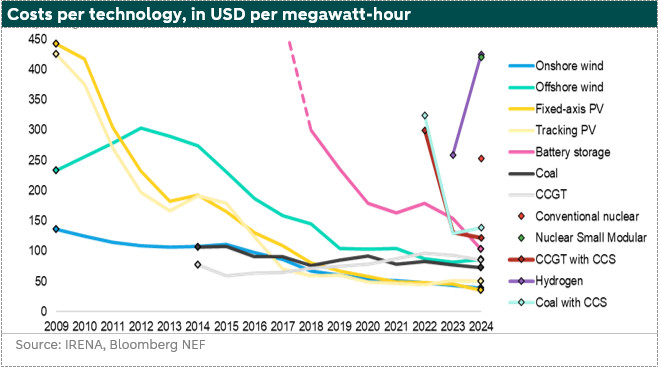
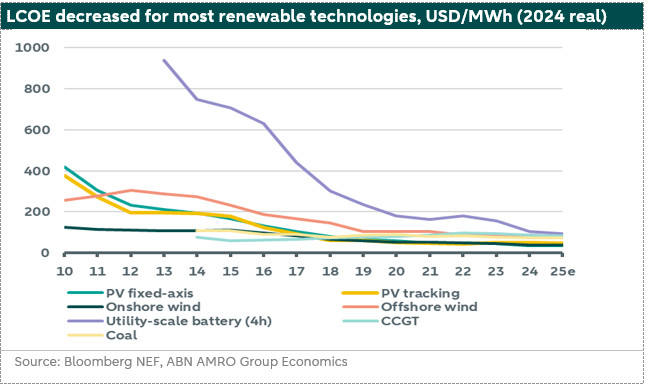
Over the past ten years, the costs of renewable energy technologies have dropped sharply (see the below on the graph on the left). Data from IRENA and Bloomberg New Energy Finance (BNEF) show that onshore wind and both fixed‑axis and tracking solar PV have become cheaper than electricity produced from gas and coal.
Other technologies have also become cheaper, but they are still more expensive than gas and coal. These include carbon capture and storage (CCS) when used with gas or coal power plants, battery storage, nuclear power, and hydrogen. In particular, CCS is still far too costly compared to simply using gas or coal without it. This means CCS prices must fall further before industries and power companies can adopt it on a large scale. Battery storage has seen big cost reductions as well, but it also needs to become even cheaper for widespread use. More on this below.
Over the last five years, the costs of onshore wind, offshore wind, and solar PV have stopped falling and have more or less stabilised. These technologies were the first to be adopted widely thanks to government policies and subsidies in many countries, so they are much further along in their development in comparison to the other technologies.
Cost components
In this section, we focus on how the costs of the important renewable technologies are built up. This is important because different cost component have different drivers as we show later in this publication. We show the different cost components for onshore wind, solar PV, and battery storage technologies. We start with the cost break down of batteries.
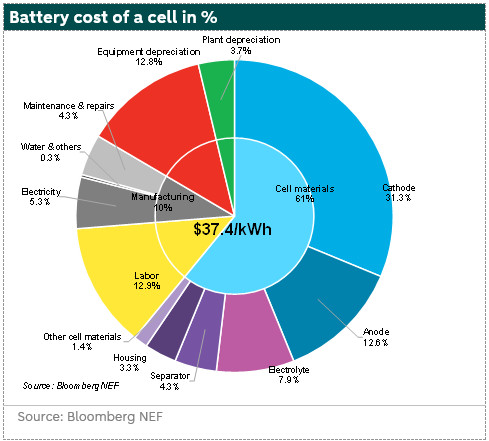
The graph above shows the cost breakdown of a battery cell. Materials used to make the cell make up to 61% of its total cost. A battery cell is the basic unit of a battery. A battery pack is made up of many battery cells combined together. According to BNEF, the battery cell represents about 55% of the total cost of a full battery pack. The other costs include thermal management system (9%), battery management system (13%), pack structural units (15%) and labour (6%), water, maintenance and depreciation (1%).
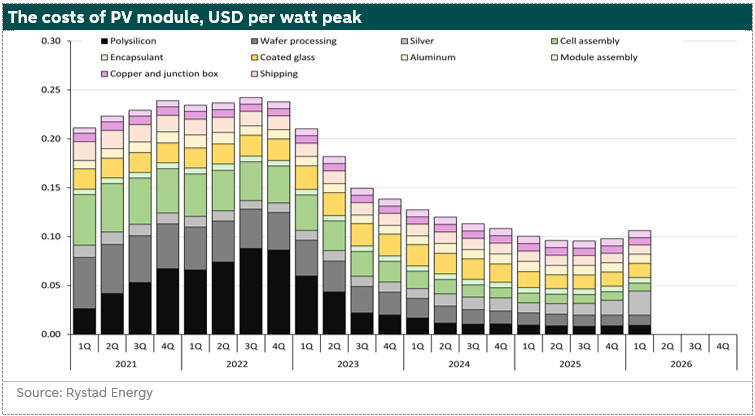
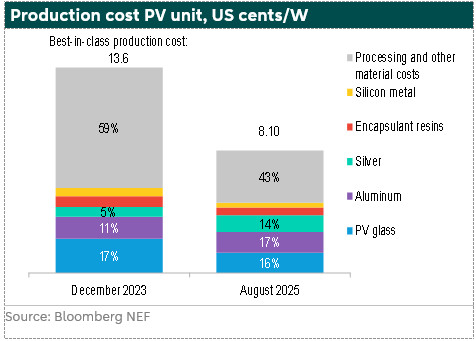
For a wind farm, raw materials account for about 13–19% of the total cost of producing a wind turbine while for solar panels, materials make up 30–40% of the total production cost (see more ) and other cost components include: labour, energy use, equipment depreciation and overhead (see more ). The graph above shows the cost trend for PV modules. The share of silver in total PV module costs has increased since Q4 2025 because silver prices have risen sharply. Silver accounted for 14% of total costs in 2025, up from 5% in December 2023. This increase is due both to higher silver prices and falling costs in other parts of the solar supply chain. It is likely that silver’s share has risen even further since then as silver prices has rallied (see graph below).
Many factors contribute to cost reduction
The cost reduction of renewables over time has been driven by several key factors, including economies of scale, advances in manufacturing, and innovations in materials and design, all of which have contributed to declining Levelized Cost of Energy (LCOE) trends across nearly all renewable technologies, as shown in the right graph below. Economies of scale have enabled large-scale deployment of renewable energy infrastructure, reducing per-unit costs as production volumes increase.
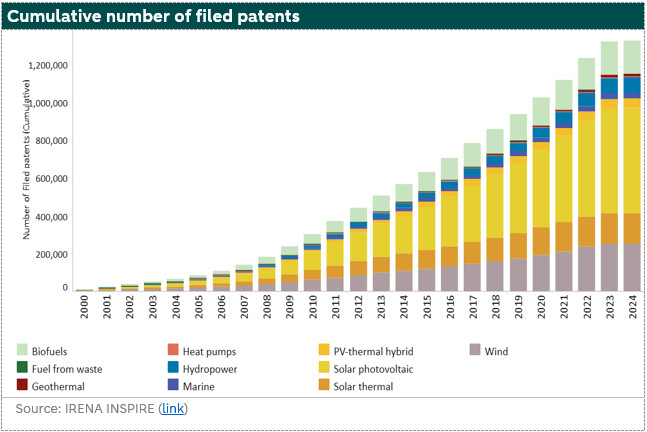
Advances in manufacturing processes, such as automation and improved assembly techniques, have further reduced costs and enhanced efficiency, making renewables more competitive with traditional energy sources. Meanwhile, continuous innovation in materials—such as higher-efficiency solar cells and lighter, more durable wind turbine blades—and advances in design have significantly improved energy yield per unit of capacity. These developments are supported by a rise in patent numbers in almost all technologies (see chart below), reflecting robust R&D efforts and technological breakthroughs. However, the increasing grid curtailment rates highlight a growing challenge in fully utilizing renewable energy due to limited grid capacity and intermittent generation, which can offset some of the cost benefits by lowering capture prices. Addressing these curtailments through flexible solutions like battery storage is key to maintaining the downward LCOE trends and ensuring the continued productivity improvements of renewables in the energy transition.
Additionally, material costs play a crucial role in shaping the overall cost trajectory of renewables—declining prices for key materials such as silicon and rare earth metals have helped reduce manufacturing costs, while fluctuations in commodity prices could influence future trends in renewable energy affordability. We elaborate on this in the subsequent section.
Commodity prices heavily influence on the cost of renewable technologies
The cost of renewable technologies is heavily influenced by the price trends of key commodities and raw materials, which are essential for manufacturing clean technologies. Metals such as copper, nickel, cobalt, and lithium play indispensable roles in the production of solar panels, wind turbines, and energy storage systems. For solar panels, silicon, silver, and copper are critical components, while wind turbines rely on steel, copper, and rare earth magnets like neodymium. Batteries, essential for energy storage, depend heavily on lithium, cobalt, nickel, and graphite, making these metals vital to the energy transition. However, fluctuations in commodity prices significantly impact the affordability of these technologies. For example, the price of lithium surged by 66% in 2025 due to supply constraints, including reduced stock levels and the closure of a major lithium mine in China. These sharp increases in material costs have notably raised the production costs of batteries, which saw a 42% increase in material costs by the end of 2025. Solar panels and wind turbines also faced cost increases, with material costs rising by 25% and 21%, respectively, due to price surges in copper, chromium, and silver.
Geopolitical uncertainties and supply-demand imbalances create price volatility, with copper and graphite shortages looming, while nickel, cobalt, and lithium remain in surplus until 2030. These challenges threaten affordability but highlight the need for recycling and material efficiency to ensure a stable supply for clean technologies and climate goals. More on the impact of commodity prices can be found in our earlier note (see more ).
Energy storage is essential due to intermittency of renewable energy
As renewable energy makes up a bigger share of electricity generation, the need to store this energy will grow. Energy storage is essential for keeping the whole energy system flexible, stable, and reliable.
Renewable energy sources like wind and solar are not constant—they produce electricity only when the wind blows or the sun shines. Storage helps smooth out these fluctuations and keeps the grid balanced. Without storage, we would see more curtailments (wasted renewable energy) and more frequent negative electricity prices, which would make renewable projects less profitable.
There are many different types of energy‑storage technologies, and each has specific strengths. Together, they support renewable‑energy integration, help electrify more economic sectors, and assist in cutting emissions across different sectors. For these reasons, energy storage is a central part of building a fully integrated and low‑carbon energy system. It also helps consumers manage their energy use and take part in energy markets more easily.
Energy‑storage technologies can also be rolled out quickly when the right policies and incentives are in place. This makes them a useful short‑term tool for improving energy security and meeting the EU’s REPowerEU goals. For example, stand‑alone battery projects can be built in under a year, and behind‑the‑meter battery systems can be installed in just a few days. These solutions support both energy efficiency and demand response (see more ).
Limited grid capacity is emerging as a critical obstacle to the transition
Limited grid capacity is emerging as a critical obstacle to the energy transition, especially as renewable capacity surges to meet climate goals. Power market operators face increasing challenges in grid balancing due to the intermittent nature of renewable energy generation, which depends on weather conditions and lacks the flexible capacity needed to stabilize supply and demand. Without sufficient grid infrastructure and storage solutions, curtailment episodes—where excess renewable energy cannot be utilized—and negative price events become more frequent. Additionally, frequency swings caused by unstable generation can lead to blackouts and economic costs, as witnessed during the recent nation-wide blackout in Spain and Portugal, which highlighted concerns about energy stability and security across Europe. Batteries provide essential solutions to these challenges by balancing supply and demand, storing excess renewable energy during peak generation periods, and dispatching it during periods of high demand or low generation. This capability enables peak shaving, reducing strain on the grid during demand spikes, and load shifting, redistributing energy from off-peak periods to peak times.
Battery storage plays a vital role in the energy transition
Batteries play a vital role in grid stabilization, offering frequency regulation and voltage control to mitigate fluctuations and prevent outages. Successful examples include the Hornsdale Power Reserve in South Australia, which reduced grid instability and enhanced energy reliability, and California's deployment of utility-scale battery systems, which ensured smooth load shifting and avoided blackouts during heatwaves. Integrating batteries into power grids not only addresses the challenge of limited capacity but also promotes energy stability, encourages investments in renewables, and accelerates the transition to a sustainable future.
There are several ways to store renewable energy, including mechanical, electrochemical, thermal, electrical, and chemical methods (see more ). In this document, we focus on electrochemical storage, better known as batteries. Batteries work by storing electrical energy in chemical form. When the battery is discharged, the chemical reactions are reversed, and the stored energy is turned back into electricity. Rechargeable batteries are the main type of electrochemical storage. This storage has been used for small‑scale applications for many years. Today, several battery types are suitable for stationary energy storage, including well‑known technologies like lead‑acid, lithium‑ion, and sodium‑ion batteries.
Right now, lithium‑ion batteries using LFP (lithium iron phosphate) chemistry are the most common choice for storage. LFP batteries are popular because they last a long time, are very safe, and are stable. However, they store less energy per kilogram than some other lithium‑ion chemistries.
Their main competitor is the sodium‑ion battery. Sodium‑ion batteries are cheaper than LFP, work better in cold temperatures, and do not use lithium. But they also store less energy than LFP and, at the moment, have a shorter lifespan.
There are also new battery technologies being developed, such as zinc‑air (Zn‑air) batteries and room‑temperature sodium‑sulfur batteries.
Cost trends in battery technology
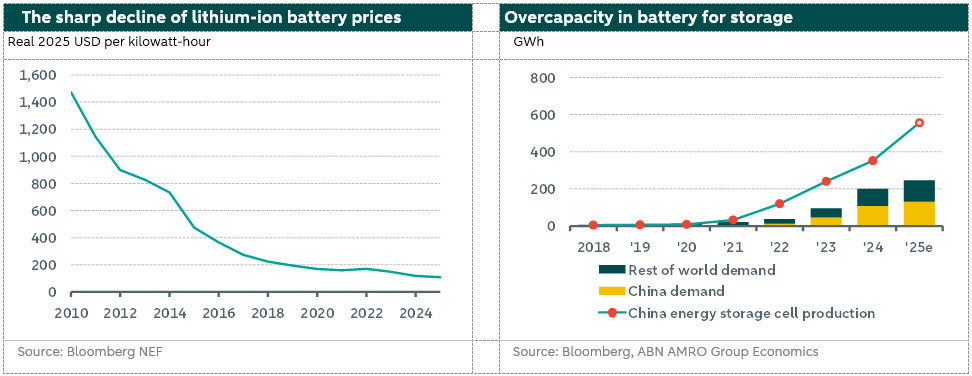
Since 2010, the price of lithium‑ion batteries has dropped sharply—from about 1,474 USD per kilowatt‑hour to 108 USD in 2025 (see graph below on the left). These prices cover all types of lithium‑ion batteries, not just LFP. This represents a 93% decline. This price decline is only partly determined by material costs. Another big reason prices fell is oversupply. Demand for batteries increased and factories scaled up production. As manufacturers produced more batteries, costs per unit dropped due to economies of scale. For several years, there has also been oversupply in the battery market, also for storage, which pushed prices downward. The graph on the right shows that battery demand in China and globally is still well below total production capacity.
We think demand for storage batteries will rise significantly. This means the current oversupply will shrink. At the same time, material prices have likely reached their lowest point (see more ). Less oversupply and higher material costs could put upward pressure on battery‑pack prices in the coming years. If no new battery technology enters the market, rising lithium‑ion battery prices could lead buyers to switch to cheaper alternatives like sodium‑ion batteries. This shift would continue until a new battery technology emerges that can store more energy without reducing lifespan, safety, or stability.
Conclusion
Renewable energy has become increasingly cost‑competitive thanks to technological progress, scale effects, and innovation, even as cost declines have recently stabilised and commodity prices have increased. As renewable capacity expands, grid constraints and curtailment are emerging as key challenges, shifting the focus from generation to system integration. Battery storage plays a critical role in addressing these issues by providing flexibility, stabilising grids, and improving the economics of renewables.
Ultimately, the success of the energy transition will depend not only on deploying more renewable capacity, but on building a flexible, integrated energy system. Batteries and other storage technologies are no longer optional add‑ons; they are essential infrastructure. Continued investment in grids, storage, and innovation—supported by stable policy signals—will be crucial to sustaining momentum, safeguarding energy security, and ensuring that the transition remains both economically viable and environmentally effective.