Spotlight - The implications of the new EU fiscal rules

The EU finally managed to agree on a new set of fiscal rules in late 2023. Although the path to meeting the new criteria is less restrictive and countries are allowed to adjust more gradually, it will still imply significant fiscal effort for the most indebted countries. The strongest incentive to stick to the rules lies in the ECB's TPI instrument, as only countries that comply to the EU fiscal rules will be eligible for asset purchases in future. Thus, this could have an impact on bond yields of countries that would fail to meet those rules. In the meantime, we expect country spreads to slightly tighten in 2024, as we expect the central bank rate-cut cycle to be the dominant driver.


ABN AMRO Group Economics
Author has left Group Economics, see text
Co-author: Sonia Renoult
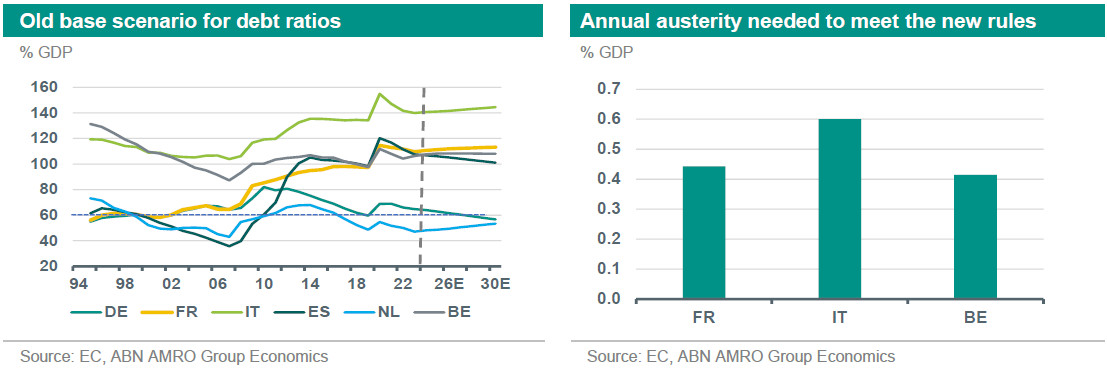
Finally, the EU member states have reached an agreement on a new set of fiscal rules. A compromise was found between fiscal tightening and investment needs. The new rules will bring fiscal tightening back to the table although less strict than under the previous rules. Fiscal effort will be required, though, and weigh on the economies of the most indebted countries. Our calculation show that within the group of big-6 eurozone countries France, Italy and Belgium are expected to be in conflict with the EU fiscal rules. This means they will have to implement significant austerity measures during the adjustment period in order for their government debt ratio’s to decline at the required pace. This adjustment is aggravated by the fact that interest payments will take up a rising part of government expenditure in the coming years.
We think that the most disciplinary element of the new fiscal rules probably is that only countries that adhere to these rules will be eligible for asset purchases under the ECB’s Transmission Protection Instrument (TPI). Indeed the TPI (see ) states that only countries that comply with the EU fiscal framework are eligible for asset purchases by the Eurosystem. This means that the sovereign bond spreads of countries that are not in compliance with these rules would probably surge higher in case of a financial or economic crisis that would affect the entire eurozone. This is one of the main reasons why we expect fiscal tightening to materialise this time, although at a very slow pace.
Most EU governments already plan to cut spending this year. However, this is mainly due to the unwinding of the financial support provided during the pandemic and the energy crisis. Thus, the more structural fiscal tightening is still yet to come. In our view, the start of the ECB interest rate cut cycle, which we expect in June, (see eurozone), will be the dominant narrative in the bond market this year. Based on our forecasts for growth and inflation, we think the interest rate cut cycle will have a narrowing effect on country spreads. As such, we forecast country spreads to tighten slightly toward the end of the year.
In our publication of 23 January (see here) we discuss the key takeaways from the new fiscal rules and what they mean for government finances and the economies of the big-6 eurozone countries. We also shed some light on this rule’s impact on sovereign bond spreads and the forecast for the year 2024.