The economic impact of a hotter Europe

The summer of 2026 has so far been exceptionally warm and dry, with wildfires spreading across large parts of Europe. Recent indicators of land temperatures, drought conditions and wildfire activity are significantly exceeding longer-term trends. Moreover, economic losses associated with heatwaves, droughts and wildfires have risen steadily over time. In this note, we estimate the economic losses incurred across Europe during the summer of 2026, and we also consider what these developments may imply for the Netherlands. Finally, we examine the implications of these extreme weather events for energy markets.


Climate hazards, direct damages, and GDP impact
It is important to distinguish between direct damages and the impact on GDP figures when assessing the economic costs of climate-related hazards. Direct damages refer to the immediate physical losses caused by an event, such as destroyed buildings, damaged or lost infrastructure and crop losses. GDP impacts, by contrast, measure the effect on economic activity and production, for instance factory shutdowns, transport and supply chain disruptions, reduced tourism activity, or lower labour productivity. Working in opposite direction on GDP, health care expenditure and expenditure on reconstruction, emergency response measures and disaster relief will increase.
While direct damages are often easier to observe and quantify, they are not necessarily a good proxy for macroeconomic impacts. The relationship between direct damages and GDP varies considerably across climate hazards because each affects economic activity through different transmission channels, listed below.
Heatwaves generally cause relatively limited physical damage but can have significant economic effects by reducing labour productivity, shortening working hours, disrupting transport and infrastructure, and (working in the opposite direction) increasing energy demand for cooling. Droughts can lower agricultural yields and livestock production, reduce hydropower generation, disrupt water-intensive industrial processes, and limit inland water transport through low river levels. They may also reduce the efficiency of thermal and nuclear power generation when cooling water becomes scarce or excessively warm. As a result, droughts can generate substantial losses in economic output even when direct physical damage is relatively limited. Wildfires often have the opposite profile. They can generate very large direct damages through the destruction of homes, commercial buildings, industrial facilities, forests and infrastructure. However, their GDP impact may be smaller than the value of the physical losses because reconstruction activity, emergency support and disaster relief partly offsets the decline in economic output. Nevertheless, wildfires can still affect GDP through business interruption, disruption to tourism and local services and supply-chain effects.
An example of the difference between direct damages and the impact on GDP is provided by the 2025 wildfires in Los Angeles County, USA, which destroyed more than 151 km² of land. These fires resulted in estimated property and capital losses of between USD 95 billion and USD 164 billion (see ). Despite the scale of this physical destruction, economists estimated that the impact on Los Angeles County's GDP would be approximately 0.48%, equivalent to around USD 4.6 billion in lost output in 2025. At the national level US GDP was reduced by only around 0.01% to 0.02%.
Economic losses of heatwaves, droughts and wildfires are rising
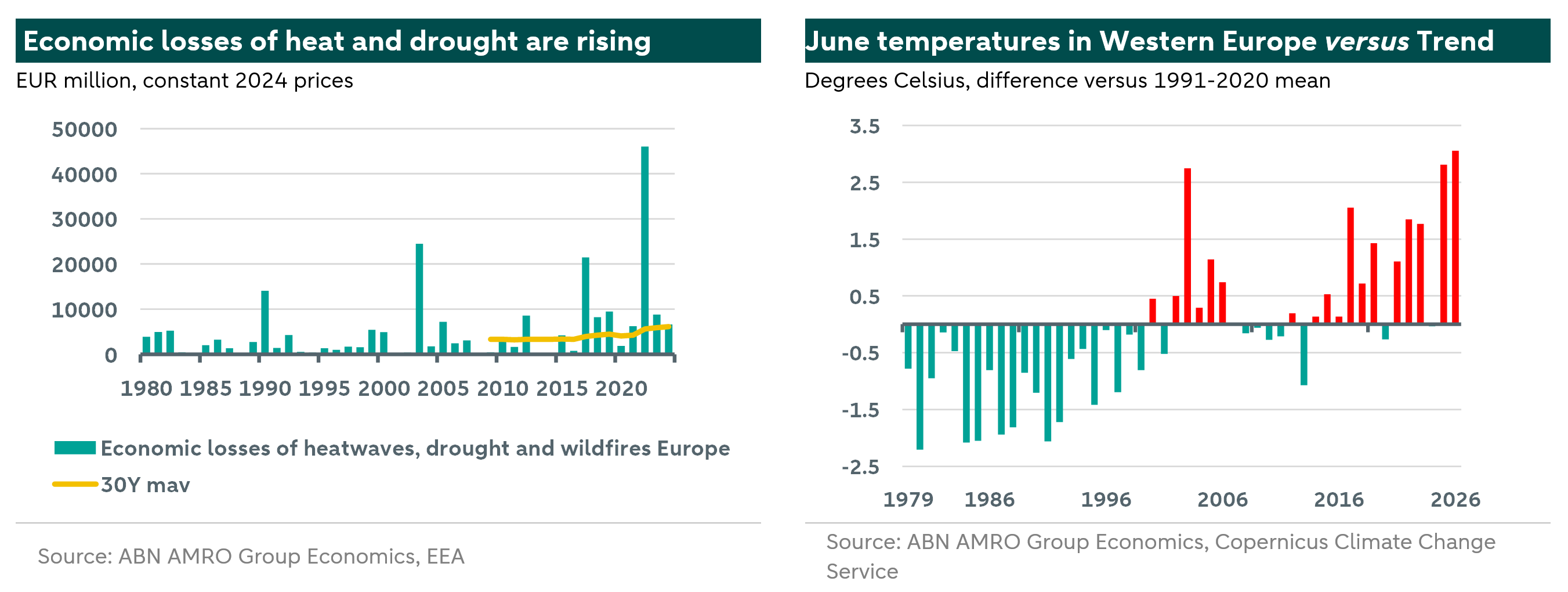
Data from the European Environment Agency (EEA, see ) show that economic losses from all extreme weather- and climate-related events in Europe increased to an annual average of around EUR 54 billion (in constant 2024 prices) during 2021-2024, which equals around 0.3% of Europe’s GDP.
In this research note, we focus on heatwaves, droughts, and wildfires. These hazards have together accounted for around 32% of total losses from all weather- and climate-related events on average over the past four years. Moreover, losses associated with these hazards have increased markedly in recent years: losses recorded during 2021-2024 are equivalent to approximately 30% of all losses incurred over the 1980-2024 period (expressed in constant 2024 prices). Unlike other natural hazards, heatwaves, droughts, and wildfires tend to have relatively low insurance coverage. On average, only around 10% of losses are insured, compared with around 50% of storm-related losses and 37% of flood-related losses.
Losses in 2026 are expected to be higher than the longer-term average
The summer of 2026 has so far been marked by exceptionally hot and dry conditions across Europe, accompanied by widespread and severe wildfire activity. June was the hottest on record, with an average temperature of 20.7°C, or 3.1°C above the 1991-2020 average (see ). By the end of June, Europe had already experienced two major heatwaves (see map below left), during which temperature records were broken across most European countries.
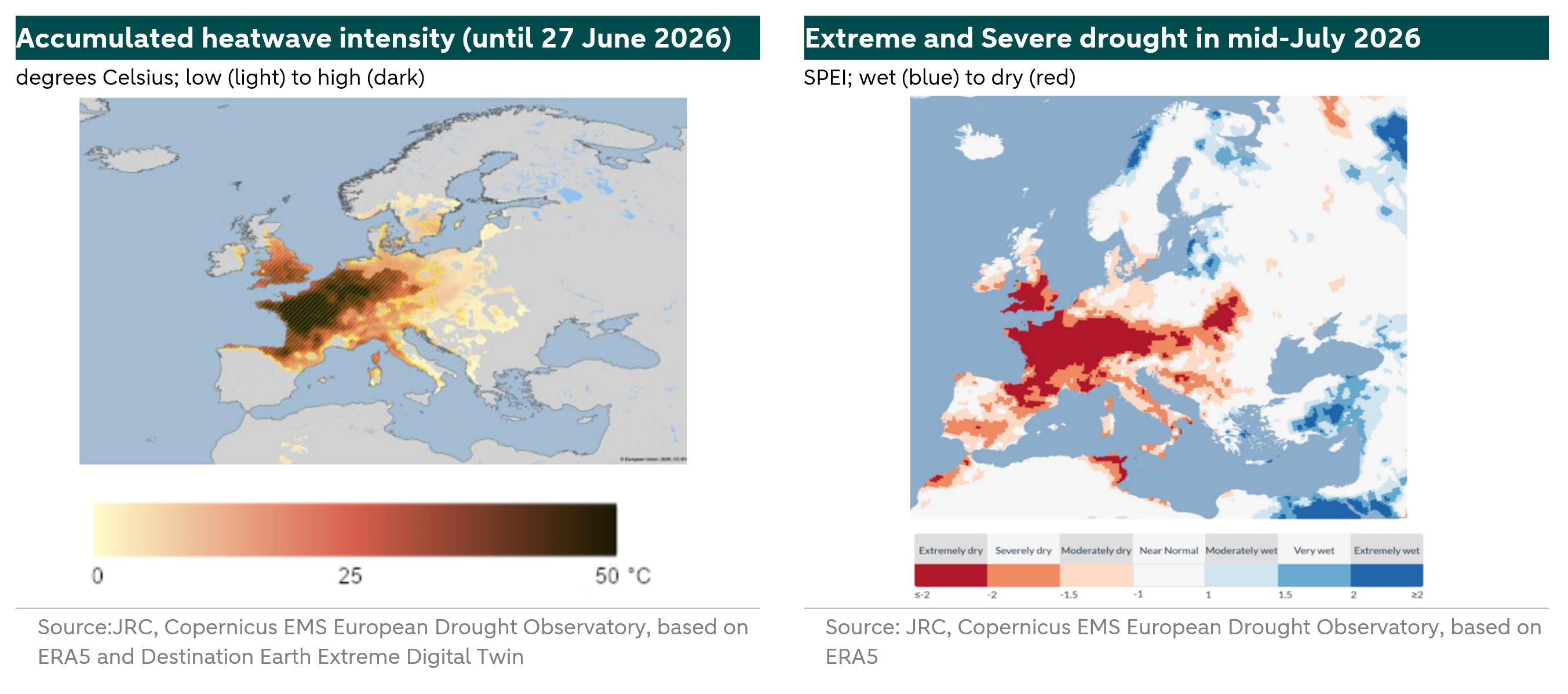
At the same time, precipitation levels remained well below average across large parts of the continent during the spring and early summer, leading to severe drought conditions (see ). The Standardized Precipitation Evapotranspiration Index (SPEI), which captures the combined effects of precipitation deficits and unusually high temperatures, signalled prolonged and severe drought across extensive parts of Europe by mid-July 2026 (dark red areas in the map above right). The combination of extreme heat and lack of rainfall fuelled large wildfires in Spain, France, Portugal, Italy and Greece, as well as in countries less commonly associated with such events, including Estonia, Germany and the Netherlands (see graph below left). Finally, the hot and dry conditions have also severely reduced the water levels in several major European rivers, including the Rhine, Danube an Italy’s Po (see map below right).
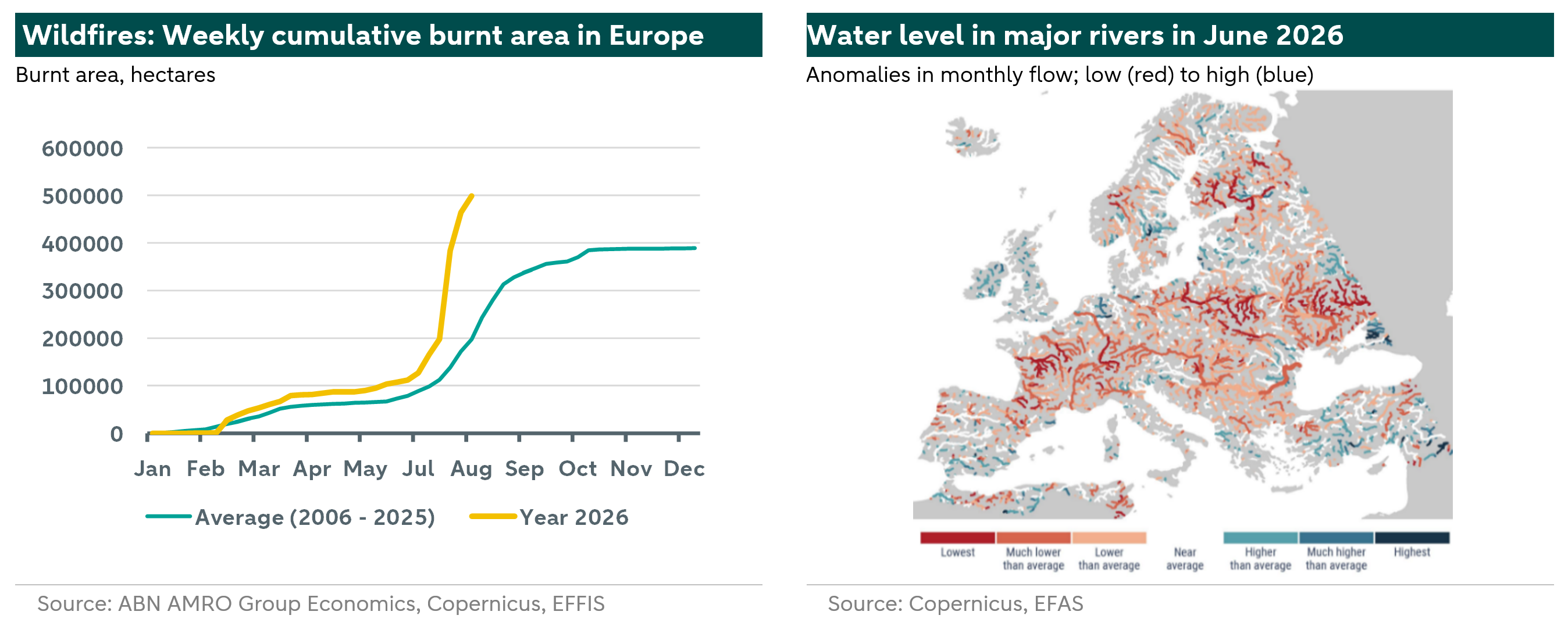
Taken together, the extreme conditions observed during the first part of the summer suggest that significant GDP impact is likely to materialize across many of the channels discussed earlier in this note. Below, we present some examples of recent estimates regarding the consequences of the 2026 heatwaves, droughts and wildfires. These estimates indicate that climate-related impact this year is likely to exceed the average observed over recent years.
To begin with, in its July outlook, COCERAL, the European grain trade association, projected that the crop yield in grain production in the EU-27 would decline by around 7% this year relative to 2025 (see ). At current market prices, such a decline would imply a direct loss in grain output valued at approximately EUR 4-5 billion.
Moreover, the Financial Times recently estimated (see ) that the economic cost of wildfires in Europe had already exceeded €3.1 billion during the first months of the 2026 fire season, based on the European Commission's methodology. This figure covers only the five most affected eurozone countries, including Portugal, Greece and Romania, and already exceeds the Commission's average annual estimate for the entire EU mentioned previously. The FT also noted that the final economic impact is likely to be substantially higher once property damage, agricultural losses, tourism disruption, higher insurance costs and other indirect effects are taken into account.
In June, the European Central Bank published a working paper examining the economic consequences of heatwaves and droughts across the European Union (see ) on industry, manufacturing and agriculture. The analysis finds that a climate shock comparable to the extreme conditions observed in 2022 could reduce annual growth in agricultural by around 4.5 percentage points on average. The corresponding impacts on industry and manufacturing are estimated at approximately 0.8 and 0.1 percentage points, respectively. The strongest effects are concentrated in Eastern Europe, highlighting both the growing macroeconomic risks associated with climate-related shocks and the increasing importance of adaptation measures.
On a country level, France is emerging as one of the countries hardest hit by the extreme weather conditions of 2026. Press reports published in early August estimated the economic costs of the heatwaves and wildfires at around EUR 3-6 billion, equivalent to roughly 0.1-0.2% of GDP. By mid-August, however, France's Ministry for Ecological Transition indicated that these estimates had increased to approximately EUR 10-15 billion, equivalent to 0.3-0.5% of GDP, reflecting the persistence of extreme drought conditions and temperatures well above seasonal norms. France recorded its warmest July on record, with a temperature anomaly of +3.8°C relative to the 1991-2020 average, substantially exceeding the European average anomaly of +2.53°C (see ).
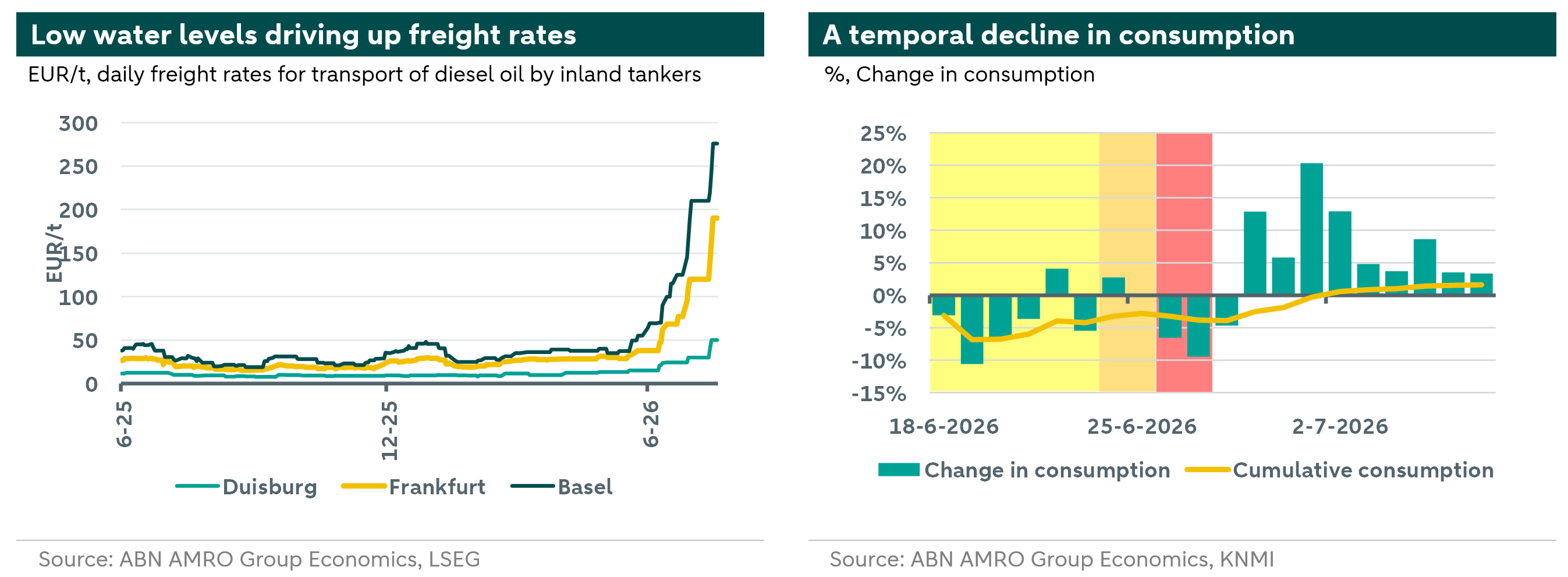
Meanwhile, Germany’s economy is being affected by low water levels on the Rhine, which have fallen below the previous record lows recorded in 2018 (see ). These low water levels severely hinder commercial shipping, raising transportation costs and reducing industrial production, for example through disruptions to raw material supplies. In a widely cited report, the independent Kiel Institute for the World Economy (IfW) recently estimated that the low water levels on the Rhine could reduce German GDP by up to 0.2% in the third quarter of this year, with the associated loss in value added estimated at between 1 and 2 billion euros during the quarter. These costs would likely increase disproportionately if water levels were to remain at record lows for an extended period.
Taken together, the available evidence suggests that the economic losses associated with the 2026 heatwaves, droughts and wildfires are likely to have exceeded the long-term average. Results from reputable climate models indicate that the negative impact on GDP may be in the range of 0.2-0.4% in the short term. Subsequently, part of the damage is projected to be mitigated by reconstruction and recovery spending, implying that the final GDP-damage could be of around 0.1-0.2%. That said, the direct damages or immediate physical losses in the year of the event could be more than twice as high, with larger impacts in countries experiencing the most severe drought and wildfire conditions.
The Netherlands – Smaller impact than the eurozone aggregate … for now?
As described above, the macroeconomic impact of this summers’ heatwaves, droughts and wildfires is unlikely to be uniform across countries, as exposure depends on geographical characteristics and climate conditions. For the Netherlands, this implies that some climate-related risks are less pronounced than elsewhere in the eurozone, while others may be more relevant. For the Netherlands, the overall GDP impact is likely to be smaller than for the eurozone aggregate.
This reflects several factors. First, the Netherlands has so far experienced fewer and less damaging wildfires than countries such as France, with the exception of the fires in Limburg in August. As a result, the direct physical damage is more limited. Second, drought can affect the economy through for instance agriculture and inland transport, in particular via low water levels seen on the Rhine. Although, as we have previously shown, the direct impact of low Rhine water levels on Dutch industrial activity is likely to be limited and less significant than in Germany. The main risks for the Netherlands therefore lie in higher transport costs and potential supply-chain frictions.
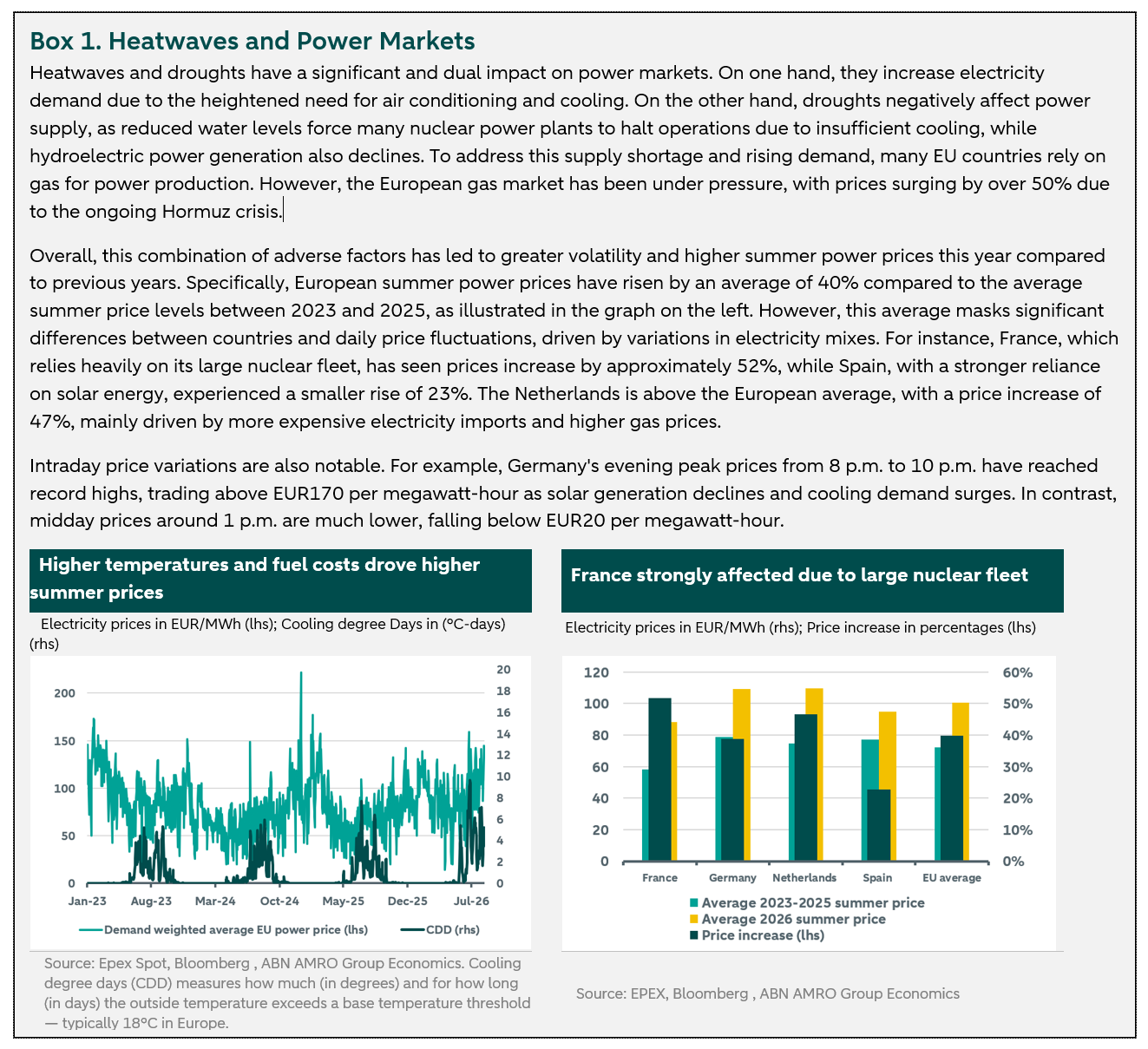
Next, the large share of services in the Dutch economy should dampen the direct macroeconomic impact. However, services are not immune to heat. Our recent study shows that during the exceptional heatwave at the end of June 2026, household spending fell below normal levels – but quickly recovered afterwards. We concluded that extreme heat mainly shifts spending over time, rather than causing a permanent loss of spending. Another channel that could affect the Dutch economy may be labour productivity. Empirical evidence suggests that, if temperatures rise above 25°C, labour productivity falls by around 2% for every additional degree of temperature increase. Finally, internationally integrated firms may be affected through international value chains. The is particularly exposed to these chain effects due to its dependence on inputs from other sectors and trading partners.
More generally, as discussed in the first section of this note, immediate direct losses could be higher than the impact on GDP, as the impact on GDP is also partly mitigated by reconstruction and recovery spending. Also, climate adaptation can for instance raise investment and strengthen firms’ .