The Netherlands - A new energy shock while still digesting the former

The fallout from the war in the Middle East means we have adjusted our forecasts. We have slightly downgraded our 2026 growth forecast, while upgrading our inflation forecast. We now expect growth in 2026 to average 1.5% (was 1.6%), and 1.2% in 2026 (was 1.4%). The uncertainty around inflation is high with an upgraded forecast of 2.8% in 2026 (was 2.2%). While the timing of the energy shock is unfavourable the economy is resilient.


Max Raatjes
Trainee at ABN AMRO
The developments in the Middle East cast a shadow over the outlook and lead to new uncertainty. The Dutch economy entered 2026 with solid underlying momentum but our new base case, including the fallout from the war, reflects lower growth and higher inflation for 2026. The forecasts show that the inflation impact is larger because of the direct effect of higher energy prices and the indirect pass through to other (energy intensive) goods and services. The growth impact is expected to be more limited, at least in the near term, in part because of solid economic momentum and resilience (see below). In more severe scenarios, we expect a larger effect on inflation and growth. Zooming out, with CLA-wage growth at an elevated 4.5% in February, the Dutch economy is still digesting the second-round effects of the 2022 energy shock. Together with the still tight labour market this means the risk of more pronounced second-round effects due to the rise in energy prices is higher in the Netherlands compared to Eurozone peers.
With petrol prices roughly 20% higher than a year ago, the price rises have already led to calls for additional support by the government. Indeed, ‘Iran’ puts the Dutch government in front of a dilemma. Before the war, purchasing power increases this year were considerable, which would be skimmed by higher taxation in the Coalition Agreement from next year onwards to fund, among other things, defence spending. Now the increase this year might be eroded already by higher inflation. Together with other sensitive reforms such as the pension age, wealth taxation and labour‑market adjustments the calls for support add to an already crowded agenda and strained budget for the minority cabinet which is dependent on opposition support to pass legislation.
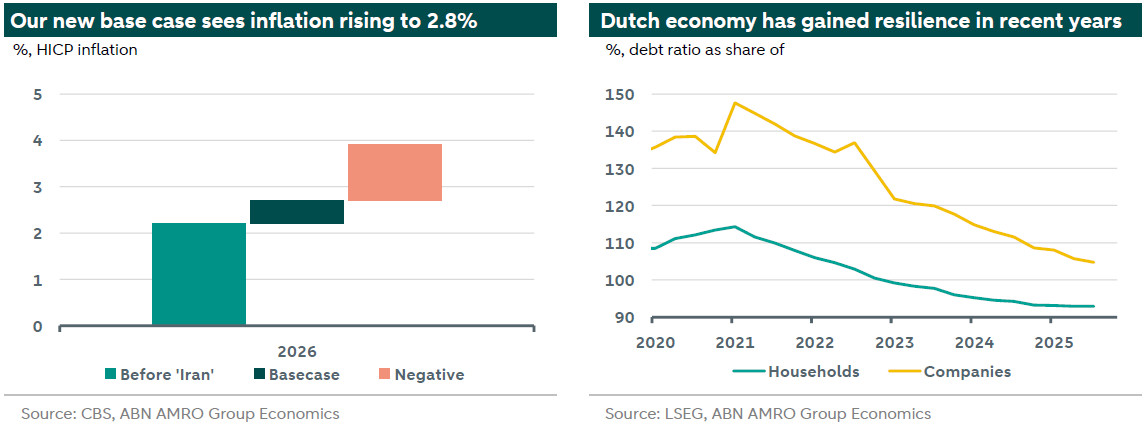
When assessing the impact, it is important to acknowledge that the Dutch economy has had solid economic momentum while the private sector has gained resilience in recent years. Whether it is the labour market, where unemployment in February ticked up to 4.2% but remains historically low, or declining business and household debt ratios (see graph above), or high household savings levels, probably caused by uncertainty. The prudence of recent years can be seen as a sign of strength going forward. This is one factor why we see a relatively small downgrade of the 2026 GDP forecast from 1.6% to 1.5%.
Going forward, inflation will change considerably from the February inflation print of 2.3% (HICP). Energy inflation, mostly petrol, will push up inflation while higher gas prices only slowly make their way into the CPI. 54% of Dutch households have a fixed contract. In our new basecase we expect inflation to average 2.7% in 2026. In more negative scenarios inflation rises to nearly 4%. Uncertainty is high but the macroeconomic starting position; higher inflation compared to the eurozone, high wage growth and a tight labour market mean the risk of second-round effects is large.