The Netherlands - Redistributive policies to support consumption next year

The caretaker government presented a policy light budget with a focus on fighting poverty. The budget led to a slight upgrade to our private consumption forecast for 2024, but we keep our GDP growth forecast at 0.5% in 2023 and 1.1% in 2024. Inflation is declining but underlying pressures remain firm. Inflation to average 4.8% in 2023 and 3.5% in 2024.


At the annual ‘Prinsjesdag’ last Tuesday, the Dutch government presented its 2024 budget. Because of the caretaker status of the government – the Rutte IV coalition fell in July – the budget was light on policy substance. A small package of measures to prevent low-income households dropping below the poverty line were announced, involving extra spending of EUR 2bn (0.2% of GDP). This package is partly financed by raising taxation on higher incomes and raising levies on alcohol and tobacco. During the budgetary debates, larger packages were announced to sway voters running up to the November 22nd snap elections. Additional measures amounting to EUR 4bn (0.4% of GDP) found broad support, such as a minimum wage rise, postponing a scheduled petrol-levy increase by one year, and other smaller redistributive policies.
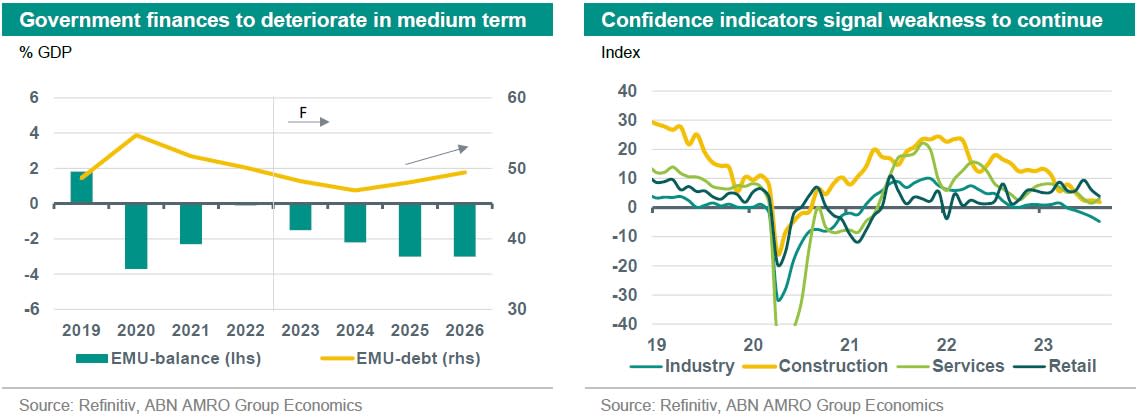
Most of the additional spending is funded, i.e. it does not result in a significantly larger deficit than the currently expected deficit of 2.2%. Compared to many other eurozone countries, Dutch government finances are solid. Still, government finances are expected to deteriorate in the medium term, as successive deficits of the Rutte IV government push up the debt-to-GDP ratio. The influential Dutch Budgetary Committee took aim at this worsening trajectory and advised the incoming government to balance spending and revenue given the longer term challenges of the Dutch economy: aging, the energy transition, and climate-related spending.
The macro impact of the budget is limited. Redistributive policies do boost the purchasing power of lower income households, which will support private consumption in 2024, but is likely not enough for us to raise our GDP forecast of 1.1%. In the near term, we expect growth to remain roughly stagnant in the third quarter before it picks up slightly in the fourth quarter on the back of household spending. Sectoral confidence indicators point to a broad slowing in economic activity. Industry is the outlier and in clear recession. The return to growth will therefore be driven by private consumption, as wage growth and the one-off energy allowance – which past experience suggests will drive a short term boost in spending – will lift private consumption in the fourth quarter. In 2023, the Dutch economy is expected to grow by 0.5%.
In August, inflation continued trend lower, falling to 3.4% (from 5.3% in July). Core inflation on the other hand remained elevated at 7.0%. Inflation is expected to come down further over the coming year and to average 4.8% in 2023, and 3.5% in 2024. With wage growth slowing but still historically elevated, and the labour market expected to remain tight, inflation is unlikely to return to 2% any time soon.
This article is part of the Global Monthly of 26 September 2023