The Netherlands - Resilient growth meets persistent bottlenecks

With GDP growth in H1-26 outperforming earlier estimates, we raised our 2026 forecast to 1.5%. Growth will moderate in the second half of 2026 and in 2027, but is still solid. Inflation is on the rise and will exceed 3% for the fifth year in a row this year.


The Dutch economy outperformed earlier estimates in the first half of 2026. Revised figures show GDP growth of 0.3% in Q1 and 0.6% q/q in Q2 – a remarkable performance given geopolitical developments and (inter)national uncertainty. Domestic demand was the main driver. Private consumption remained robust despite elevated uncertainty and rising inflation, businesses kept investing – potentially also reflecting one-off purchases in transport such as aircrafts – and government consumption, for instance healthcare spending, continued to add to growth. Additionally, Dutch exports benefited from the global AI boom; both in goods exports to for instance Taiwan and in related services exports. Industrial sector performance reflects different international developments. For instance, the Netherlands has a unique advantage in its innovative semiconductor sector, which has approximately doubled in both revenue and employment over the past six years. The petroleum cluster is benefiting from disruptions in international refining, while international developments and energy prices result in a challenging competitive position for chemicals.
Alongside this strong performance we see an economy that continues to be constrained by different bottlenecks, such as electricity grid congestion, labour shortages and binding nitrogen norms. These bottlenecks will increasingly weigh on economic performance going forward, and may also have other externalities. While Dutch businesses have improved their financial resilience, and private sector debt as share of GDP has decreased in recent years, this may also be a sign that companies are being held back by bottlenecks such as limited electricity grid connections and staff shortages. Households have accumulated substantial savings, providing a financial buffer but also reflecting elevated uncertainty. The low number of bankruptcies may similarly reflect these constraints and could point to limited business dynamism. Cyclical pressures are also building. Consumption growth is expected to weaken in 2027 as higher food and energy inflation will weigh on household sentiment. Rising interest rates will bite, and the housing market is expected to slow. Moreover, recent hoarding behaviour by companies may fade. Nevertheless, domestic demand should continue to support activity in the near term and we expect GDP growth of 0.3% q/q in Q3.
While GDP growth is still solid, higher energy prices have led us to downgrade our underlying growth outlook. However, the upward revision to H1 growth more than offsets this for 2026. We therefore raise our GDP growth forecast for 2026 to 1.5% (from 1.3%), while leaving our 2027 forecast unchanged at 1.1%.
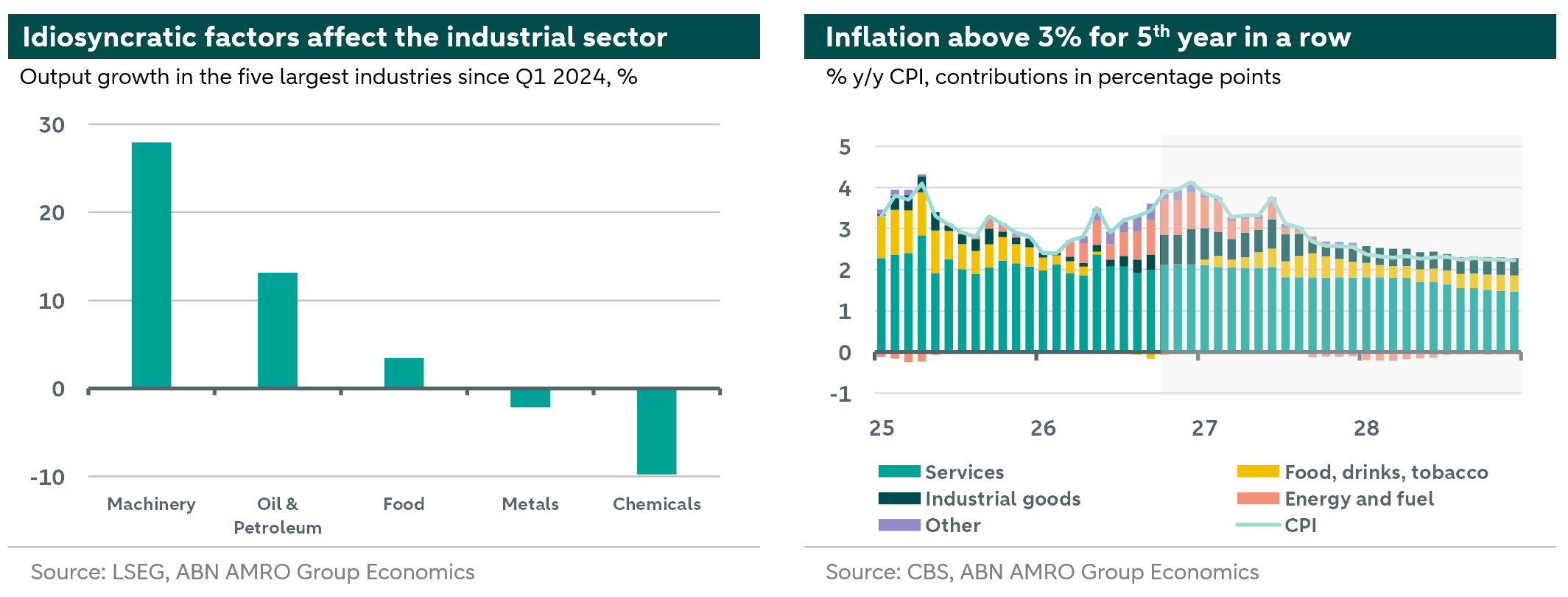
Inflation is rising. Following the upward revision to our energy-price assumptions, we now expect CPI inflation of 3.2% in 2026 and 3.1% in 2027. Inflation will surpass 4% around the turn of the year, mainly due to higher fuel prices. The near-term impact on household energy bills is more limited because many households have fixed-rate contracts. Industrial goods prices are also edging higher in response to energy costs and the AI boom. Food inflation has eased in recent months, and even turned negative, but underlying pressures are increasing. Still, we expect the pass-through of higher energy prices to the broader inflation basket to remain more limited than during the previous energy crisis.