Transaction Trends - How the Dutch spend their week

Dutch consumer spending follows a stable weekly pattern. Saturday is consistently the busiest day, while Sunday and Monday are consistently the quietest days. This pattern differs significantly across age groups: younger Dutch consumers tend to spend most on Saturdays and show only a limited decline on Sundays, whereas older consumers spend the most on Fridays and experience a much sharper decline in spending on Sundays. It is this predictability that makes transaction data valuable as an economic indicator: deviations from the normal weekly spending pattern can provide an early signal of changes in consumer behavior.

The Netherlands returns to its routine
As the holiday season comes to an end, the Netherlands gradually returns to its normal rhythm. Work, school, and daily routines resume, bringing back familiar spending patterns. But what does a typical weekday actually look like in terms of consumer payment behavior? At the individual level, spending can vary considerably: one week we may do our major grocery shopping on the weekend, while another week we may dine out or stay home instead. However, when millions of payments are aggregated, a clear picture emerges. The Netherlands exhibits a recognizable weekly rhythm, with consistent peaks and troughs in spending.
In this publication, we analyze PIN transaction data from 27 “normal” weeks in 2025: weeks without public holidays and outside school vacation periods (see the methodology section for more information). The data covers payments at supermarkets, restaurants and cafés, clothing stores, gas stations, and other points of sale. The results show that the Netherlands has a distinct day-of-the-week spending pattern. Friday and especially Saturday are the busiest spending days, while Sunday and Monday lag behind. Beneath this national pattern lies another interesting insight: younger and older consumers follow different spending rhythms. The stability of the large volume of transactions makes the data particularly valuable from an economic perspective. Understanding the normal weekly rhythm helps identify shifts in consumer behavior more quickly. If consumers suddenly begin spending on different days or at different levels, it may serve as an early indication that broader economic conditions are changing.
Friday and Saturday are the peak spending days
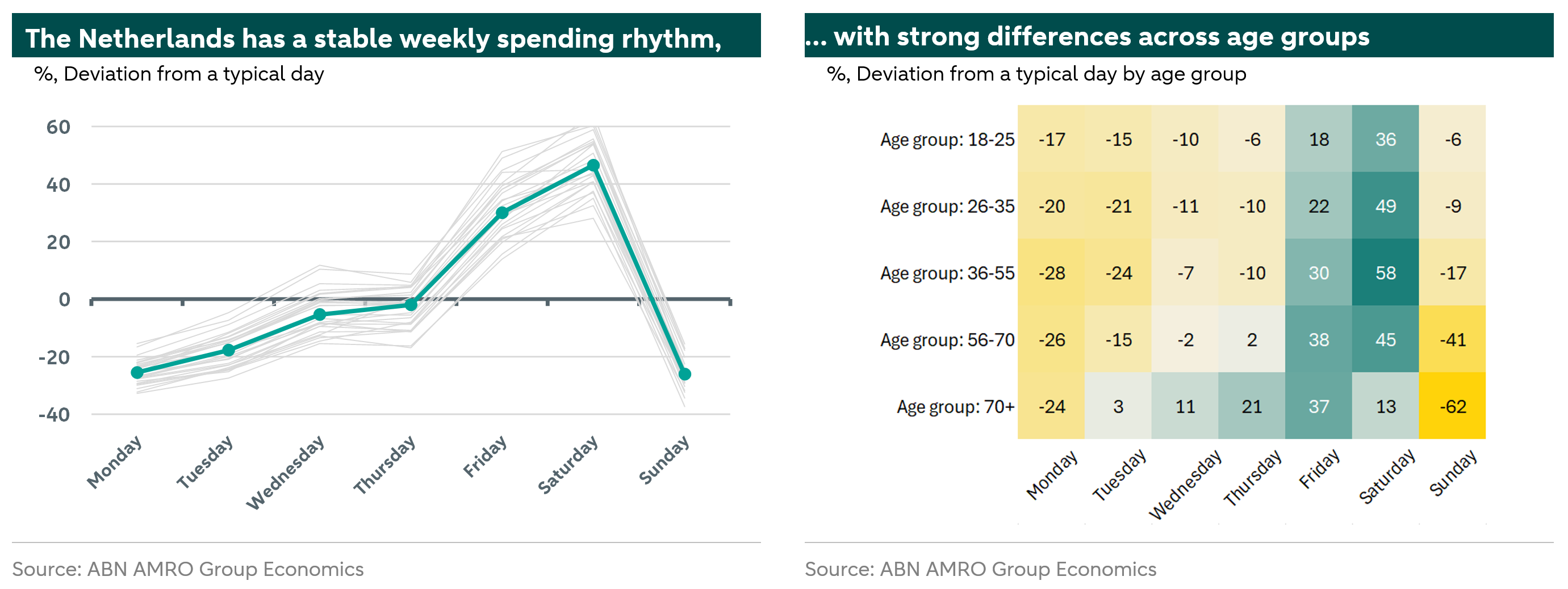
The week starts relatively quietly, with lower spending on Mondays and Tuesdays. Wednesdays and Thursdays fall in the middle, with spending levels close to those of a typical day. Spending then rises significantly toward the end of the week. On Fridays, expenditures increase markedly, and on Saturdays payment activity reaches its weekly peak: PIN spending is more than 46 percent above that of a typical day. On Sundays, spending declines again, falling to roughly one-quarter below normal levels.
This rhythm is also clearly visible when looking at individual weeks. Differences between weekdays are larger than differences between weeks. Although the figures have not been adjusted for seasonal effects, price changes, or payday effects, the pattern remains remarkably stable. Spending levels on Mondays and Sundays are relatively close to each other, whereas Fridays and Saturdays show greater variation. These are not only the days with the highest levels of consumption, but also the days with the greatest fluctuations.
As a result, although individual choices vary from week to week, a highly recognizable collective rhythm emerges for the Netherlands as a whole. The timing of spending is closely linked to the amount of available leisure time. During the workweek, jobs, school, and other obligations often take priority. In the weekend, people have more time for shopping, dining out, and social activities.
Younger and older consumers follow different rhythms
All age groups exhibit a recognizable weekly spending pattern, but these patterns differ noticeably from one another. Monday is the most similar day across all groups, as it is consistently a day of relatively low spending. Among young adults, differences between weekdays are relatively modest. Their spending peaks on Saturday, when expenditures are 36 percent above the average daily level. As age increases, this Saturday peak becomes more pronounced. Among consumers aged 36 to 55, spending on Saturdays is almost 60 percent higher than on a typical day. For those aged 56 to 70, the Saturday peak becomes somewhat less pronounced, while among consumers aged 70 and over, the highest spending level is already reached on Friday. The spending peak thus gradually shifts from Saturday to Friday with increasing age. This pattern is consistent with differences in work schedules and leisure time. While working-age consumers tend to concentrate their purchases in the weekend, younger adults and older consumers appear to spread their spending more evenly throughout the week.
The differences between age groups become most pronounced at the end of the week. For young adults aged 18 to 25, Sunday spending is only 6 percent below their normal daily spending level, whereas for consumers aged 70 and over it is 62 percent below normal. In other words, the decline in spending on Sundays becomes substantially larger with age. One possible explanation is that older consumers spend a relatively larger share of their budget on everyday essentials such as groceries, for which shopping opportunities may be more limited on Sundays. Younger consumers, by contrast, tend to spend more on hospitality, entertainment, and leisure activities. In addition, older consumers are more likely to live outside major cities, where Sunday opening hours are often more restricted, and many grew up with Sunday being observed as a traditional day of rest.
Conclusion
Dutch consumer spending follows a stable weekly rhythm. Friday and especially Saturday are consistently the busiest spending days, while Monday and Sunday tend to see lower levels of expenditure. At the same time, different age groups exhibit their own distinct weekly spending patterns. The predictability that emerges from aggregating the behavior of millions of consumers makes transaction data a valuable real-time economic indicator. When daily spending suddenly deviates from its normal pattern, it may provide an early signal that consumers are changing their behavior. By adjusting transaction data for day-of-the-week effects, shifts in consumption can be identified more quickly, potentially even before they become visible in traditional macroeconomic statistics.
The results also show that a single day-of-the-week adjustment is not always sufficient. Because spending patterns vary considerably across age groups, age-specific adjustments are essential when seeking to understand which groups respond first to economic shocks.