US inflation cools, but pipeline pressures persist

US Macro: Drag from used cars drives a further moderation in inflation. The core CPI rose just 0.1% m/m in August, the weakest print since February. Although coming in below expectations (consensus: 0.3%; ABN: 0.2%), the report is consistent with our view that inflation has peaked in the US, and as we have previously flagged, the main driver was a fall in used car prices – which have gone from being a significant boost to inflation, to a drag.

At the same time, there was an unexpected cooling in services inflation, driven by declines in airfares and hotel room rates – categories that had firmed significantly over the past few months as the economy fully reopened.
The declines are likely on due to the leveling off in demand in recent weeks, as the spread of the Delta variant led to increased consumer caution – evident in both consumer confidence and high frequency indicators such as daily air traffic numbers. However, other key components such as housing rents and medical services remained firm, albeit broadly consistent with longer term trends, and as yet not exhibiting much catch-up growth from the weakness of the lockdown period last year.
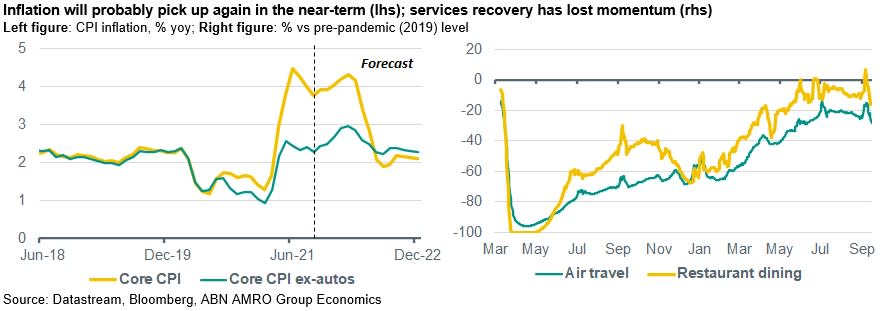
We still think inflation has peaked, but a renewed acceleration is likely in the coming months – We think we are past the peak in US core inflation, both on a monthly and an annual basis. However, annual inflation will remain elevated over the coming months given the low base of last year, and monthly inflation is unlikely to stay at the current subdued level for very long, for three reasons. First, although used car prices are now becoming a drag on inflation, the decline in wholesale prices has been less than we anticipated given the drop-off in demand we have seen – likely due to the continued manufacturing bottlenecks for new cars, which have led to renewed plant closures among some auto makers. Second, we do not expect weak services inflation to last. , we appear to be past the worst of the Delta wave of cases and hospitalisations, and recent indicators confirm this.
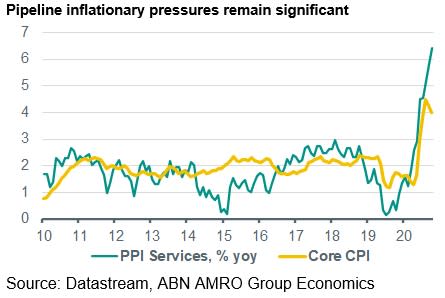
Consumer confidence is therefore likely to quickly rebound, giving renewed momentum to the services recovery; as such, airfares and hotel rates are likely to resume their recovery. Third, the record level of job vacancies is likely to mean further strong gains in the labour market, and this should drive a firming in housing rents – by far the biggest component of the core CPI. At the same time, the risks to our inflation forecast remain tilted to the upside, with supply-side bottlenecks easing only modestly so far, and PPI inflation yet to have peaked (see chart below). Taken together, we see scope for monthly inflation picking up again in the coming months, although we do not expect it to get anywhere close to the near-1% monthly gains we saw a few months ago. For annual inflation, this is likely to mean a significant drop-off from mid-2022 onwards to nearer 2% from the current 4% readings, as base effects ease.