US - Post-shutdown data fails to fully clear the fog

Post-shutdown data shows a further discrepancy between headline growth and the labour market. Inflation has been mixed, with surprisingly low shutdown period data, followed by a sharp rebound. We see a simple reorientation towards more productive sectors as the most likely explanation.

US data has been difficult to interpret throughout the past year, but the latest releases have been even more contradictory than usual. GDP growth suggests the economy is booming – now driven not only by AI‑related investment, as earlier in the year, but also by stronger consumption and rising exports. In contrast, labour market data tells a different story. Job growth has essentially stalled, and after a brief uptick, the unemployment rate is back at a mild 4.4%, exactly matching the 2015-2019 average. Inflation data released after the shutdown shows no meaningful goods (i.e. tariff‑related) inflation. In fact, cumulative inflation over the two shutdown months looks unusually low, even if partly supported by softer activity indicators.
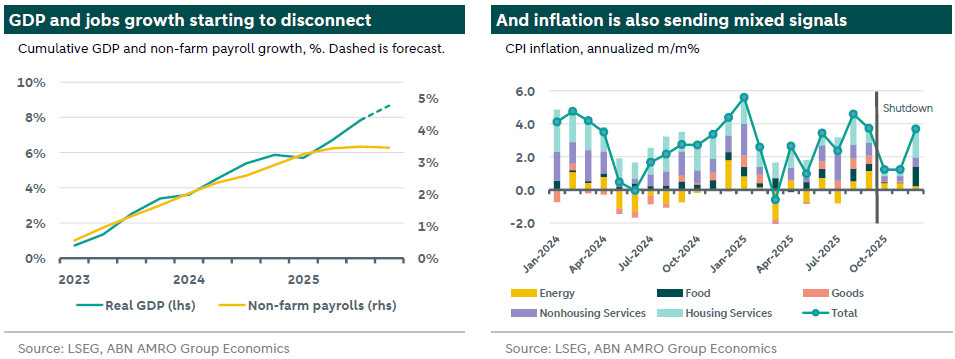
This raises the questions whether the economy is booming, as GDP would suggest, or whether the economy is about to slow down significantly, as labour market data and perhaps the weak inflation data would suggest. Could GDP be significantly overstated? GDP revisions are usually large, but not all components of GDP are equally likely to be revised. The personal consumption component, which was a strong contributor in Q3, tends to be accurate, and is believable in the context of significant wealth effects from strong equity gains and extended credit use for low income households.
Alternatively, might labour market data be understated? Unlikely. Recent revisions have been predominantly downward, and the Federal Reserve has noted that payroll figures may still be overstated by roughly 60k per month. Even beyond the decreasing labour supply from foreign born workers, we see a decrease in participation from native born workers as well.
The gap between growth and labour market data could also suggest an exceptional rise in productivity. Are we seeing the first impact from AI? We think it’s too early to see any broad-based productivity gains. Rather, we think it’s more likely that what we’re seeing here is a shift in the economy to a number of more productive sectors, predominantly Technology and Information services. Similar ‘jobless growth’ occurred during the recovery following the early 2000s recession, where we also saw strong GDP growth driven by growth of that same sector, with rises in productivity without proportional employment gains. Such a scenario of weak labour demand because of positive structural forces has less downside risk to the employment mandate thanfor instance some of the more cyclical demand-driven explanations sought last year, although they still cannot be fully ruled out.
Recent Fed commentary has been consistent with this view, having taken a decidedly more hawkish turn (with some exceptions) even before the December labour market report where unemployment dropped again. We now put our next cut in the June meeting, where further evidence of labour market stabilization will have occurred, headline inflation should have remained relatively benign, and a new Fed chair will have taken the reign. We continue to see three more rate cuts this year, now reaching an upper bound of 3.00% in the final meeting of the year. Beyond the update to our Fed view, we’ve upgraded our growth forecast for predominantly Q4 of 2025, and a little bit more spillover into 2026, with slightly stronger consumption growth and a bigger contribution from net exports. The outlook remains strong on the back of the private sector, fiscal and monetary stimulus. Second, we adjusted our inflation forecast down slightly, particularly in the short run, consistent with the latest data releases, but see some risk of near-term catch up from the shutdown data. Overall, we see inflation picking up again throughout the year on the back of remaining and potentially renewed tariff pressure, tight labour supply, and substantial stimulus.