US - Supply chain pressures are mounting

The labour market remains stable, but the unemployment rate is flattered by a decline in participation. Producer prices show initial signs of the energy shock cascading through the economy.

April job creation was strong, with non-farm payrolls increasing by a solid 115k. Despite that, the unemployment rate increased from 4.26 to 4.34%, still substantially lower than its high of 4.54% in November of last year. Since then, the apparent improvement has reflected labour-force changes more than employment gains, making the labour market harder to read. Labour supply is being constrained not only by weaker immigration, but also by falling participation. This decline is partly due to the baby boomer generation retiring early, but there is also a notable decrease in the population of prime working age men, who usually have a high participation rate. The decline in the unemployment rate is therefore partly a ‘bad news decline,’ at least in terms of economic growth. An uptick in the unemployment rate might be welcomed if it’s due to increasing participation.
Meanwhile, Inflation continues to rise. Headline CPI rose 0.6% m/min April, with a 0.3 ppcontribution from energy prices. The y/y rate now stands at an uncomfortable 3.8%. Core came in at 0.4% (2.8% y/y), which reflects the final impact of last year’s government shutdown on inflation. Because of the way shelter inflation is calculated over six months, April partly reflected a catch-up for October’s missed increase. The most remarkable aspect of the report was a higher than expected food inflation, coming at 0.5% m/m, contributing almost 0.1 pp to the overall headline number. While always volatile, the worry is that the food inflation reflects an initial sign of pass-through of the energy shock to other categories. Unfortunately, the rise in the New York Fed’s Global Supply Chain Pressure index, and this month’s Producer Price index (PPI) report suggests we are indeed starting to see pressures building throughout the supply chain.
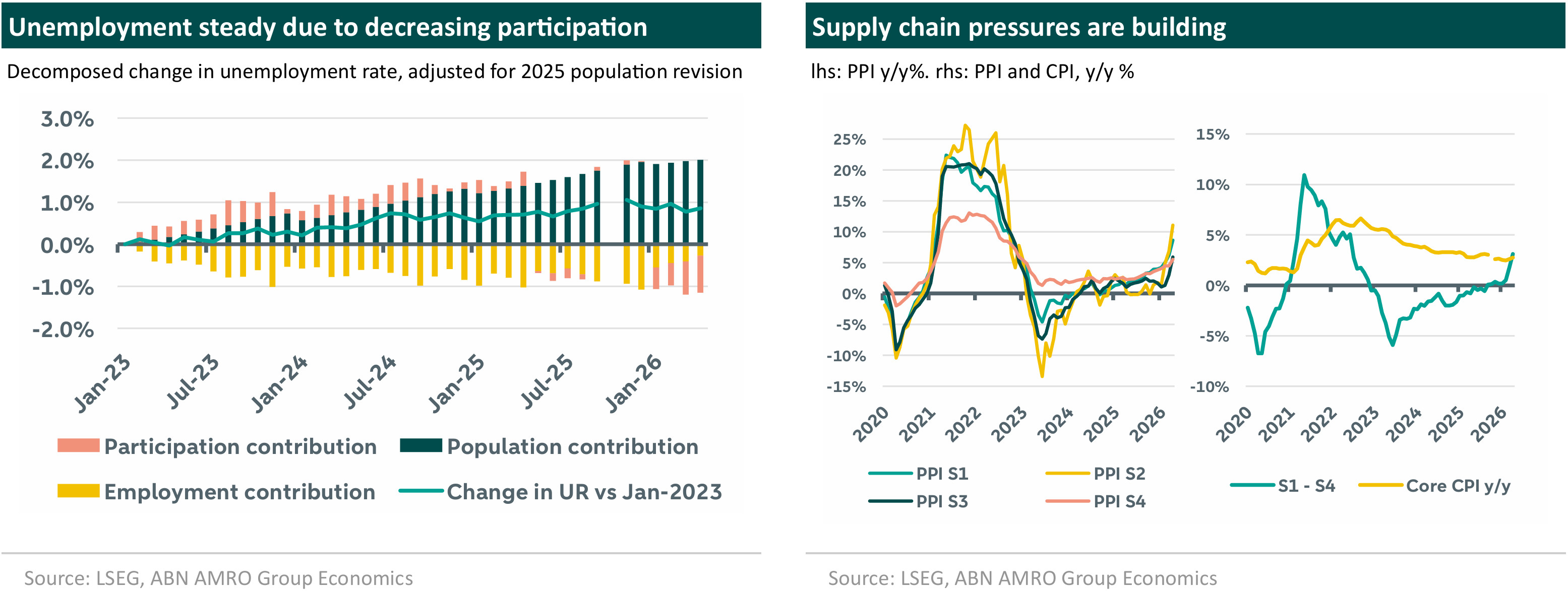
What can we learn from the PPI report? Headline PPI came in at 1.4% m/m, which was a significant surprise compared to the 0.5% consensus expectation. The y/y rate rose to 6.0%, and the ‘core’ measure excluding food and energy also rose significantly to 5.2%. But the richness of the PPI data allows us to dig deeper. There is significant granularity in the data, such that we can track prices through four stages of the supply chain: raw extraction, refining, intermediate manufacturing, and near-final producers. The energy shock may well raise all stages simultaneously, so rising prices in all stages is not necessarily a sign of transmission of the shock through the supply chain. The chart above shows that all four categories are indeed rising sharply, but the interesting, and somewhat worrying, datapoint is that price rises in Stage 3 have just surpassed those in Stage 4 for the first time since 2022. When price pressure in intermediate production exceeds that of near-final producers, it suggests cost pressure is still moving downstream rather than fading before reaching consumers. Past episodes suggest this crossover can mark broader downstream transmission of the shock through the supply chain. Our analyses of the predictive power of the PPI stage-spread indicates that there is limited pass-through of PPI to CPI in ‘normal’ times, but that the pass-through to CPI increases substantially when S3 exceeds S4. That analysis also suggests non-linear amplification effects when the gap between the two rises. In short, we will be keeping an eye on PPI data as an early sign of the energy shock’s transmission through the economy. We’ve already put in a moderate update of our inflation path, with further risks to the upside.
On balance, signs of rising inflation beyond the energy category decrease the likelihood of the Fed rate cuts by year end currently in our base case. At the same time, the apparently benign unemployment rate masks labour-market fragilities that could be a prelude to a faster deterioration. The Fed has made it clear that the employment mandate carries more weight in their collective view. Warsh’s entry as the new chair will only tilt that balance further.