Carbon Market Strategist - Prices are up but not for long

EUA witnessed a surge in prices in March mainly driven by the increase in coal and gas prices, following escalations in the Ukrainian war, and the covering of short positions by some investment funds. The upward trend in European gas price is not expected to last, as the continent is ending the heating season with higher than average storage levels, sustained supplies and suppressed industrial demand. From the supply side, no changes are expected in March or April as the decision on the total number of allowances in circulation will only take place mid-May. Accordingly, we think that the current surge in EUA and European gas prices is temporary and the upward trend will reverse.

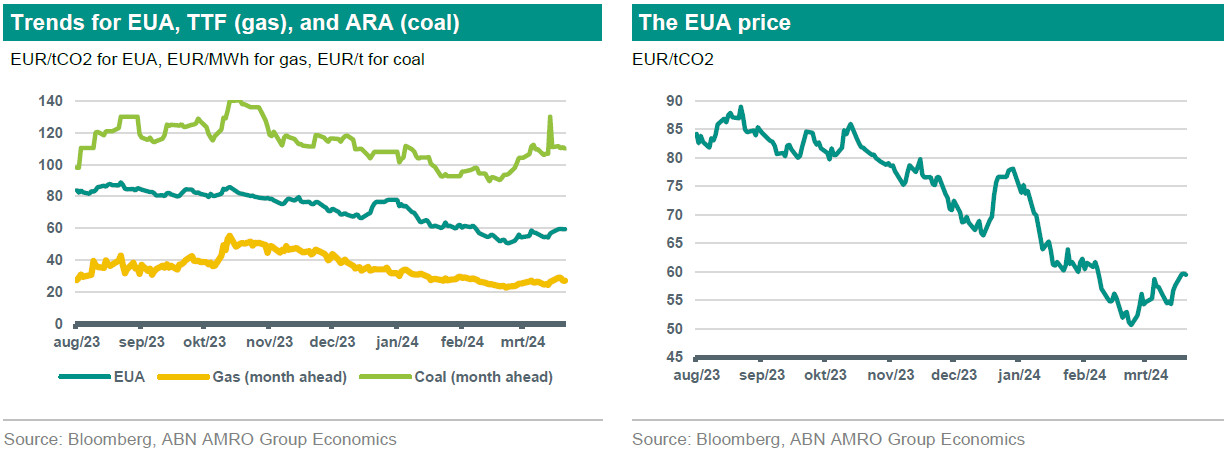
Late February EUA prices dropped to 50.6 EUR/tCO2, their lowest level in two years. Subsequently, the market turned upwards and EUAs are currently trading around 60 EUR/tCO2, which is the average since the start of 2024. The recent surge was mainly driven by the increase in European gas prices.
The EUA price has been highly correlated to European gas prices. The correlation even reaches a one-to-one level in some days. Since the end of February, European gas witnessed a surge in prices that has been driven by multiple factors such as low flows to the largest export terminal in Texas, unplanned outages in Norway, and energy markets reacting to attacks on energy infrastructure in Russia and Ukraine. Accordingly, EUA moved aggressively upwards. This was also driven partly by a simultaneous relatively higher increase in coal prices that was triggered by sanctions on Russian producers (see left hand chart below), making gas more attractive for power generation. At the same time, demand for EUAs by investment funds aiming at covering their short positions increased as well.
However, the upward trend in European gas prices is not expected to last, as the continent is ending the heating season with higher than average storage levels (59.18%, at the time of writing), thanks to the sustained supplies, suppressed demand for industrial purposes, and the milder than usual weather that had prevailed over the winter months in the region. The current levels give the region a comfortable position at the start of summer and increase the probability of it meeting the European filling target (90%) way in advance than planned (1st of November).
In the same direction, for EUA, the weakness in industrial activity, triggered by high interest rates in Europe and sluggish global economic growth, is expected to remain for the coming months until the economy picks up real momentum, which is likely towards the end of the year as interest rates cuts are widely anticipated to start only in June. For the power sector, the increase in renewable deployments and output reduces the need for conventional power generation, while, at the same time, increase vulnerability, to weather conditions. That is, demand for EUAs in the coming months become sensitive to wind speed or sun shine. Overall, as we enter the spring season with an expected mild weather, anticipated abundance in renewable output, and weak demand for heating, demand for allowances is expected to remain low from the power sector in the coming months.
From the supply side, front loading under the REpowerEU package put the market in excess supply. No changes are expected until the decision on total number of allowances in circulation, which will only take place mid-May. This means that no upward pressure from the supply side in March or April.
EU-ETS developments
On a different note, 31st of January 2024 marked the deadline for the first reporting period for importers under the new Carbon Border Adjustment Mechanism (CBAM). CBAM comes in response to the risk of carbon leakage and in order to ensure a level playing field within the sectors under the EU-ETS. CBAM entails a levy on the carbon content of imported goods entering the EU. It is intended to further encourage the switch to low carbon production processes in the exporting countries. The phase in of the CBAM will be gradual with a transition phase that started on the 1st of October 2023 and lasts for almost two years. During the transitional phase, importers only need to report the emission (direct and indirect emissions) content of their imports. Sectors initially covered by the CBAM are cement, iron and steel, aluminium, fertilisers, electricity and hydrogen. The permanent CBAM system enters into force on 1st of January 2026. The phase in of CBAM goes hand in hand with the phase out of free allowances to support the decarbonization process in the targeted industries (in the period 2026-2032).
Outlook
All in all, we think that the current surge in EUA and European gas prices will prove temporary and the upward trend will reverse. Accordingly, based on the current information, our outlook for EUA is bearish and we expect the price to range between 52 and 57 in March and April. However, markets remain responsive to any unforeseen escalation in geopolitical risks.