China - Domestic imbalances worsening, trade tensions brewing
Supply-demand imbalances worsen amidst weak growth momentum. Beijing still seems to be taking a cautious approach towards fresh stimulus. US-China tensions resurface in run-up to Trump-Xi summit; tougher EU stance on China.

Supply-demand imbalances worsen amidst weak growth momentum
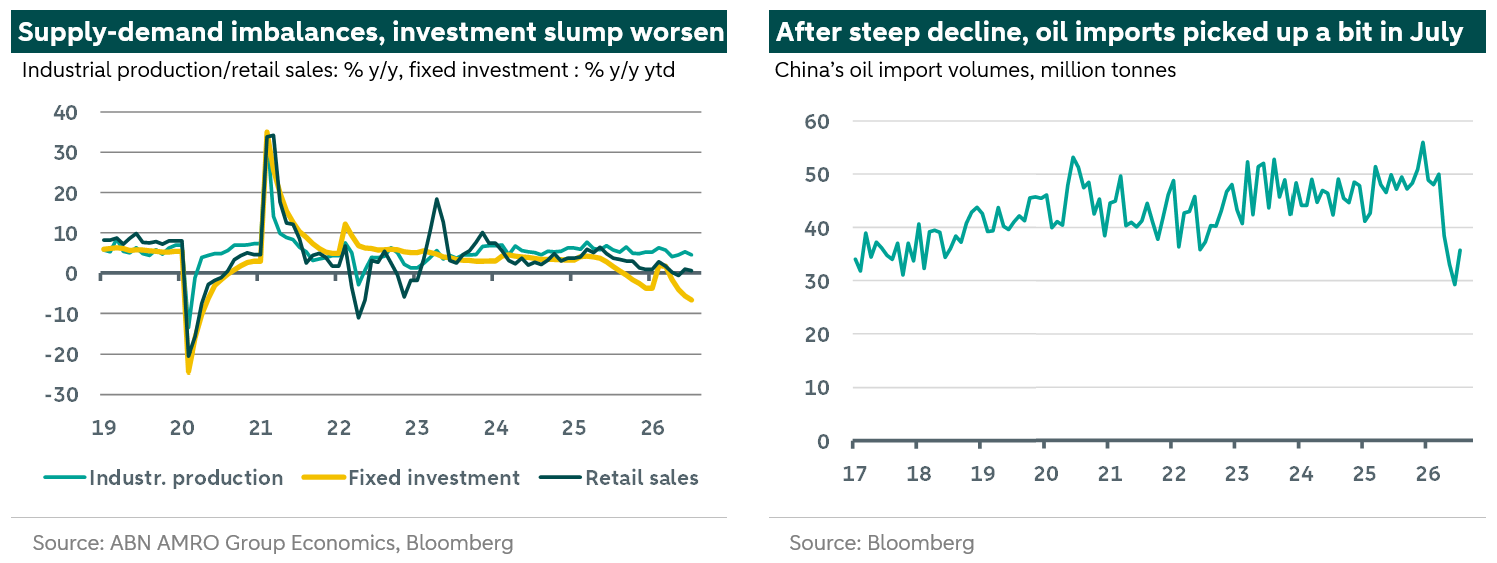
The prolongation of the energy crisis over the summer contributed to a weakening of growth momentum in July, although August PMIs showed some improvement. On the demand side, retail sales slowed to a meagre 0.6% y/y in July, with car sales still hit by payback from fading subsidies. An ongoing property slump, slowing income growth, a weak labour market and low consumer confidence keep putting a brake on household demand. The contraction in investment deepened to -6.7% y/y ytd: the slump in property investment drags on, but investment in manufacturing and infrastructure also turned negative. On the supply side, industrial production was hit by extreme weather and drags from the energy shock, although monthly oil imports picked up in July for the first time since March. All told, the production side remains much stronger than the demand side. That is also illustrated by ongoing strength of exports (and in their slipstream imports), as China still benefits from the global AI boom, and by CPI inflation falling back again.
Beijing still seems to keep taking a cautious approach towards stimulus
All in all, although China has proven remarkably agile with regard to the energy crisis (the global ‘swing consumer’), risks to Beijing’s 2026 growth target (4.5%-5.0%) have risen over the summer. Meanwhile, worsening domestic imbalances add to frictions with key trade partners and to future external risks (see below). Still, it seems that policy makers are so far sticking to the view that the energy shock is a temporary one and are not in a hurry to add new stimulus. Instead, Beijing seems to prefer a quicker, bolder execution of previously announced measures – such as more bond issuance by local governments that will boost infrastructure investment (‘under delivery’ of fiscal stimulus contributed to the slowdown in Q2). The PBoC will probably also show patience regarding further piecemeal monetary easing steps, but we think RRR cuts and mini policy rate cuts are still in the pipeline.
US-China tensions resurface in run-up to Trump-Xi summit; tougher EU stance on China
The US package against Iran contained (potential) secondary sanctions including for some smaller Chinese/Hong Kong firms, although large Chinese banks were left out. On the tariff front, the US prepares a 7.5% ‘overcapacity’ tariff on China, on top of the 12.5% ‘forced labour’ tariff imposed in July. That would lead to a (post SCOTUS-ruling) ‘replace-ment tariff’ of 20%, which looks in line with what was agreed. The US also imposed 100% tariffs on imports of drones and related products, confirming the decoupling in strategic tech areas. We think these sanctions and tariffs are unlikely to derail the fragile tariff and chokepoint truce, in the run-up to a (potential) Trump-Xi meeting in Washington later this month. Meanwhile in Europe, Brussels and Beijing have agreed on an October deadline for some trade/ investment measures (also see here). While we still think the EU will take a cautious approach, German Chancellor Merz recently stated that his government is prepared to take a tougher position on China, also reflecting that German industry changed its stance. Meanwhile, the Netherlands Scientific Council for Government Policy (WRR) published a with recommendations for tackling trade imbalances with China while strengthening innovation in Europe.