China: Growth improves, imbalances remain

Real GDP growth picks up moderately in Q3, in line with our forecast. September data confirm pick-up of growth momentum during summer. Supply-demand imbalances do not show signs of easing.

China Macro - Real GDP growth picks up moderately in Q3, in line with our forecast
This morning, China’s Q3 GDP data and September activity data were published. Real GDP growth showed a modest pick-up compared to the previous quarter, accelerating to 4.5% y/y –in line with our forecast and slightly above the consensus estimate of 4.4% (Q2: 4.3%). Quarterly growth rose to 1.2% q/q, from 0.9% in Q2. This pick-up in GDP growth mainly reflects ongoing export strength on the global AI/tech boom, more than offsetting drags from the Iran conflict and ongoing weakness in domestic demand, although with some improvement during the summer (see below). We keep our growth forecasts for 2026 and 2027 at 4.6% and 4.5% for now, although ‘upside risks’ are rising somewhat. This would imply that annual GDP growth would still come in at the lower end of Beijing’s growth target range (4.5-5.0%) for this year. Our forecasts are partly based on the fact that the authorities are adding some targeted support, while refraining from large-scale macro stimulus (see the China update in our October Global Monthly for more background).
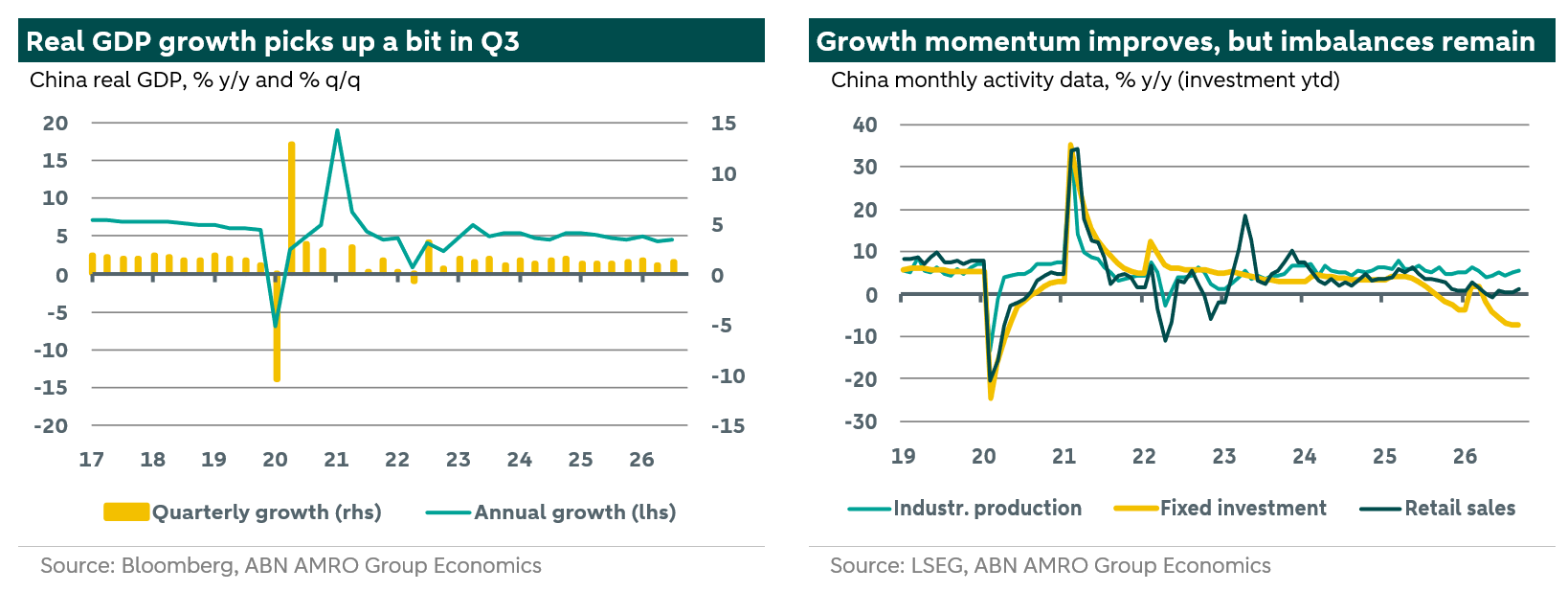
September data confirm a further pick-up of growth momentum during the summer,…
As noted in our latest Global Monthly update, recent PMI surveys were already pointing to some improvement in growth momentum over the summer, following relatively weak July/August data. The September activity data published this morning point in the same direction, with improvements both on the supply and the demand side. In line with strong annual export/import growth for September published data last week (on the back of the ongoing global tech/AI boom), industrial production accelerated further, to 5.5% y/y (consensus: 5.5%, August: 5.2%) and 0.6% m/m (August: 0.5%). Retail sales growth came in stronger than expected at 1.1% y/y (consensus: 0.5%, August: 0.4%) and 0.4% m/m (August: -0.2%). Meanwhile, the annual contraction in overall fixed investment did not show signs of easing (-7.2% yoy in January-September), led by an ongoing slump in property investment. The surveyed jobless rate in urban areas fell moderately to 5.2% (August: 5.3%).
… although supply-demand imbalances do not show signs of easing
All in all, industrial production keeps outpacing retail sales by a wide margin, pointing to ongoing domestic supply-demand imbalances, which adds to frictions with key trade partners such as the EU. Brussels and Beijing agreed on a cap for Chinese hybrid car exports to Europe (and some other measures) earlier this month, but following an EU summit last week the European Commission was asked to take further measures to expand its trade toolkit and manage the fall-out from this ‘China Shock 2.0’. Although EU-China trade relations are at a critical juncture, we still think Brussels will follow a balanced approach to prevent an all-out trade war with China.