Top of Mind - Skyfall: The macro impact of an AI crash

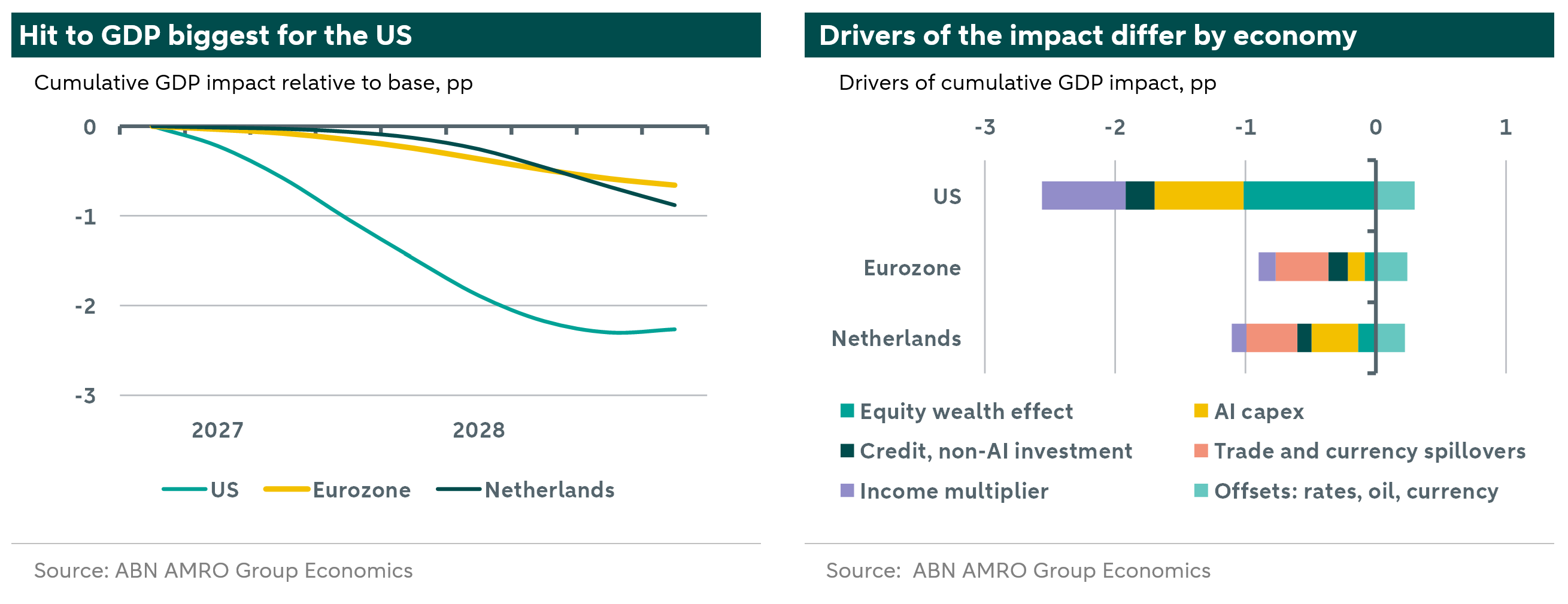
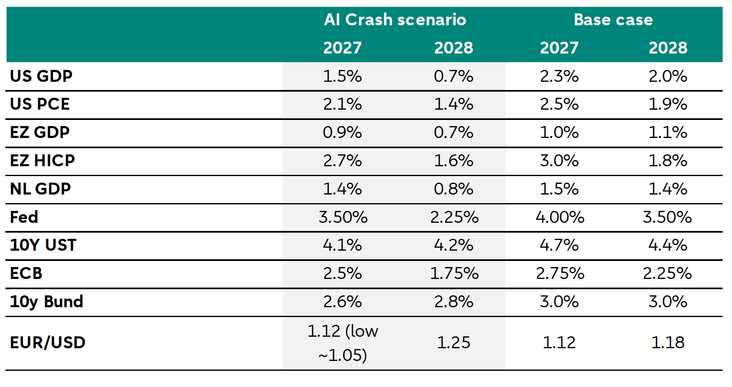
The AI boom has been a source of resilience for the economy and while our base case sees this continuing, we explore an AI crash scenario. An AI crash would hit the economy through several channels. The US is hit predominantly through household wealth, while the eurozone sees an external demand shock and the Netherlands sees additionally a delayed manufacturing hit due to its position in the AI supply chain. The US is hit hardest with GDP around 2.3% below our baseline by end-2028, versus around 0.7% in the eurozone and 0.9% in the Netherlands.


Thinking through an AI crash scenario
The AI boom has been an important factor behind the resilience of the global economy over the last two years. However, fears have grown that the boom may now turn to bust. Concerns are multiple, from the worry that revenues may not justify the spectacular investment in compute, to the problems in financing the capital spending, circular finance structures within the sector and a possible political and regulatory backlash. Given the recent fall in equity prices and decline in multiples, it looks like investors are already treating future earnings projections with more than a pinch of salt. Our base case is that fundamentals are still strong and that the AI capex boom will die another day (see here). However, the weakness in investor sentiment towards the AI trade does raise the question of what the effects on the economy, interest rates and the dollar would be if we are heading for a bust in a short term. What if this is not a drill? In this note, we set out the macro effects for the US, the eurozone, and the Netherlands of an AI crash scenario.
A 17 trillion dollar wealth loss
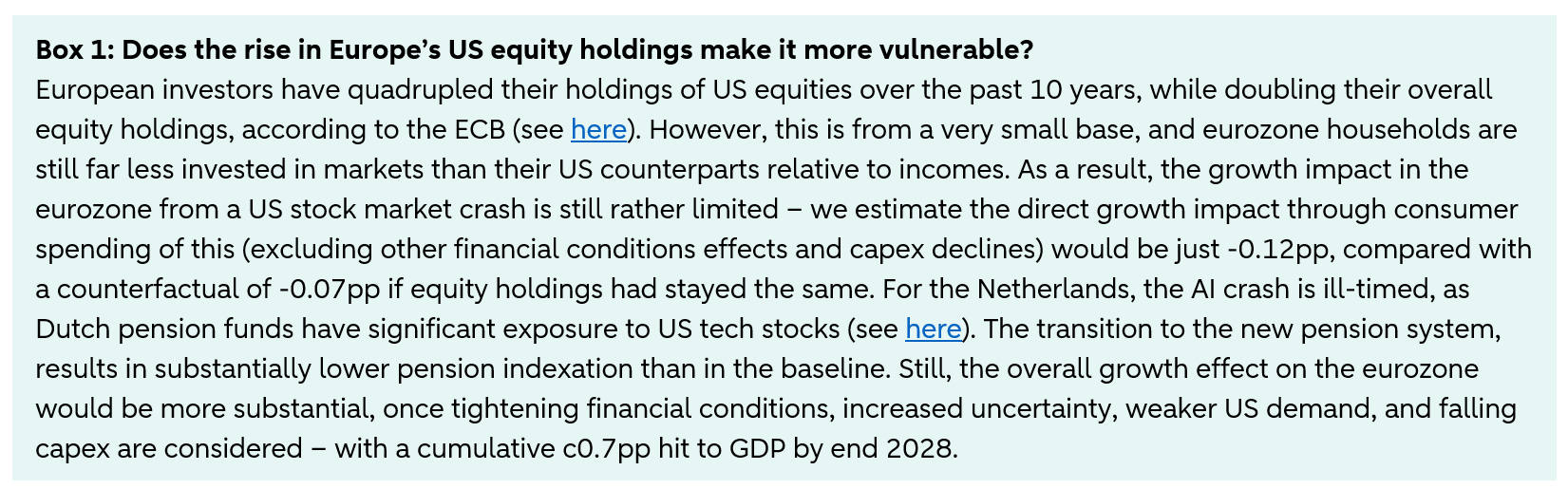
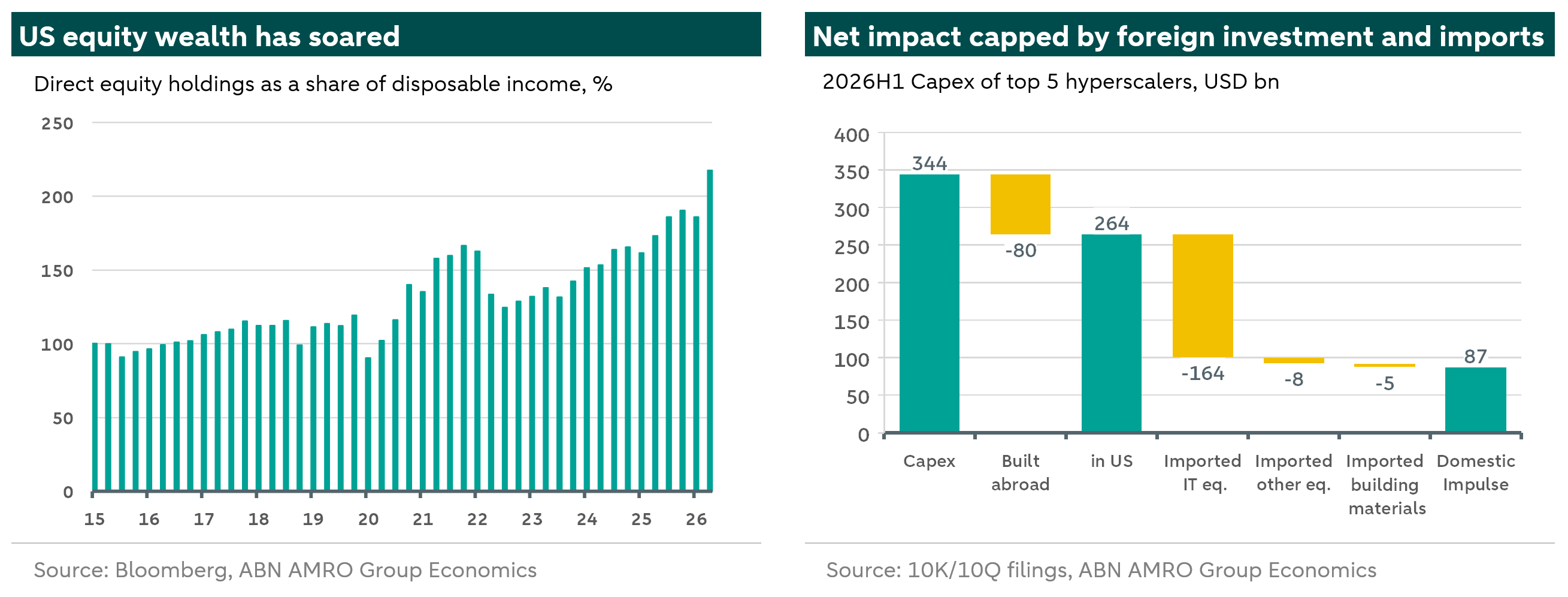
An AI crash would work through the various economies through six channels. First, and most importantly, through the decline in equity prices. We are assuming a 25% decline in the S&P 500, a 14% decline in European equities, with the more tech heavy AEX at 20%. Still, the decline we are assuming is less than during the ICT boom, reflecting that equity prices are much less inflated. Having said, US household equity wealth relative to income is now much higher, so the impact on consumer spending for any given fall in equity prices will be bigger. Indeed, we estimate that 17 trillion dollars would be wiped off the asset side of household balance sheets, leading to a serious hit to consumer spending. By end-2028, this leaves the level of US GDP around 1.0% below our current base. The shock starts with wealthy households, but reduced spending hits jobs and incomes among households that spend most of what they earn. This makes the downturn consumption-led, rather than simply a slump in technology investment. The smaller decline in European equities combined with lower household holdings of equity wealth mean that the impact on consumer spending will be much less on this side of the Atlantic (see also Box 1 on page 4).
Credit squeeze
The second channel is a credit squeeze. Financial conditions have generally remained accommodative in recent years, helping to cushion the impact of the various geopolitical shocks. The turn in risk appetite would lead to a credit squeeze, dampening non-AI investment, which has already been flatlining. Financial conditions in the eurozone would be less impacted by lower equity prices and higher credit spreads, but the impact could be amplified by even higher sovereign country spreads, which would be pushed up further because of the deterioration in risk sentiment and weaker growth. This would particularly hit countries with poor public finances such as France. As we explain below, an important offsetting factor will be lower base rates.
The AI capex slump
The third channel is a decline in AI capex. We assume that hyperscaler capex in 2027 falls to 10% below its 2026 level. The impact compared to our base case is bigger than it seems, as in our base case we are assuming that capex continues to grow rapidly at 40% next year. For the US economy, this implies around 0.7 percentage points lower US GDP by end-2028 compared to our current base, including the wider AI ecosystem and grid investment. The gross effect is actually much bigger, but the overall impact on the US economy is cushioned by a slump in imports, reflecting that most of the equipment housed in the data centres is imported from the big AI manufacturers in Asia, especially Taiwan and Korea. Spending does not stop overnight, with various contracted projects expected to continue, pushing much of the domestic hit in the US into 2028. For the eurozone the impact of lower AI capex is modest, reflecting that the data centre build out was also relatively modest from a macro perspective. However, Ireland’s role as a hub for US technology multinationals could amplify the hit to headline eurozone GDP through weaker recorded production and exports, though underlying domestic demand is likely to relatively unscathed by this.
A delayed AI Dutch manufacturing hit
However, Europe has also benefited from the spillovers to AI manufacturing and this brings us to our fourth channel of impact. This is most significant in the Netherlands, because it produces the machines used to build the most advanced chips. Given order backlogs, this would provide a buffer for 2027 and part of 2028. However, as weaker semiconductor demand eventually feeds through the supply chain, we expect a drag on the Dutch economy from the second half of 2028 onwards. As a result, the hit to Dutch GDP relative to our baseline eventually exceeds that of the eurozone as a whole. In this scenario, the Dutch growth outperformance embedded in our baseline therefore fades, narrowing the growth gap with the eurozone.
A weaker dollar… eventually
The fifth channel is a weakening of global trade growth and hence weaker exports, with the eurozone and the Netherlands relatively more exposed given their reliance on external demand. This reflects weaker US demand more directly, but also a wider slowdown of the global economy as it imports less consumer and AI investment goods. The exact impact will also depend on currency moves. A weaker euro will first provide some cushion for exports from the impact of lower global growth, but later in the horizon the euro is likely to strengthen significantly. This reflects the movements in the dollar due to the AI crash. At first, the dollar strengthens due to safe haven effects, which would probably take EUR/USD to around 1.05 by mid-2027. Once this effect fades, we expect the dollar to weaken sharply as fundamentals take over. The Fed would be expected to cut rates by much more than the ECB (see below), given the much bigger growth impact in the US, and this narrowing in rate differentials will weigh on the dollar. Moreover, the AI boom has helped to keep the dollar over-valued against most other currencies, as it has seen capital flowing into the US. Indeed, the US net international investment position currently stands at around USD 22 trillion.
Second round effects
The sixth channel is the labour market, which broadens the downturn beyond investors and AI suppliers. In the US, weaker spending by wealthy households hits labour-intensive services, reducing hiring and incomes among households that spend most of what they earn. Their spending then falls too, amplifying the initial shock. In Europe, weaker exports and supplier activity transmit the slowdown to jobs and domestic demand. Automatic stabilisers and a tight labour market in the case of the Netherlands to begin with, cushion income losses, but do not prevent this second-round hitting. In the eurozone, already negative jobs growth (see here) would run the risk of turning into a more self-sustained downturn.
Central bank response: Back to lower for longer
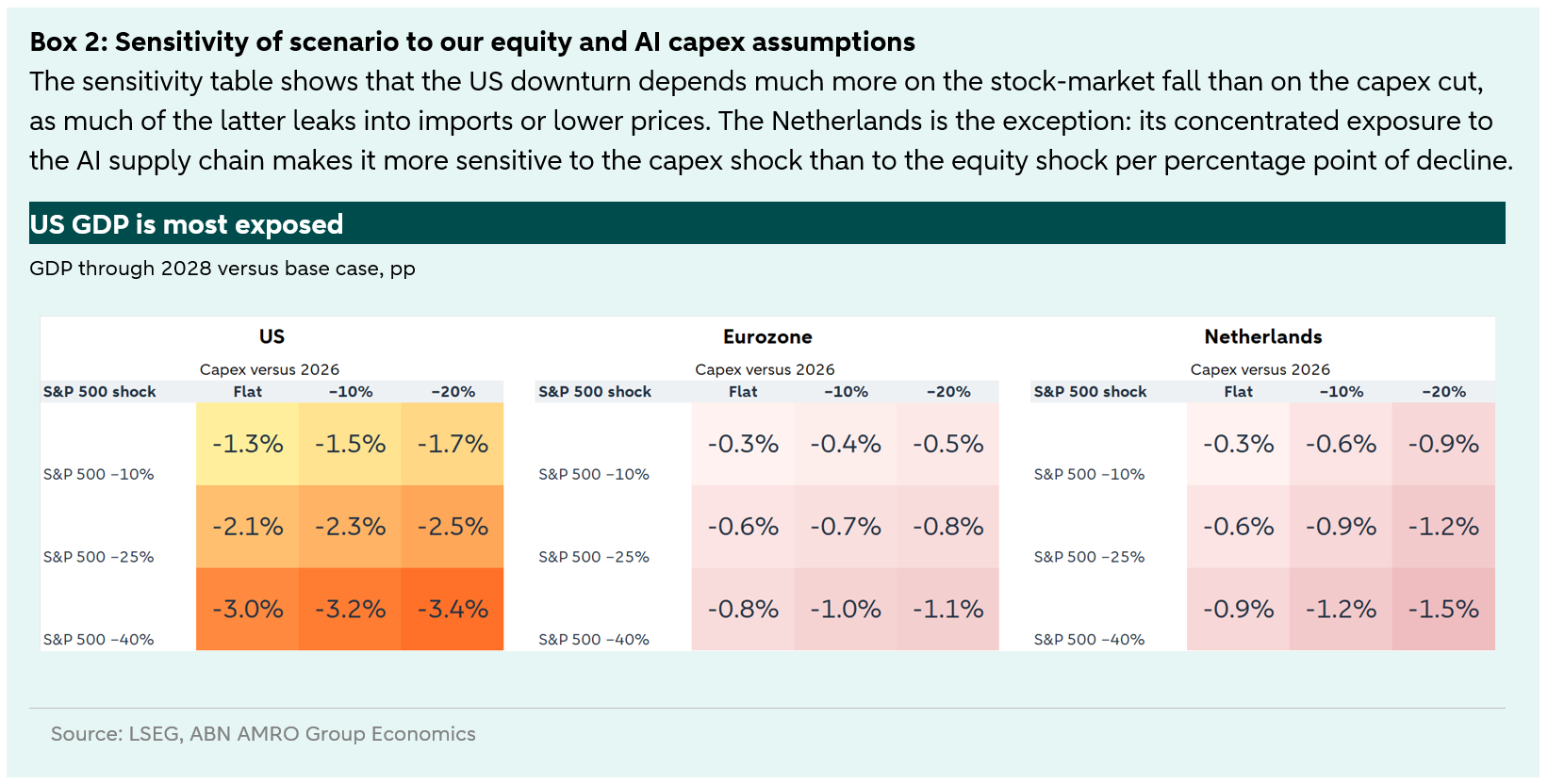
The higher for longer narrative for interest rates – a dominant feature this year – would likely switch back to a lower for longer outlook. This is because US growth would likely slow to a crawl, while the eurozone and Dutch economies would see a period of variously stagnation and well below-trend growth (the outlook is sensitive to the assumptions we use for the extent of the declines in equity prices and AI capex – see Box 2 for different scenarios). In addition, lower global demand would likely bring oil prices down more quickly than in our current base case. We would expect the Fed to start cutting in Q3 2027 and end 2028 around 125bp below our base case, at 2.25%, while the ECB would skip the March 2027 hike, cut from the second half of 2027 and end 2028 around 50bp below our base case, at 1.75%. In the case of the US, this reflects the particularly large hit to the economy, while for the eurozone, the disinflationary effects of a strong euro in 2028 would also play a role.
Bonds would make a comeback as safe havens
Over the past year, some investors have started to doubt the safe haven characteristics of government bonds, but we think an AI crash would restore their haven appeal. While we have become used to supply-side shocks in recent years that mainly push up inflation, this bust would be a demand shock that lowers both growth and inflation, while also hurting risk sentiment. We would therefore expect government bond yields to fall sharply at first, before later recovering. Lower interest rates would eventually stabilise both markets and the economy, with their main effect a faster recovery in 2029; the eurozone and Dutch GDP shortfalls would still be deepening at end-2028.