Energy Outlook 2027: Rebalancing the system

Energy markets enter 2027 with depleted inventories, disrupted trade flows and persistent supply constraints. This outlook examines crude oil, European gas and refined products, assessing how recovering supply and new capacity could ease prices during the year. While we expect market normalisation, inventory replenishment, refinery repairs and shipping bottlenecks should limit the pace of adjustment. Geopolitical uncertainty and weather remain key risks to the outlook.


Oil markets
The oil market is moving from severe supply shortages towards a better balance between supply and demand
Middle Eastern exporters are restoring flows through alternative routes and shipping methods, bringing exports back close to pre-conflict levels
Low inventories and continued uncertainty are keeping the market sensitive to further disruptions in the near term
We expect oil market to be in oversupply in 2027 and oil prices to decline
Gas markets
Low gas storage levels mean Europe faces tight supplies this winter and a challenging task rebuilding stocks in the summer of 2027
Qatari supply disruptions and the ban on Russian gas increase reliance on US LNG and Norwegian pipeline flows
New LNG capacity, particularly in the US, should ease prices in 2027, but storage purchases and recovering demand would keep them above pre-war levels
Weather, geopolitical tensions and delays in new LNG capacity remain key upside risks
Refined product markets
Supply disruptions and lower refinery capacity have tightened the global market
Refinery throughput has fallen most in Russia, the Middle East and China
Damage to complex refinery equipment in the Middle East and Russia takes time to restore
Postponed maintenance increases the risk of unexpected refinery outages
New refining capacity will come online gradually but this will not immediately resolve shortages
Product prices are likely to remain high at the start of 2027 before falling in the course of 2027
The market is expected to normalise in 2028, leading to substantially lower prices
Oil markets
Tight supply and high shipping costs supported oil prices despite the recent decline
Crude oil prices rose sharply between the start of 2026 and the end of October. Brent prices almost doubled, while WTI prices increased by more than 80%. Since then, prices have fallen substantially: WTI by 18% and Brent by 23%. The decline initially followed signs that the US and Iran were willing to resume talks. The US mid-term election results then put further downward pressure on prices. Markets interpreted the strong Democratic gains as increasing the likelihood of an earlier end to the Iran war, which has been very unpopular among US voters.
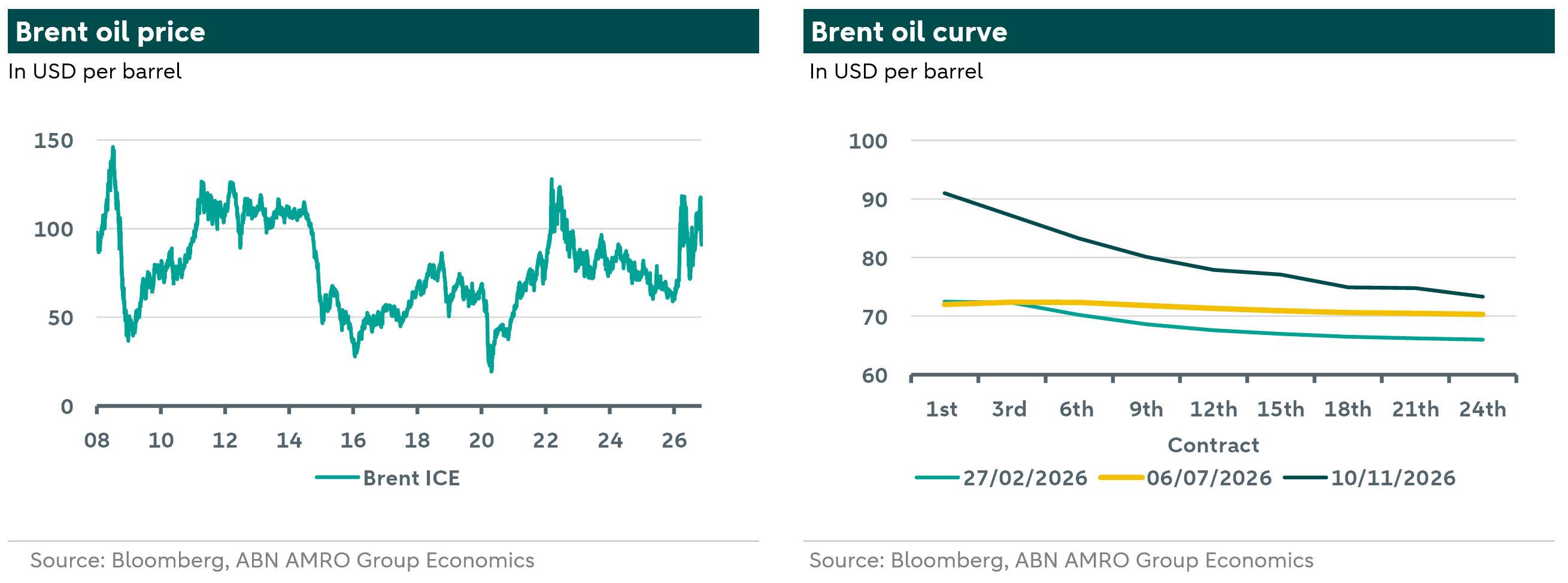
These developments coincide with a recovery in Middle Eastern crude oil exports (see charts below). Countries in the region continue to use alternative export routes, including pipelines through Yanbu, Fujairah, Kirkuk-Ceyhan and SUMED. They also transport oil through “dark transits”—voyages in which tankers deliberately hide their tracking signals or switch off their tracking systems—and by transferring oil between ships. Producers have adopted different pricing strategies to support exports. Some offer discounts to buyers loading crude oil inside the Gulf to compensate for higher costs and uncertainty. Others quote the crude oil price separately and charge an additional fee for delivery outside the Strait of Hormuz. Some countries offer both options.
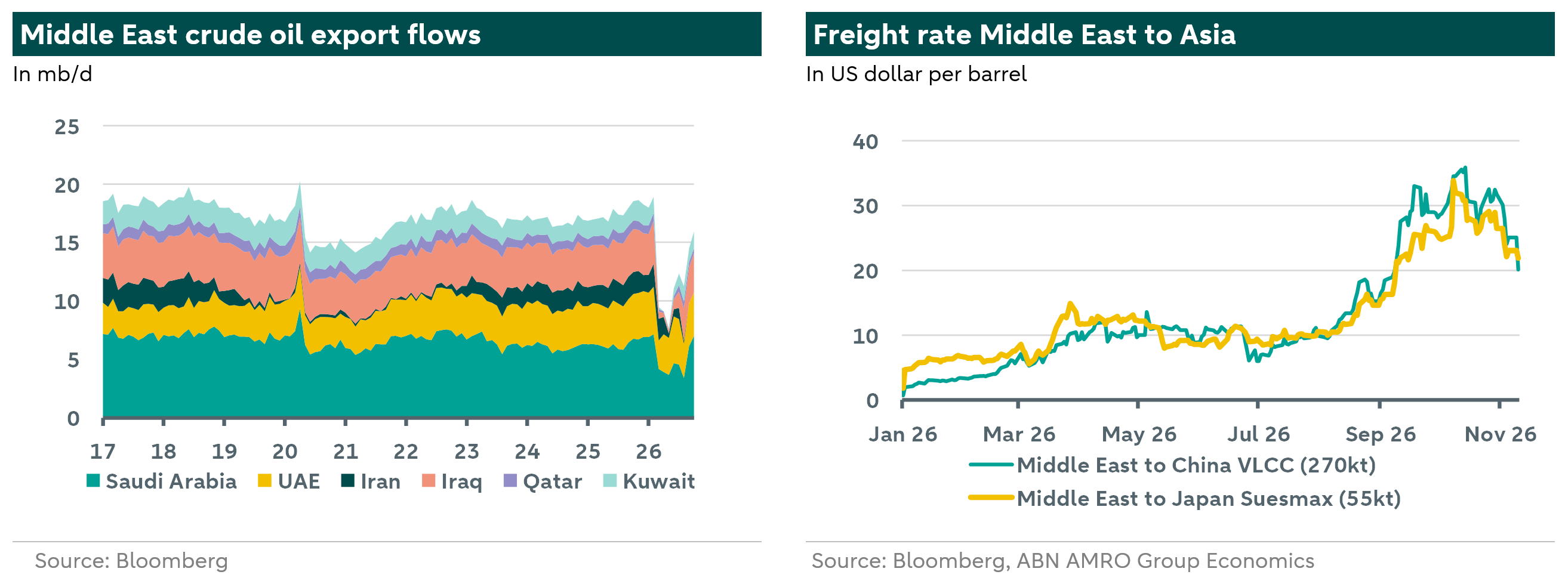
Despite the recent decline, oil prices remain 50% higher than at the start of the year. Several factors explain this. First, supplies of crude oil for immediate or near-term delivery remain tight. This is reflected in the strong backwardation of the Brent futures curve: prices for delivery in the coming months are higher than those for later delivery. Refinery margins appear high when calculated using Brent futures prices. However, margins remain negative when calculated using the price of Brent for immediate delivery and including all costs.
High shipping costs are another important factor. The chart above on the right shows the cost of transporting crude oil from the Middle East to China and Japan. Although freight rates have fallen, they remain very high by historical standards. War-risk insurance premiums add to these costs. Oil can therefore still be transported through the Strait of Hormuz, but at a substantial expense.
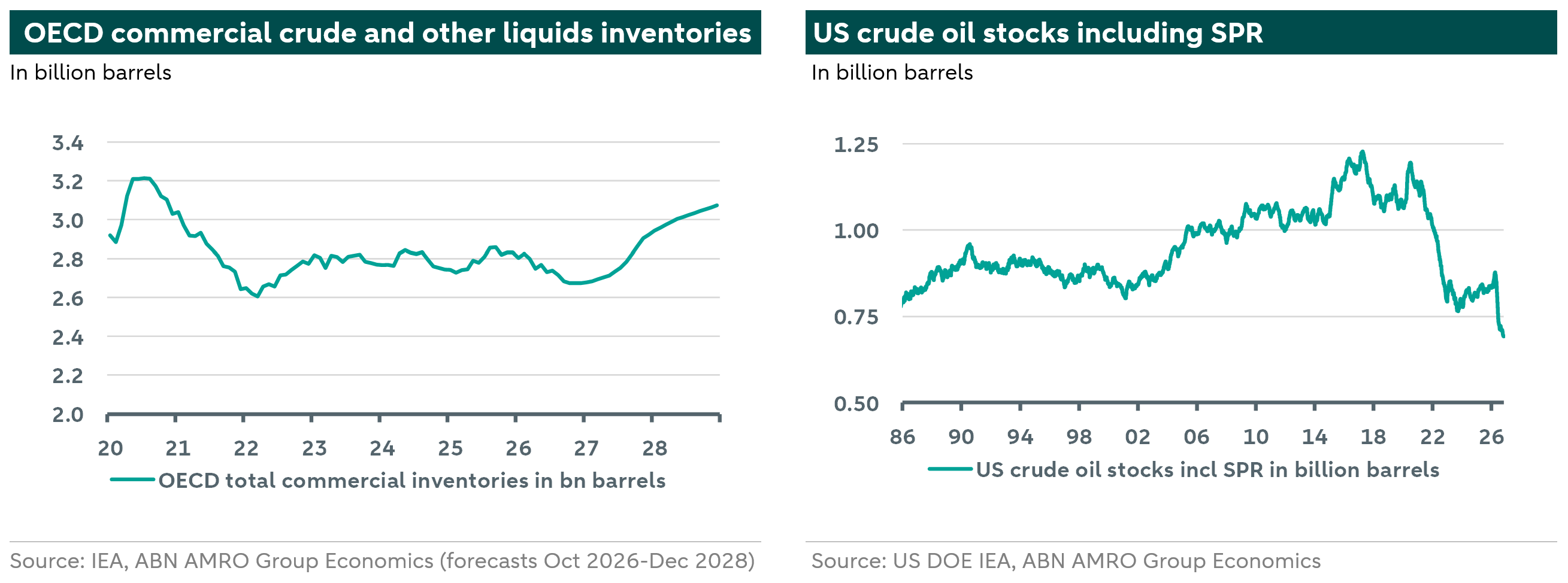
Alternative methods, such as transferring oil between ships, have helped maintain flows through the Strait. However, deliveries are less efficient than before the conflict, and crude oil takes longer to reach refineries. Oil inventories have also fallen sharply, leaving little buffer against another supply shock. Market participants recognise that the recovery in Middle Eastern exports could quickly reverse if tensions rise again. Together, these factors are likely to keep oil prices elevated in the months ahead.
Supply is expected to exceed demand in 2027, allowing inventories to recover gradually
The oil market is moving from severe supply shortages towards a better balance between supply and demand. Some reports suggest that supply already exceeds demand. If Middle Eastern crude oil exports continue to recover without further disruption, market conditions should ease further in 2027. Markets are currently optimistic that the Iran war will end sooner than expected. However, much could change before the new Congress takes office in January. It may therefore be too early for the additional price premium associated with conflict risks to decline. For 2027, we expect oil supply to exceed consumption, putting downward pressure on prices while allowing depleted inventories to recover.
Global oil inventories are currently low and need to be rebuilt. Purchases to replenish these depleted stocks should absorb part of the excess supply, cushioning the downward pressure on prices in 2027. Countries are likely to increase their stocks to improve their resilience to future supply shocks, but this process will probably be gradual. Much lower oil prices, as well as lower freight and insurance costs, would make a faster rebuild more affordable. Lower prices should therefore encourage stock replenishment, while the resulting purchases should in turn help support prices.
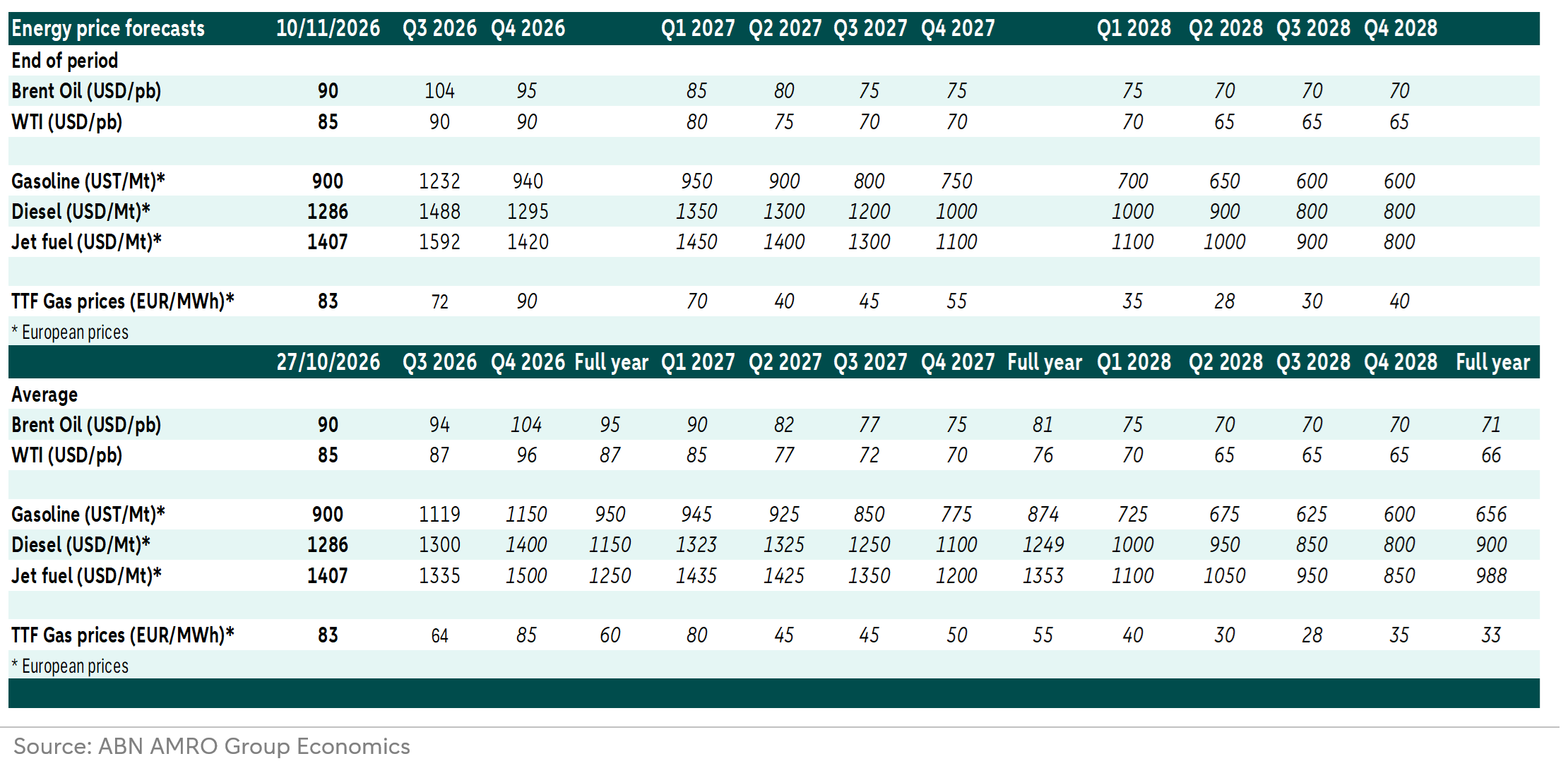
Oil deliveries also need to become more efficient, or new trade routes need to become a standard part of market planning. These changes will take time, so delivery constraints and associated costs should ease only gradually. Together, inventory replenishment and the gradual normalisation of deliveries should cushion the price decline as supply recovers. We therefore expect oil prices to remain relatively high for the rest of this year, fall considerably during 2027 and decline further in 2028. We forecast Brent crude at USD 95 per barrel at the end of 2026, with an average price of USD 104 per barrel in the fourth quarter of 2026. By the end of 2027, we expect Brent to fall to USD 75 per barrel.
European gas markets
So far, 2026 has been a challenging year for the European gas market. The market had been moving towards a long-awaited supply surplus before the Iran war reversed that trend, with the effective closure of the Strait of Hormuz disrupting around 20% of global LNG exports. Europe ended the 2025-26 winter with storage levels at multi-year lows, making the subsequent refilling season particularly challenging. A backwardation in forward curves - where short-term prices are higher than long term ones - during injection months further weakened the commercial incentive to inject gas into storage. Uncertainty over the duration of the war and strong competition from Asia for LNG cargoes added to these pressures.
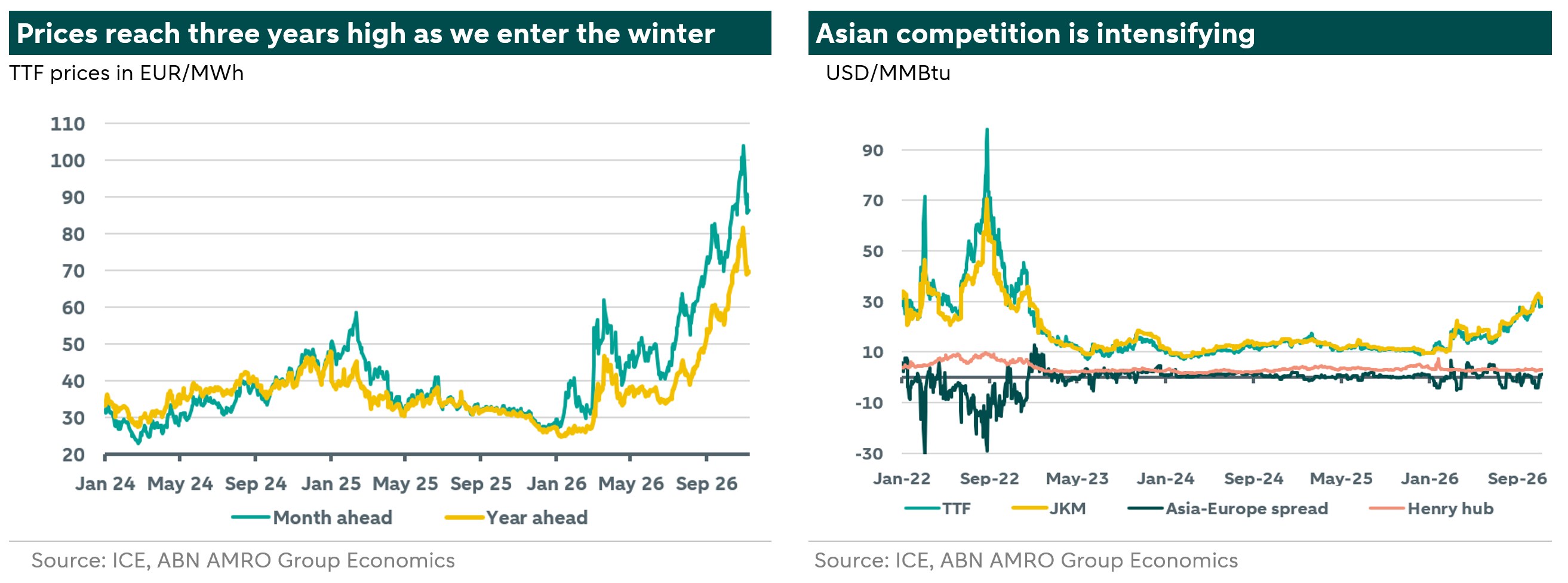
Additional LNG export capacity, particularly in the US, has helped limit price increases, but Europe is entering the 2026-27 winter with storage only 75% full (see graph below on the left). Against this backdrop, the market remains highly sensitive to weather conditions and further supply disruptions from main supplier like the US or Norway. The European gas market is expected to remain tight through the winter heating season at the start of 2027, leaving a challenging starting point for summer storage injections. Under mild weather conditions, we expect European storage levels to end March at 24%. A cold winter could instead bring inventories down to 10–15%. In either scenario, substantial replenishment will be needed during the subsequent injection season.
Supply constraints extend beyond the winter. The effective closure of the Strait of Hormuz has reduced Qatari LNG exports by approximately 96%, taking roughly 100–105 bcm/year out of global supply. Our base case assumes that, even if an agreement is reached and the Strait reopens, flows will take time to normalise. Damage to infrastructure at Ras Laffan and severe shipping bottlenecks - including higher war-risk insurance costs, vessel rerouting and tanker damage - are expected to delay the recovery. These shipping constraints have also limited the effective delivery of alternative supplies. Accordingly, we expect Qatari LNG to gradually come back during the first half of 2027, with meaningful flows taking place in Q2.
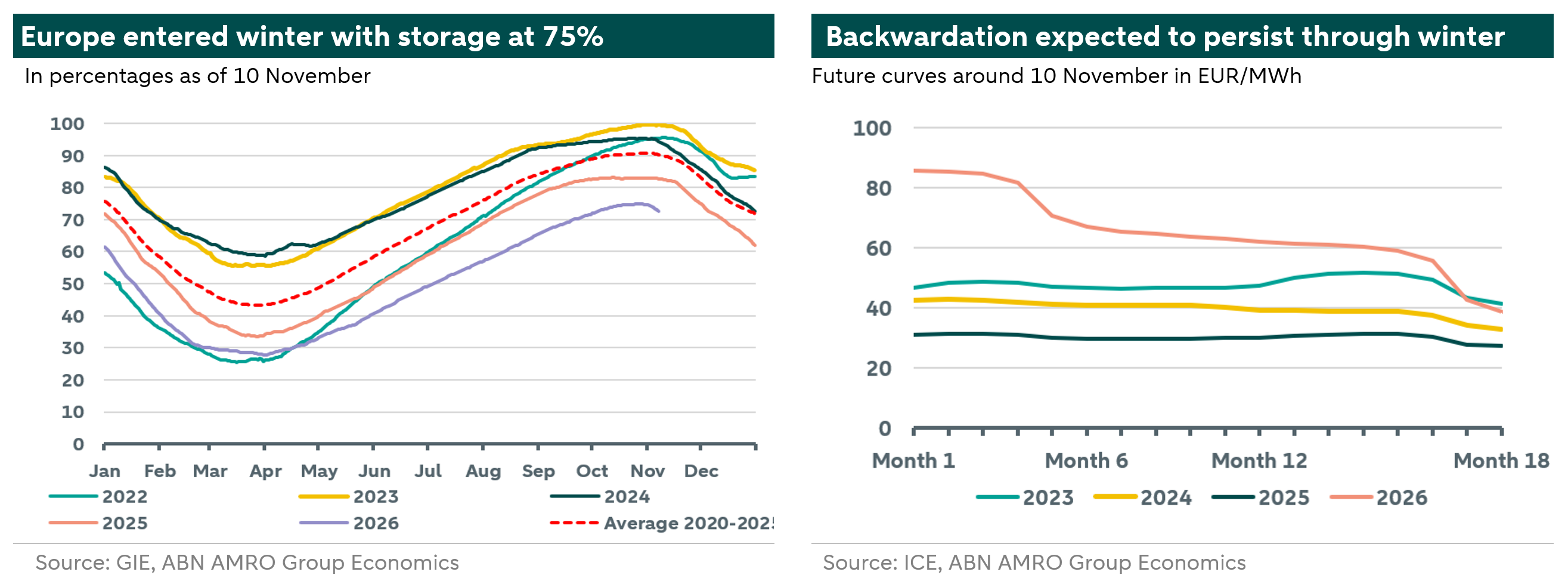
At the same time, the EU’s transition away from Russian pipeline gas and LNG takes effect in 2027, further tightening supply and reducing flexibility. Europe will consequently become more reliant on US LNG cargoes and Norwegian pipeline flows.
New LNG capacity is expected to provide a counterweight to these supply pressures in 2027. Global additions are estimated at around 90-100 bcm, with approximately 60% concentrated in the US and more than 60% expected to become operational in the first half of the year. For example, Golden Pass LNG exporting facility in Texas is expected to reach full commissioning in the first half of 2027, adding 25 bcm. While Rio Grande LNG and Port Arthur LNG, also in the US, are expected to add 24.3 bcm and 18.6 bcm, respectively, while Qatar is expected to add 15–22 bcm and Nigeria 10.5 bcm.
As additional LNG supply becomes available, market tightness should ease and prices should decline from current highs. However, Europe and Asia will need to replenish severely depleted inventories, absorbing part of the increase in supply. Lower prices should also allow some previously curtailed industrial and heating/cooling demand to recover, while weakening incentives to switch away from gas in the power sector. Storage purchases and recovering consumption should therefore cushion the price decline, rather than prevent it, keeping prices above pre-war levels. That is, a summer-to-winter price spread sufficient to cover storage financing and other relevant costs would strengthen the commercial incentive to refill storage. Lower summer prices should encourage replenishment, while the resulting purchases should in turn help support prices.
Storage policy could also evolve in 2027, as the current storage target regulation expires. Europe may move towards a revised framework to strengthen its resilience to energy shocks. Strategic reserves are one option, with European states taking a greater role in securing supplies and managing storage. Such a development would provide a signal of a rising demand and support prices.
The outlook remains sensitive to both weather and supply risks. Weather is the most important short-term demand variable throughout the year: adverse conditions during either the injection or heating season could trigger price spikes. On the supply side, renewed geopolitical tensions, war-related disruptions, unplanned maintenance or delays in commissioning new LNG export capacity could prolong market tightness and push prices above our base-case expectations.
All in all, we expect the balance to ease after winter as heating demand falls and additional LNG output becomes available. Storage replenishment and recovering consumption should absorb part of this improvement, limiting the price decline. Our projected easing during Q2–Q3 depends on additional LNG supply becoming available early enough to support the injection season; later commissioning or a slower ramp-up would delay that relief. We expect TTF month-ahead prices to ease to an average of 80 EUR/MWh in Q1, before declining further to around 45 EUR/MWh on average during the Q2–Q3 storage-filling season. With the onset of the following winter, we expect prices to rebound, reaching around 55 EUR/MWh by year-end.
Refined products markets
Refinery constraints keep fuel prices elevated despite the recent decline
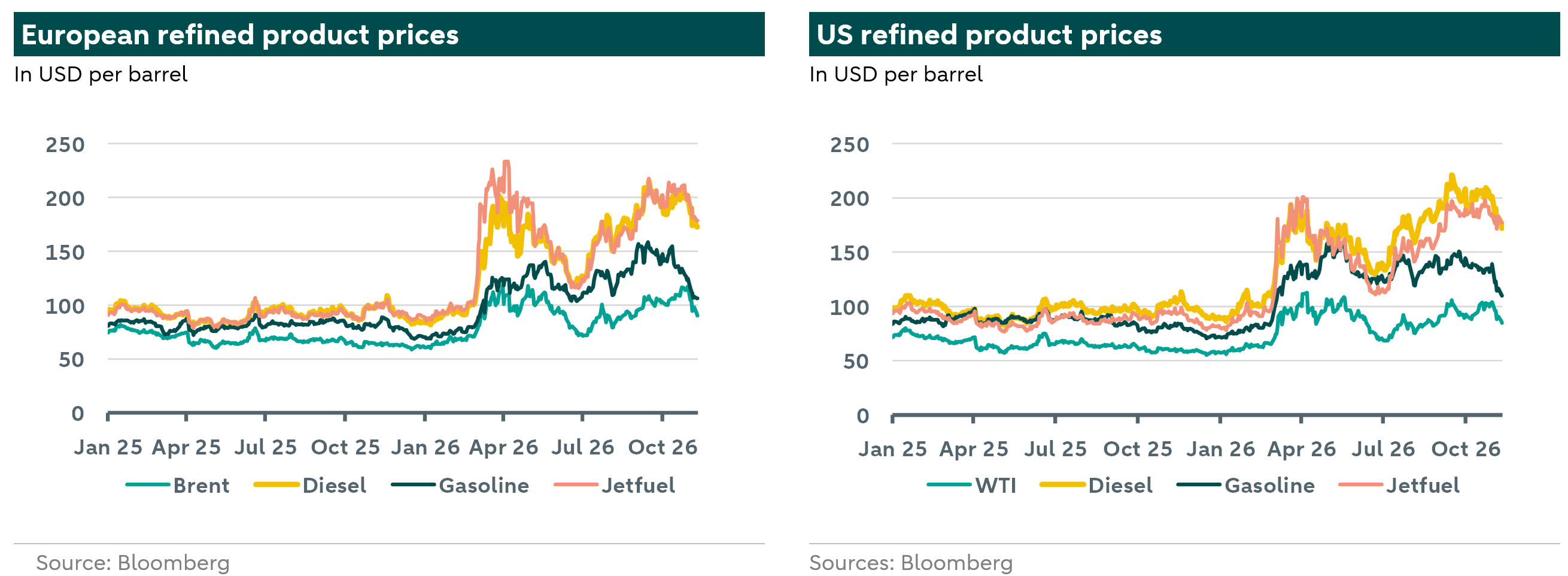
Refined product prices rose sharply between the start of 2026 and the end of October. The graphs below show changes in refined product and crude oil prices, expressed in USD per barrel. Refined product prices, however, are usually quoted per metric tonne. European gasoline prices increased by 77%, from USD 595 to USD 1,055 per metric tonne. Diesel prices rose by 139%, from USD 626 to USD 1,499 per metric tonne, while jet fuel prices increased by 128%, from USD 698 to USD 1,595 per metric tonne. Refined product supply has tightened through three distinct channels: damage to refinery equipment has reduced available processing capacity; disrupted crude supplies have constrained refinery throughput; and lower exports have reduced the supply available to international buyers. These constraints, discussed below, have pushed up refinery margins and product prices, while inventories have fallen. Since the start of November, refined product prices have declined significantly, largely for the same reasons as crude oil prices.
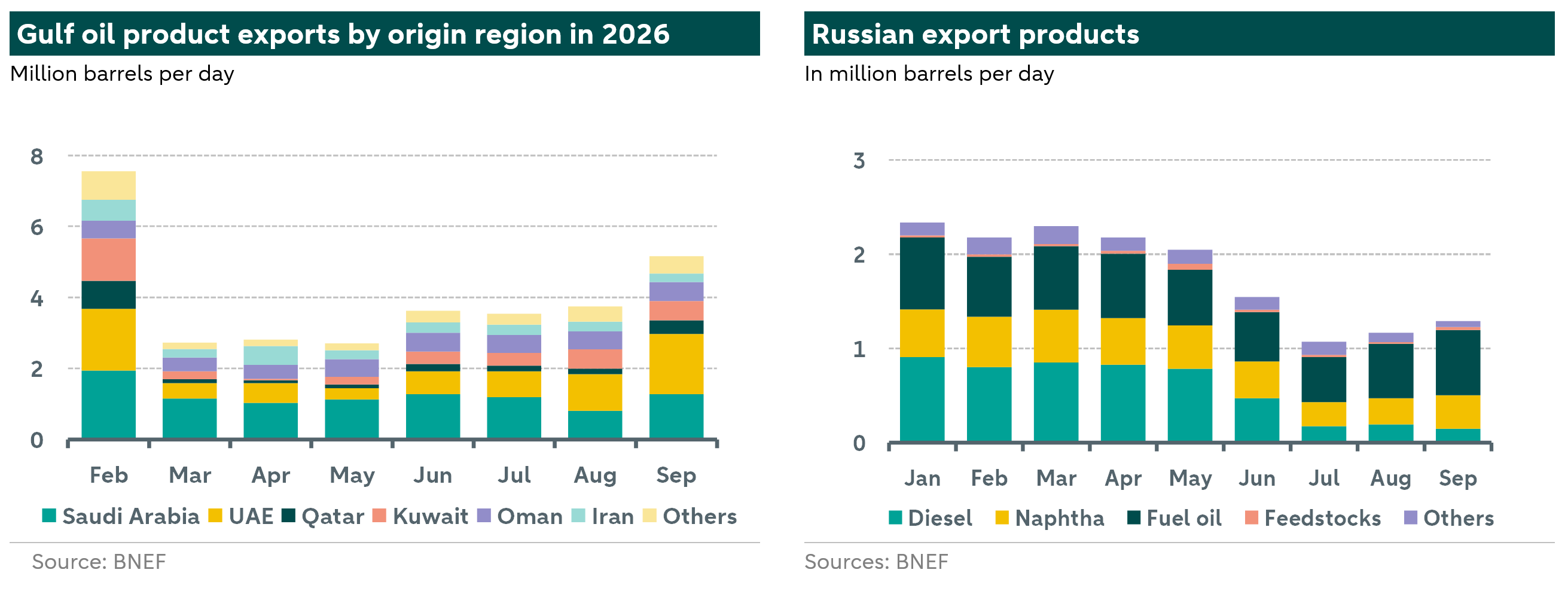
The chart below on the left shows the global refinery throughput—the volume of crude oil processed—in key countries and regions. Global throughput has declined since the start of the Iran war, despite increases in North America and Europe. The US accounts for more than 85% of North American throughput.
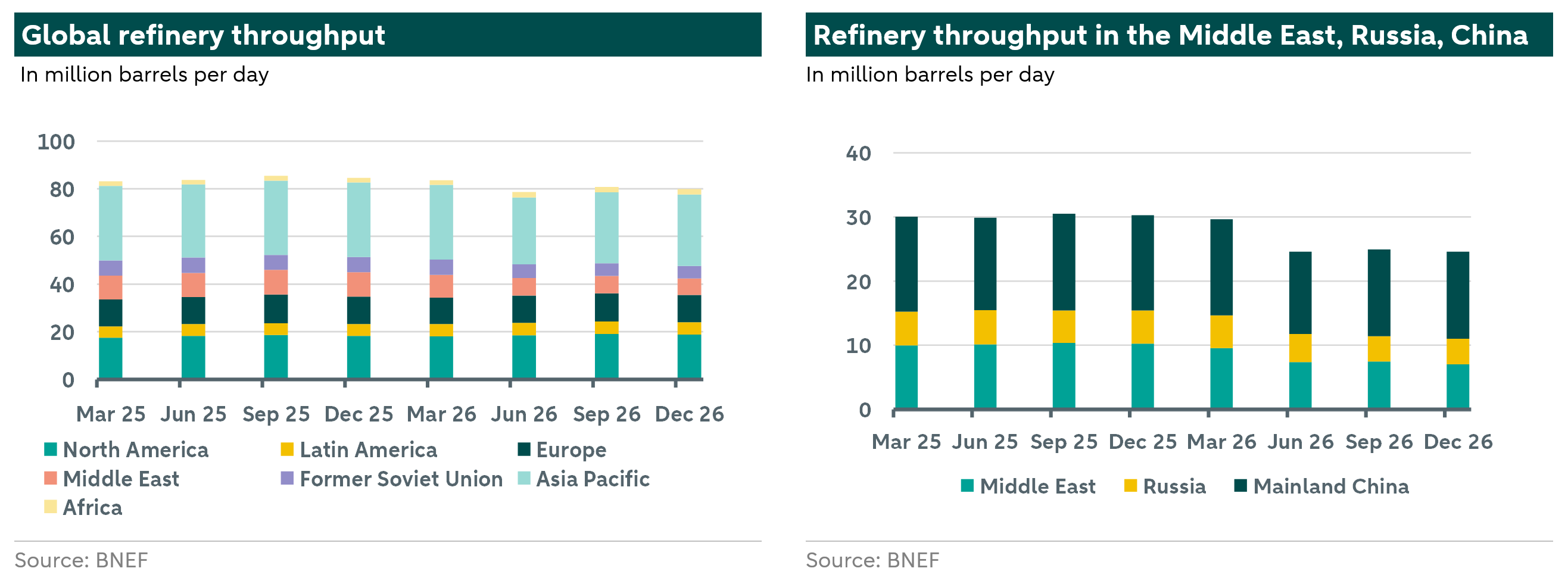
The largest declines have occurred in Russia, the Middle East and China, but the underlying constraints differ. In the Middle East and Russia, attacks on refineries and related infrastructure have reduced available processing capacity. In China, lower throughput partly reflects reduced access to crude oil, refined product export bans and quota restrictions, and changing domestic demand associated with electrification. Lower operating rates therefore do not necessarily imply a loss of physical refining capacity. Although operating rates at state-owned and large independent Chinese refineries have recovered somewhat, they remain below the lowest levels recorded for this time of year during 2021–2025.
Changes in domestic demand help explain refinery operating rates, while export restrictions directly limit the supply available to international buyers. In Russia, refinery attacks have caused gasoline shortages and diverted some of the country's usual diesel surplus to the domestic market. Russia introduced a diesel export ban in July 2026, which was partly eased following the agreement between Trump and Putin allowing Russia to export diesel. Russia generally exports surplus diesel and other refined products, but has a tighter gasoline market. Europe has the opposite balance: it usually exports surplus gasoline and relies on diesel imports.
A gradual refinery recovery should ease fuel prices in 2027
Even if attacks on Russian refineries stopped and the Strait of Hormuz fully reopened, refining capacity would take time to recover. Damage does not necessarily shut down an entire refinery, and some units can be repaired faster than others. A refinery may therefore continue to produce simpler petroleum products while its more advanced processing equipment is being repaired.
Scheduled maintenance also reduces available refining capacity. However, the amount due to be offline in the coming months is relatively low by historical standards. To benefit from high margins, refineries, mainly in Europe, have postponed maintenance affecting about 1.5 million barrels per day of global capacity until 2027. Delaying maintenance increases the risk of unplanned outages, as essential work cannot be postponed indefinitely.
New refining capacity is also expected to come online in 2027. However, new refineries do not reach full capacity immediately. Their interconnected chemical processes require a gradual start-up. Catalysts, the substances that help chemical reactions take place, must be prepared for use, while temperature and pressure are increased step by step. New capacity will therefore translate into additional product supply only gradually, delaying the easing of market tightness.
As discussed earlier in this report, we expect crude oil supply to exceed demand in 2027, while freight and insurance costs decline. Improved crude availability should support higher refinery throughput, while lower crude oil prices and delivery costs should help reduce refined product prices. We expect repairs to restore available processing capacity in Russia and the Middle East during 2027, and improved crude availability to support a recovery in throughput, including in China. Easing export bans in Russia and China should increase the supply available to international markets. New refining capacity should make a meaningful contribution in the second half of 2027 as plants gradually increase production. However, repairs, deferred maintenance and the phased start-up of new refineries will limit the pace of supply recovery, so refined product markets are likely to remain tight for longer than crude oil markets. We expect refined product prices to stay high in the first few months of 2027 before falling substantially during the year. Our end-2027 forecasts are USD 750 per metric tonne for gasoline, USD 1000 per metric tonne for diesel and USD 1100 per metric tonne for jet fuel. We expect the market to return fully to normal in 2028, leading to substantially lower prices.
Our energy price forecasts