ESG Economist - Fewer free allowances forces companies towards low-carbon action

The EU ETS free emission allowances offer companies covered by the emissions trading system protection against competition from abroad. The allocation of free emission allowances limits the costs for ETS companies compared to competitors outside the EU. However, because this system also puts a brake on investments in decarbonization, these free emission allowances will be phased out completely by 2034. From that point on, a carbon border adjustment mechanism (CBAM) will take over to partially minimize the loss of competitiveness. This will bring significant changes, particularly for ETS companies in the industrial sector. In this analysis, we highlight the trend in carbon costs for ETS companies in the Netherlands. To this end, we discuss the structure of the EU ETS in the Netherlands, its trends in ETS emissions, and the balance between free emission allowances and ETS emissions by sector. Finally, we highlight the impact of the phasing out of free emission allowances and the trends in carbon costs for ETS companies towards 2030. We end with a conclusion.

Since its launch, the EU ETS has had a positive impact on reducing CO2 emissions in Europe
A 1% decrease in ETS emissions in 2024 for the entire EU-27 is at odds with the 6% increase in ETS emissions in the Netherlands
The mismatch between free emission allowances and actual emissions within the EU ETS is forcing emission-intensive sectors to accelerate decarbonization in order to avoid rising carbon costs
Based on a projection using the average ETS emission reduction rate over the period 2017-2024, there will ultimately be an emission gap of 35% in 2030 compared to the 2030 target in the Netherlands
This means there is a high probability that carbon costs will continue to rise towards 2030 and that investments in decarbonisation will accelerate going forward
EU ETS
The EU ETS was launched in 2005. Thirty countries in Europe are now participating (all 27 EU member states plus Iceland, Liechtenstein, and Norway). Currently, the EU ETS covers approximately 10,000 power plants and industrial installations. This means that approximately 45% of CO2 emissions in the EU are regulated by the EU ETS.
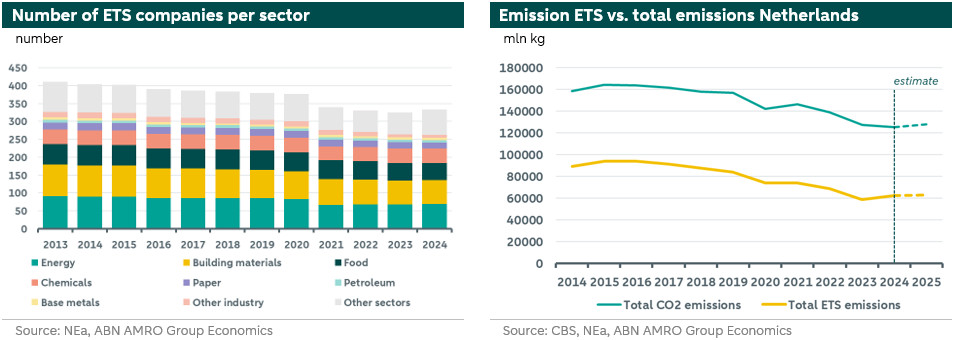
In the Netherlands, this ETS share is slightly lower at 44%. This concerns approximately 330 stationary companies within the EU ETS. The number of Dutch ETS companies has fallen by around 70 since 2013, due to mergers, relocations and/or closures. The industrial ETS companies account for almost 60% of this. The energy sector and other sectors each account for approximately 20%.
On balance, the ETS system has a positive impact on the EU emissions. In 2024, ETS CO2 emissions from the EU-27 has fallen by around 1%. However, this decrease is at odds with the increase of almost 6% on an annual basis from Dutch EU ETS companies in the same year. In the Netherlands, industry and aviation in particular contributed to this increase. The decline in emissions from electricity production levelled off slightly in the Netherlands in 2024, while this sector was the main driver of the reduction in CO2 emissions in the EU-27 as a whole. Emissions from electricity production in the EU-27 fell by 12% in 2024. This was mainly due to an increase in renewable sources and nuclear energy and a decrease in gas and coal consumption.
ETS emissions versus free emission allowances
For CO2 emissions by ETS companies in the EU, free emission allowances are granted. This way, these companies are more able to compete with companies outside the EU that are subject to less stringent climate legislation. However, within the emissions trading system, there may be a net mismatch between actual emissions and free emission allowances. If a company's emissions under the EU ETS exceed the free emission allowances it has received, these companies must purchase additional emission allowances from other market participants or at auctions to make up the shortfall. If emissions are lower than the free emission allowances, ETS companies can sell their surplus emission allowances or save them for future use. The allocation of free allowances is benchmarked to the emission level of 10% best companies. This way there is still an incentive for least efficient companies to reduce their emissions.
Two emission-intensive sectors are heavily represented within the EU ETS in the Netherlands. Industry accounts for 57% of ETS emissions and the energy sector accounts for 38%. The remaining 5% is accounted for by other sectors (such as the built environment). The number of free emission allowances in the energy sector is relatively low. The idea behind this is that energy companies are better able to pass on their higher carbon costs to their end users. This is because they witness much less international competition and production and usage are regional oriented. This also means that the risk of carbon leakage is relatively low. With a low number of free emission allowances and a rising CO2 price (and therefore carbon costs), CO2 emissions in the energy sector have fallen sharply. For industrial companies, the number of free emission allowances is much higher, because the risk of carbon leakage in this sector is much higher due to the high international competition. With the reduction in the number of free emission allowances, CO2 emissions have also fallen here.
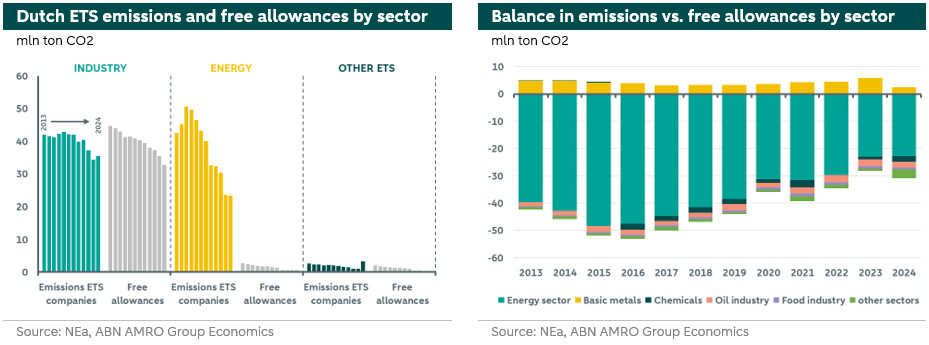
The figure on the right shows the balance between the number of ETS emissions and the free emission allowances per sector. The sectors above the horizontal axis receive more free emission allowances each year than they emit. The opposite is true for the sectors below the horizontal axis. These ETS companies have a shortage of emission allowances and must purchase them through auctions or on a secondary market. The figure clearly shows that the base metal industry (particularly the steel sector) has an annual surplus of emission allowances, while all other sectors have to buy allowances on the for their excess CO2 emissions. Energy companies in particular have to purchase significantly more emission allowances, which is an incentive for these companies to decarbonise at a faster pace.
Carbon costs
The ultimate goal of the EU ETS is to reduce CO2 emissions by 62% in 2030 compared to 2005 levels. This goal also applies to the Netherlands. The green line in the figure on the left below shows the CO2 emissions of all ETS companies together. After 2024, this line splits into a green dotted line (the Dutch 2030 ETS target) and a dark green line. The latter line shows the emission path if the rate of reduction in emissions achieved in the post-Paris period (2017-2024) is maintained. If we follow this emission reduction path, this will ultimately result in an emission gap of 35% in 2030 compared to the 2030 target. This means that the climate measures taken 2017-2024 have been insufficient to achieve the intended target.
The yellow line in the figure on the left below shows the free emission allowances in tons of CO2. These allowances have been slowly decreasing since 2013. In the coming years until 2034, particularly after 2027, these allowances will be phased out more rapidly to zero (see the yellow dotted line after 2024). The shaded area in the figure shows the number of tons of CO2 for which emission allowances will have to be purchased over time through auctions and secondary markets.
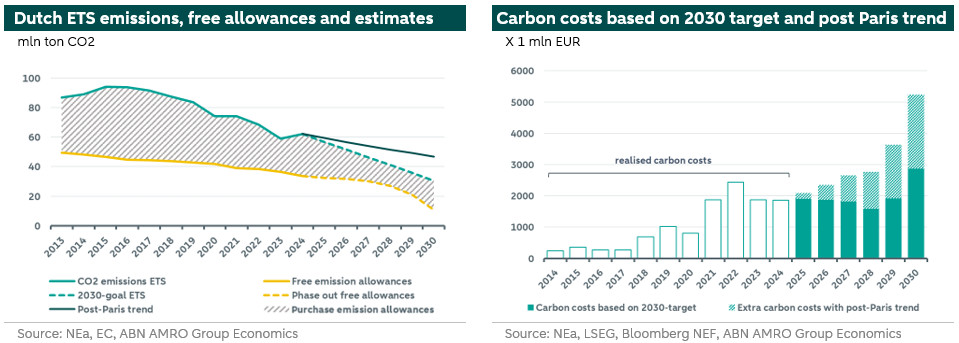
According to estimates by ABN AMRO's Group Economics, the upward trend in CO2 prices is set to continue in the longer term. Our 2034 CO2 price forecast is based on approximately EUR 200 per ton of CO2 in 2035, compared to the current level of EUR 78 per ton of CO2 (for more information, see our publication ). This means that carbon costs for companies covered by the ETS system will also increase in the coming years if these companies do not invest in decarbonisation. The number of free emission allowances is decreasing annually and the difference must be purchased at primary market through auctions and OTC secondary markets.
This means that decarbonisation remains an important agenda item, not only for companies but also for the EU. The EU is encouraging further decarbonisation through policy (such as the EU ETS), subsidies, and tailor-made agreements. ETS companies in particular would benefit from a more structural and transparent long-term policy that would allow them to assess the long-term impact of low-carbon investments. When companies decide to invest more intensively in decarbonisation, carbon costs will ultimately decrease. In addition, clean energy and low-carbon technologies are associated with less price volatility (of energy) and less import dependency (of energy). Based on the pace of emission reductions among ETS companies since 2017 (up to 2024, which is the post-Paris reduction pathway), carbon costs will continue to rise even stronger, in line with the upward trend in the price of CO2. In 2029 and 2030, these costs could almost double compared to the trend of the 2030 target. This prospect should be convincing enough for many emission-intensive companies to continue decarbonising.
Conclusion
The EU ETS plays a crucial role in reducing CO2 emissions and encourages companies to invest in decarbonisation, but the current rate of reduction is insufficient to achieve the ambitious target of a 62% reduction in emissions by 2030. The rising CO2 price, which is expected to reach EUR 200 per ton by 2034, will place an increasing financial burden on companies that are not decarbonising sufficiently. The 35% emissions gap that threatens to emerge in the Netherlands as a result of the post-Paris reduction rate underscores the urgency of low-carbon investments, but also of structural and transparent long-term policy. Only through more intensive investment in low-carbon technologies and clean energy can companies not only reduce their costs, but also contribute to a more sustainable economy and reduced exposure to volatile energy prices. The coming years will be crucial in finding the balance between economic competitiveness and the level of investment in decarbonisation. The effectiveness of EU climate policy will be an important indicator of whether climate targets are achieved.