ESG Economist - Netherlands' emissions gap towards 2030 is growing despite progress
The Netherlands is decarbonising, and the transition is in full swing. However, the pace of the transition to a low-carbon economy is not yet sufficient to achieve the climate targets that have been set. This analysis highlights the shortfall and examines the reasons behind it. Among other things, we see that there are numerous initiatives to decarbonise and that many best practices can now be identified. However, the sectors responsible for the largest share of greenhouse gas emissions – the energy-intensive sectors covered by the EU Emissions Trading System (EU ETS) – still face a major challenge in becoming low-carbon. For many companies in these sectors, decarbonisation solutions are often within reach, but it is the preconditions that often create obstacles. In this analysis, we first examine the trend of a number of sustainability indicators for the Dutch economy and the current state in reducing greenhouse gases (GHG) in various sectors. In doing so, we look at, among other things, the feasibility of the 2030 climate target per sector. We then take a closer look at the portion of emissions covered by the EU ETS and how energy-intensive sectors in industry are performing. Specific industrial climate targets are discussed, including the most obvious decarbonisation options. We end this analysis with a conclusion.

Within many sectors of the Dutch economy, the transition to a low-carbon or carbon-free way of working is now in full swing
However, the climate targets set are not yet within reach
In order to achieve the climate targets, it is important that decarbonisation in energy-intensive industries is supported and encouraged
The EU ETS has proven to be a valuable instrument in the fight against climate change and in promoting sustainability
However, a real acceleration in decarbonisation is being hampered by high investment costs, the long lifespan of existing installations, limited infrastructure, and uncertainty about preconditions such as grid capacity and the supply of raw materials
These challenges – as well as the changing geopolitical context – require attention. On balance, there is still much to be done
The climate challenge facing the Netherlands requires not only greater climate ambition on the part of businesses, but above all consistent choices and leadership from the government
Decarbonisation efforts in the Netherlands
Decarbonisation—i.e., the removal or reduction of emissions, particularly carbon dioxide (CO2)—can be achieved in several ways, and the best practice decarbonisation technique varies greatly by sector and company. For companies in one sector, fuel substitution may be the most promising option, while companies in other sectors may benefit more from electrification and efficiency measures. The ecological benefits of many climate measures taken by companies often go hand in hand with economic benefits. For example, an energy efficiency measure will reduce the energy and fuel consumption of many processes, thereby saving costs. Furthermore, shows that companies with low GHG emissions often have higher revenue growth. They are also more resilient to negative shocks (mainly due to a more loyal customer base), have lower operating costs (greater efficiency), and lower capital costs (less risk).
Many low-carbon technologies are now available (see also our publication ). However, many of these technologies are still under development or involve relatively high investment costs. In addition, some assets (particularly in industry and transport) have a relatively long lifespan, which makes investment decisions even more complex. Ultimately, the Netherlands is striving to achieve a low-carbon economy without compromising its international competitiveness. Because the Netherlands has an open economy and exports are an important part of the Dutch revenue model, it is essential to maintain competitiveness. In theory, Dutch companies would therefore benefit more from a gradual transition to a low-carbon economy, so that their existing competitive position is maintained or the ultimate damage to it is limited. However, this gradual transition makes the challenge of achieving the 2030 decarbonisation target greater.
The European Green Deal aims for climate neutrality by 2050. The Netherlands is also bound by this. The positive news is that many sustainability indicators show progress in becoming more sustainable. For example, energy productivity – more output with less energy – has increased more strongly in recent years. Energy and emission intensity has also decreased in many sectors, partly due to the decline in final (fossil) energy consumption.
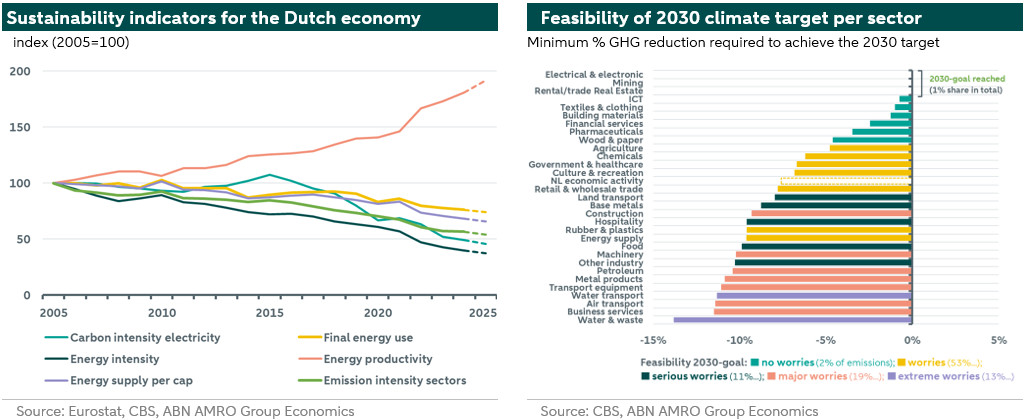
Every part of the Dutch economy has a role to play in achieving the climate targets. In some sectors, this role is greater than in others. In many sectors of the Dutch economy, the transition to a low-carbon or carbon-free way of working is already in full swing. The 2030 target (55% emission reduction compared to 1990 levels) has only been achieved or is within reach for a small number of sectors. However, the sectors responsible for the most greenhouse gas (GHG) emissions still face a relatively large climate challenge in making their processes and products low-carbon. These are the energy-intensive sectors, such as the chemical industry, the food industry, the paper industry, the oil industry, and the basic metal industry. The transition in these sectors is often much more complex and still faces many obstacles. The building materials industry is also an energy-intensive sector, but the climate challenge for this sector is currently lower than for other energy-intensive sectors.
EU ETS trends in the Netherlands
Under the EU Emissions Trading System (EU ETS), the largest emitters of greenhouse gases in the energy supply and industrial sectors must pay for every ton of CO2 they emit in excess of their allowances. Under this system, large emitters are allocated a certain amount of free emission allowances, and the negative balance with actual emissions must be settled at the CO2 price per ton of CO2. By reducing the number of free emission allowances each year, the EU aims to force businesses to reduce their GHG emissions. The annual reduction in free emission allowances, in turn, puts upward pressure on the EU ETS auction price for an emission allowance. On balance, this system has proven to be a valuable tool in the fight against climate change and in encouraging decarbonisation in the business community. Currently, 99% of GHG emissions from energy supply are covered by the EU ETS, and in industry this represents approximately 78% of total industrial emissions. Companies that are not covered by ETS-1 will be subject to ETS-2 from 2028 onwards.
The figure on the left below shows the ratio of ETS emissions to emissions not covered by the EU ETS system. Approximately 60% of total Dutch emissions are not covered by the EU ETS. The remaining 40% concerns ETS emissions, of which industry accounts for the lion's share with a 61% share. Energy supply is responsible for the majority of the remaining ETS emissions. The ultimate goal of the EU ETS is to reduce CO2 emissions by 62% in 2030 compared to 2005 levels.
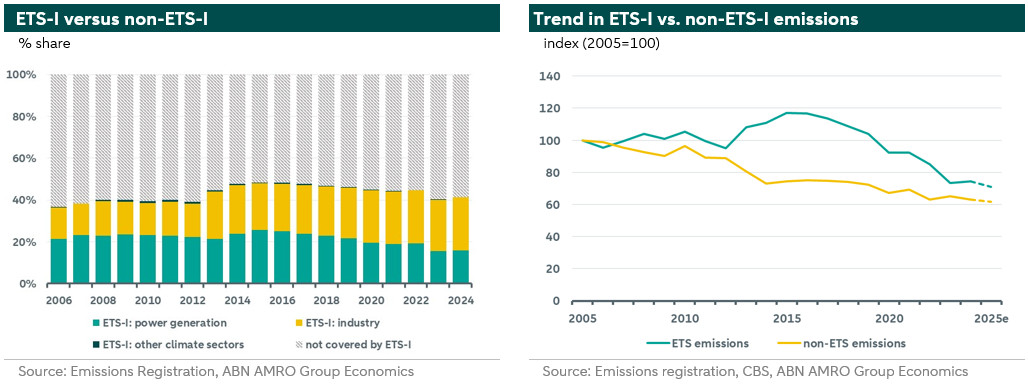
The positive impact of the EU ETS on CO2 emissions is evident from the figure on the right above. Emissions levels have fallen for both energy supply and industry compared to 2005. The increase in industrial emissions in the period 2012-2016 is mainly due to more industrial installations being added to the EU ETS. After 2016, emissions declined again. In 2024, approximately 330 Dutch companies and installations were covered by the EU ETS system. More recent figures are not yet available. At the beginning of April 2026, the Dutch Emissions Authority (NEa) will publish the emission figures for the installations over the year 2025.
In the figure below, we have only shown the industrial ETS emissions (CO2) per company. This concerns a total of 177 companies. The horizontal axis shows the total industrial ETS emissions. These are the cumulative emissions, whereby the emissions of all industrial companies are added together. Each separate block or bar in the figure represents an individual company, with the width of the block or bar representing the amount of emissions from that company. The wider the block or bar, the more emissions the company emits. The color of the block or bar indicates the sector in which the company operates. This immediately shows that Tata Steel IJmuiden—active in the basic metal industry—is the company with the highest emissions in the Netherlands. We can also conclude from the figure that the emissions of companies active in the chemical industry are well represented within the EU ETS.
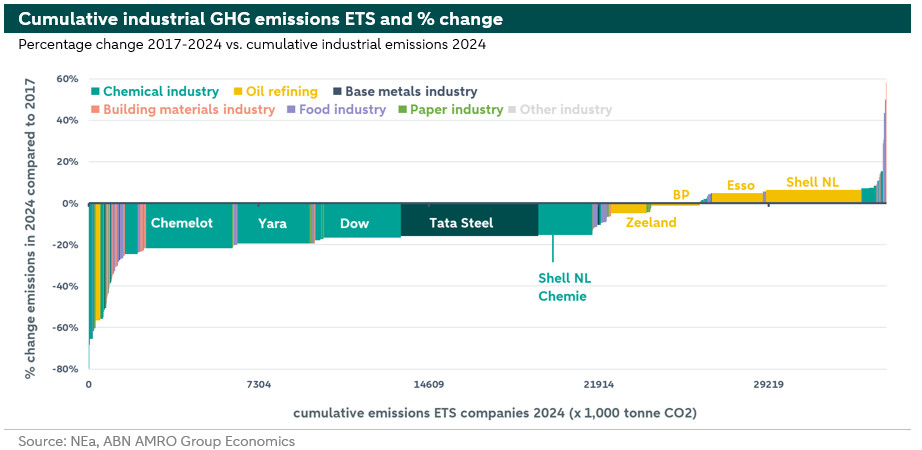
The vertical axis shows the percentage change in CO2 emissions in the period 2017-2024 (the post-Paris Agreement period). For the companies on the far right of the figure above the horizontal axis, emissions have increased, while for the companies on the left of the figure below the horizontal axis, emissions have decreased. By doing so, an EU ETS decarbonisation curve for Dutch industry emerges. The large chemical companies (including Chemelot, Yara, Dow, and Shell NL Chemie) and a number of smaller installations have reduced their GHG emissions, while on the right side of the figure there are still a significant number of chemical companies that have not succeeded in doing so. All 40 companies whose GHG emissions increased in the period 2017-2024 together account for 23% of these industrial ETS emissions. The remaining 137 companies have been more successful with their climate measures.
The companies on the decarbonisation curve can be divided into six sectors. These are the energy-intensive industrial sectors. Each of these sectors has its own unique ETS characteristics. For example, the chemical industry is well represented in the EU ETS, some mainly large companies in the oil industry have not succeeded in reducing their emissions, and the trends in the base metals industry mainly relate to Tata Steel IJmuiden. Furthermore, emissions in the paper, food, and building materials industries are much more fragmented across multiple companies. Finally, concerns about the feasibility of the 2030 climate target in the paper and building materials industries are much less, as we noted earlier. Five of the six energy-intensive industrial sectors are shown in the figure below based on five indicators. The oil industry is missing from this overview, as much of the data needed to make the calculations was not available or was limited.
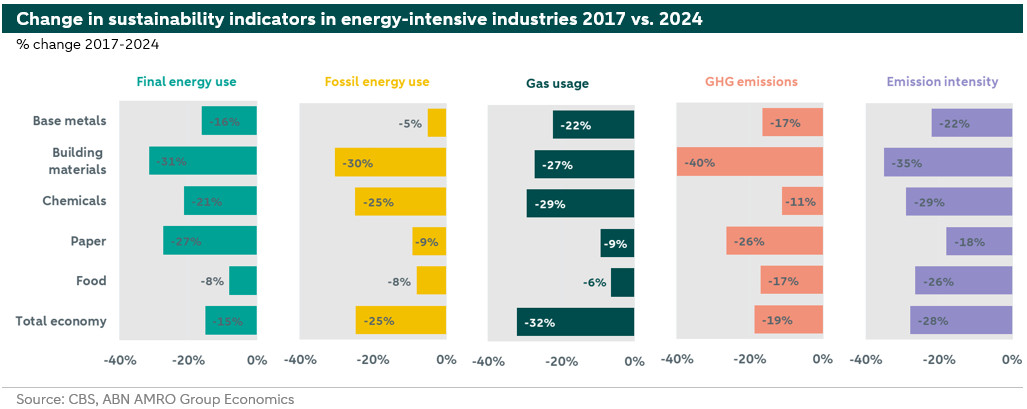
The above overview shows that companies in these sectors have clearly taken steps towards decarbonisation. In all sectors, the change in the indicators over the period 2017-2024 has a positive effect on climate targets. The building materials industry shows the best results across the board, with the strongest decreases of all energy-intensive industrial sectors in the period 2017-2024 in final and fossil energy consumption, GHG emissions, and emission intensity. This is also true in relation to the economy as a whole. The chemical industry is also showing good results. However, it is striking that GHG emissions are declining less rapidly than the other indicators. This is because this industry emits a wider range of greenhouse gases than the other sectors. A reduction in fossil energy and gas consumption mainly relates to CO2 emissions. The food industry has more difficulty reducing energy and gas consumption. This is because this sector is much more dependent on gas in the production process than other sectors. As good alternatives are not yet readily available on a large scale, this makes the transition in this sector more complex. The basic metals industry—particularly steel production—faces a similar problem, as this sector is still highly dependent on the consumption of coking coal for steel production.
Industrial decarbonisation targets
Decarbonising emission- and energy-intensive industries deserves special attention in the climate targets for 2030 and beyond, as this is where the greatest climate gains can be achieved on balance. And those climate targets are not yet within reach. Our calculations in an earlier analysis (see ) revealed that with the reduction in CO2 emissions in 2024, ETS emissions will be approximately 50% below 2005 levels. This seems to put the ETS 2030 target of -62% compared to 2005 within reach. However, the same analysis showed that if the emission reduction path set out in the Paris Agreement (the 'post-Paris reduction rate') is maintained, there will still be an emission gap of 20% in 2030. In addition, the share of energy-intensive industrial sectors is large, see also the figure on the left below. This paints an unfavorable picture of the feasibility of the transition.
The chemical industry in the Netherlands in particular accounts for a significant share of total industrial greenhouse gas emissions. The production process in the chemical industry is also one of the most polluting and energy- and raw material-intensive processes. Many of the end products or semi-finished products from the chemical industry find their way into other sectors and processes. In recent years, the chemical industry has invested heavily in cleaner production facilities, such as heat pumps and heat and cold storage. However, the most relevant decarbonisation options for the chemical industry are carbon storage, electrification, and fuel substitution. However, determining which technology is most suitable depends heavily on the chemical process.
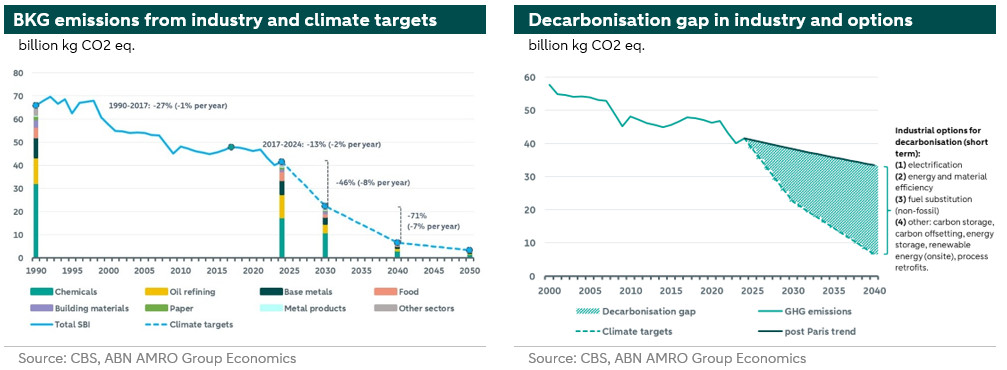
Despite increasing investments in clean energy and decarbonisation technologies (and innovation in this area) in recent years, the structural pace of GHG emission reductions is still insufficient. This is also evident from the figure on the right above. At the rate of emission reduction from the period 2017-2024 (the post-Paris Agreement period), the 2030 climate target is not within reach. This is partly due to the preconditions for achieving further acceleration in emission reduction, such as the structural shortage of personnel, the limited network capacity for electrification, and the uncertainty surrounding the supply of raw materials.
In order to achieve the 2030 target, it is necessary to deploy the decarbonisation technologies with the greatest impact on a larger scale, particularly in energy-intensive industrial sectors. It is obvious that more investment is needed in network capacity for further electrification. In addition, transparent, supportive, and stimulating government policy remains indispensable in order to keep the course towards climate neutrality in sight. Only then will greater efforts by industrial companies have a better chance of success. All the efforts being made now will help to make the transition to climate neutrality towards 2050 smoother and more affordable.
Conclusion
Decarbonisation is clearly gaining momentum in the Netherlands and is delivering not only ecological but also economic benefits to businesses. However, there is still much to be done. The pace of emission reduction is insufficient and progress is being hampered by, among other things, high investment costs, the long lifespan of existing installations, limited infrastructure, and increased uncertainty about grid capacity and the supply of raw materials in a changing geopolitical context. All of this requires a great deal of attention. Many sectors, particularly energy-intensive industries, are still lagging behind the reduction path needed to achieve the 2030 target, despite the availability of increasingly low-carbon technologies. Accelerating the transition increases the likelihood that the Netherlands will be able to achieve its climate goals without losing too much of its international competitiveness. However, this task requires greater climate ambition from companies, as well as consistent choices and leadership from the government. Only when all the pieces of the puzzle fall into place simultaneously can the pace of decarbonisation reach the desired level.