Eurozone goods consumption plummeting
Germany and France have published data for retail sales and goods consumption in April in recent days. The volume of retail sales in Germany dropped sharply lower in April, while France's real household expenditure on goods declined as well. The levels of both series ended up far below the pre-pandemic trends. Despite the drop in goods consumption, total consumption still should expand in the coming quarters.

Goods consumption slows sharply ...
Germany and France have published data for retail sales and goods consumption in April in recent days. In Germany the volume of retail sales fell by 5.4% mom in April, after it increased by 0.9% in March. In France the volume of household expenditure on goods fell by 0.4% mom in April after it dropped by 1.4% in March. The data for France and Germany are not comparable as France’s goods consumption data includes cars, whereas Germany’s retail sales do not. To make the numbers more comparable we have added data for new car registrations in Germany to the retail sales data. The resulting weighted average index fell by 6.5% mom in April after it increased by 1.8% in March. The level of France’s goods consumption stood at around 5.5% below the pre-pandemic trend level in April, while the comparable gap in Germany was 8.5%.
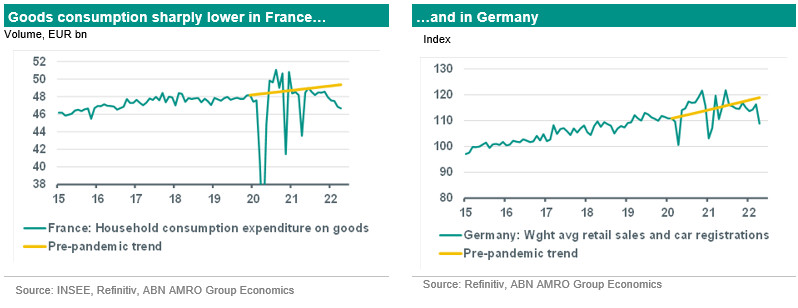
The detailed data shows that the volume of consumption of food products fell particularly sharply in Germany (-7.7% mom) and France (- 1.1%). The monthly drop in consumption of food products in Germany actually was the sharpest drop since the start of the series in 1994. On top of that, non-food consumption also fell noticeably in April, with durable goods consumption declining by 0.7% mom in France and consumption of non-food items dropping by 4.4% mom in Germany. Finally, consumption of car fuel roughly stabilised in Germany in April, while it fell by 0.9% mom in France.
... but total consumption should still expand
The volume of goods consumption is probably depressed by a number of factors at the moment. To begin with, the high level of inflation reduces the volume of purchases, as consumers are forced to cut back purchases in response to price rises or to downsize. Having said that, even Germany’s nominal retail sales declined in April (-4.7% mom). Another factor that probably depresses consumption of goods at the moment is a sharp rebound in consumption of services after the unwinding of lockdowns and social distancing measures throughout the eurozone. Finally, goods consumption is probably being reduced by long delivery times due to supply chain problems, particularly for durable goods such as household equipment and transport equipment. Therefore, we do not think that the current weakness in goods consumption implies that total consumption will contract in the coming quarters. As we mentioned in our Global Monthly (see here) eurozone consumption growth will be supported in the coming quarters by consumers spending part of the savings they accumulated during the pandemic, as well as by still healthy growth in employment. We expect total consumption growth to slow more fundamentally and more broadly amongst all categories of spending towards the end of this year. We have pencilled in total private consumption growth of around 1.7% in 2023, following expected growth of 3.5% in 2022.