Eurozone PMIs signal sharp drop in GDP moving into Q4

The eurozone PMIs staged another decline in October. The composite PMI, which is a weighted average of the manufacturing and services PMI and a good tracker of GDP growth, declined to 47.1, down from 48.1 in September. This drop in the composite PMI clearly signals that the pace of decline in eurozone GDP intensified moving into Q4. This is in line with our base scenario for the eurozone economy of a modest contraction in GDP in Q3 and a sharper contraction in Q4.

The eurozone PMIs staged another decline in October, which was in line with expectations. The manufacturing PMI fell to 46.6, down from 48.4 in September and the services sector PMI declined to 48.2, down from 48.8 in September. As a result, the composite PMI, which is a weighted average of the manufacturing and services PMI and a good tracker of GDP growth, declined to 47.1, down from 48.1 in September. The drop in the composite PMI clearly signals that the pace of decline in eurozone GDP intensified moving into Q4. This is in line with our base scenario for the eurozone economy of a modest contraction in GDP in Q3 and a sharper contraction in Q4 (we have pencilled in -0.2% qoq and -0.9% qoq, respectively).
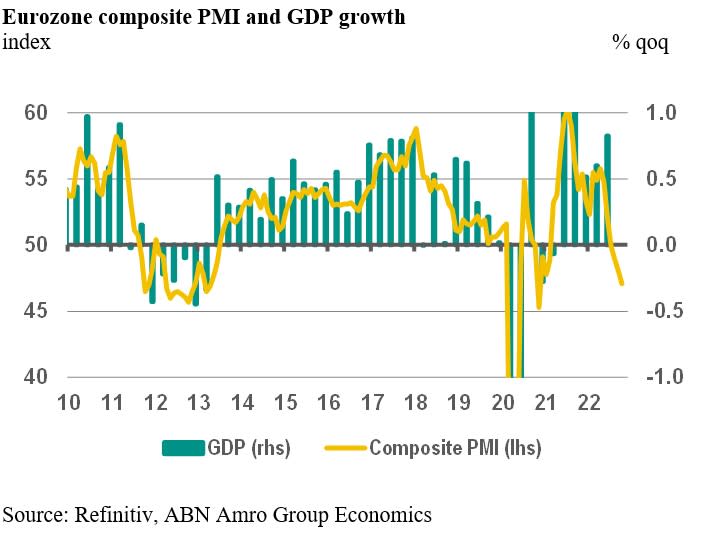
The more forward looking details of the PMI report reveal that there is more weakness ahead. The new orders component of the manufacturing PMI dropped to 37.8 in October, down from 41.3 in September and the new business component of the services PMI fell to 47.6, down from 48.2. On a positive note, the employment component of the composite PMI was broadly unchanged in October and stayed at a level (52.6) that is consistent with modest employment growth. Indeed, the post-pandemic tightness in some parts of the eurozone labour market is still supporting employment growth for now, but we think this effect will peter out towards the end of the year, when the unemployment rate is expected to start rising. The parts of the PMI report that gauge price pressures showed some easing in October (particularly the input prices index in manufacturing) although the index remained at historically high levels. Still, the decline in the input price index probably reflects the drop in global commodity prices in the past few months, which should also result in declining food- and energy price inflation in the coming months.