Eurozone - Resilient, but bruised… alors, encore?

The eurozone weathered another turbulent year in 2026, with the German fiscal expansion and resilient consumers offsetting the latest energy shock, and intense external competitive pressures. Growth to slow in 2027 on tighter fiscal and monetary policy and falling employment, but eurozone resilience should live to fight another year. The ECB’s new president could face some challenging judgement calls next year, not least over France. We expect a pivot from rate hikes to cuts as inflationary pressure eases and growth slows.

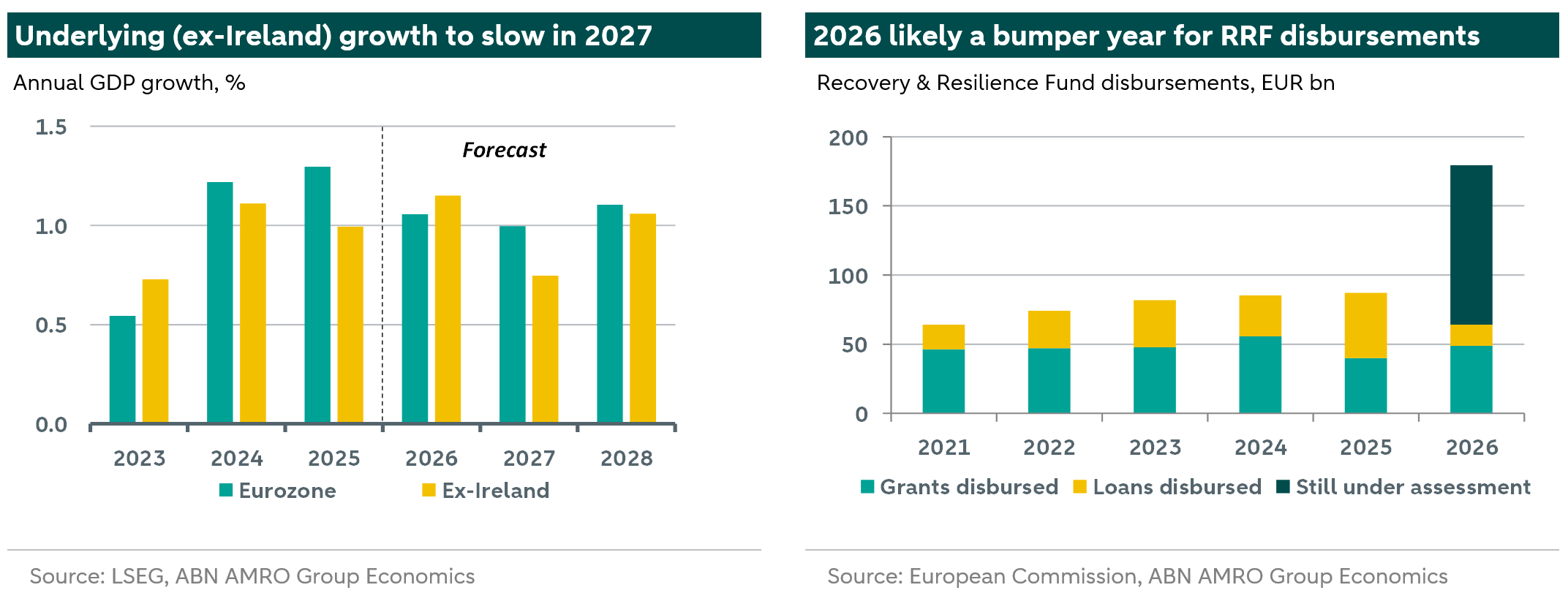
The eurozone economy has taken some serious knocks over the past few years: a pandemic, a historic rise in US tariffs, and now two energy supply shocks. It has almost become an annual tradition. And yet the economy has continuously dodged recessions when it would have been reasonable to expect one. Rather than recession, we find ourselves reaching for that other R word – resilience. Is it going to stay that way? We think that it will, but the headwinds from inflation, falling employment, tighter fiscal and monetary policy, and weak external demand are likely to weigh more heavily, while the risks from France’s fiscal woes are coming into sharper focus. All told, we expect underlying (ex-Ireland) eurozone growth to slow to 0.7% next year, from an expected 1.2% outturn this year.
To assess the outlook, it helps to first understand why the economy has held up so well. While the usual volatility in Ireland’s output muddies the picture of headline GDP growth, underlying growth accelerated in 2026 to 1.2% from 1.0% the year before. As expected, the German fiscal bazooka finally kickstarted the eurozone’s biggest economy. And although we have been disappointed by the lack of accompanying reforms to stimulate the private sector (see Germany), the spending boost definitely helped to soften the blow from yet another energy shock. Also supportive were the final Recovery & Resilience Fund (RRF) payments: 2026 is likely to have been a bumper year as countries rushed to meet project milestones to qualify for disbursements before the closure of the programme in August. Some EUR115bn in requests are still under assessment, but if all are approved, disbursement would be almost double that in 2025, at EUR177bn (1.1% of eurozone GDP). This is likely to have supported growth in the biggest recipients in southern Europe, though it also raises risks of a mini ‘fiscal cliff’ for these economies next year. Indeed, the overall fiscal stance is expected to go from being a clear positive in 2026 to a mild negative in 2027, with Germany’s ongoing fiscal expansion offset by the end of the RRF as well as an expected modest fiscal consolidation in France. Given bond market developments, the risks look tilted to additional pressure on governments to reduce deficits rather than less.
The external environment is also expected to weigh on growth. This year has been a mixed bag. The drag from US tariffs (remember those?) eased, with exports to the eurozone’s biggest trade partner picking up again – likely helped by robust US growth. Trade with China was another story, with exports continuing to stagnate, partly thanks to China’s rapid shift to EVs and Europe’s failure to keep up with Chinese EV makers. This has been a triple whammy for Europe’s carmakers, with intense competition in China, third countries, and in Europe itself (see here for more). More broadly, European industry continues to face structural challenges from high energy prices – this year exacerbated by the latest energy shock – as well as the EV transition. These headwinds are unlikely to relent in 2027, though they will be helped by the expected fall in energy prices, and perhaps further EU-China agreements to ease the competitiveness pressures in the car sector. Industry is also seeing some lift from higher defence spending, though the overall boost to GDP growth for now is offset by the drag from higher imports. Further progress with import substitution in the defence sector would help turn higher spending into more of a growth impulse (as we argued last year, also here), but this is slow-moving. We therefore expect net exports to continue to be a mild drag on growth in 2027.
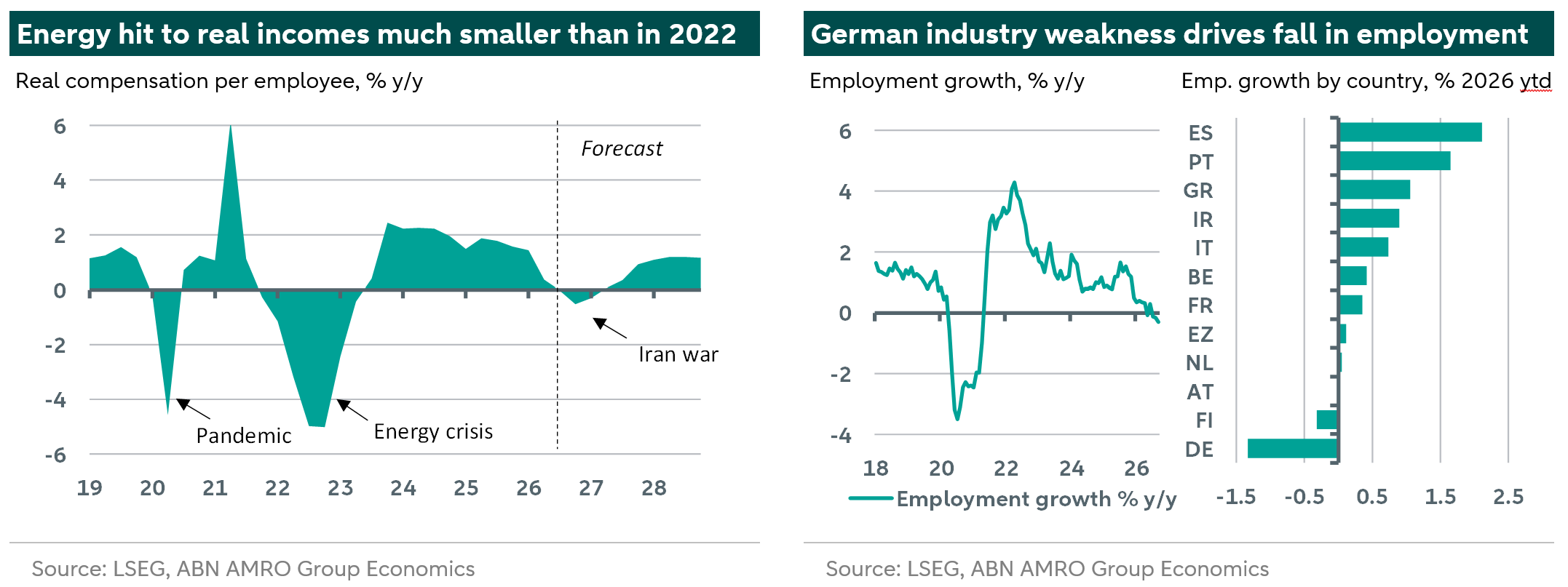
What about households? They have so far weathered the latest energy shock both better and differently to in 2022-23. Better, because the shock to real incomes is itself much smaller: we expect only a mild negative drag in real compensation per employee compared with the peak drop of around -5% in 2022. Differently, because the response to shocks also seems to have shifted, suggesting households may be adjusting to the new normal. In 2022-23, households raised their savings rates as governments doled out support to cushion the shock. This time, perhaps also linked to the more measly government support, households have lowered their savings rates in order to sustain consumption growth. Savings rates are still on the high side, suggesting caution is still high, but another way of looking at high savings rates is that it suggests households still have some buffer they can draw on if necessary. Our base case assumes households continue to slowly lower their savings rates in 2027, which should enable consumption growth to continue broadly as in 2026 at c1% annually.
There are risks to this benign view. First, although petrol prices are now falling, diesel remains elevated, and households have yet to feel the full effects from high gas and electricity prices due to the lagged pass-through to energy bills. Second, the rise in interest – especially mortgage – rates will slowly reach those whose fixings are coming due. Third, the labour market – which became noticeably weaker in 2026 – could also start to have a more meaningful impact. The labour market had already been on a long cooling trend, but for the first time since the pandemic, eurozone employment growth turned negative over the summer this year. Industrial weakness in northern Europe seems to be the principal driver, but economic weakness in France has also contributed. Both of these pressures are likely to continue weighing on jobs growth, while southern European labour markets could also cool given the end of RRF spending. The risk is that the labour market slowdown hits confidence, triggering a return to more cautious household behaviour.
With risks to inflation also not fully ebbing, the new ECB president (whose identity is likely to be decided at the 17-18 December 2026 EU summit) could face some difficult judgment calls next year. Our base case sees two more rate hikes at the December and March meetings, but with the energy shock fading and the economy weakening, March is looking like a close call, and the risk is that the ECB could pivot to cuts sooner than our current Q4 expectation. Aside from growth and inflation, another complicating factor could be France’s election outcomes. Polls suggest Marine Le Pen will win the presidency, but a key uncertainty is whether her party wins an outright majority at a (likely) subsequent Assembly election. This will be crucial in shaping how responsive Le Pen is to market and European institutional pressure to credibly rein in the deficit and stabilise France’s debt ratio. Our base case is for ‘muddle through’ to continue, and markets are probably pricing this, but the contradictions in Le Pen’s programme suggest the risk is tilted toward more bond market volatility and pressure on the ECB to intervene (which in our view would only happen in exceptional circumstances). Indeed, France’s debt woes are arguably the biggest risk to the eurozone outlook next year. We do not foresee a crisis, but the risks are significant (see here for more).
Staying with politics, imminent elections in Spain (29 November) and Italy (likely May/June 2027; by December at the latest) will also be important. Spain is likely to see a shift to the right, which could portend stricter migration controls that ultimately dampen Spain’s economic boom. In Italy, PM Meloni may need to rely on Futuro Nazionale, a more right-leaning coalition partner, to retain her majority, which could test Italy’s commitment to EU fiscal rules.