Eurozone inflation: Another wave, but not a repeat of 2022



This is part of a series of key themes we are exploring ahead of the publication of our Global Outlook 2027 next week.
Eurozone inflation is set to peak above 4%, as elevated energy prices are joined by rising food inflation and renewed supply-chain pressures
The inflation mix will shift during 2027: energy inflation will ease, but food and delayed pipeline pressures will keep inflation elevated
Some wage growth pick-up is likely, but looser labour markets and high interest rates should prevent a repeat of 2022–23 wage-price dynamics
Introduction
Several overlapping supply-side shocks are reinforcing inflationary pressures. The conflict in the Middle East has triggered an energy price shock and renewed supply chain disruptions. At the same time, the global AI investment boom is raising demand for selected intermediate goods, infrastructure components and transport capacity while adverse weather and El Niño are putting upward pressure on agricultural prices. As a result, eurozone inflation has been trending up in recent months and reached 4% in October.
These shocks affect inflation through different channels and at different speeds. Energy prices have an immediate direct effect and a delayed indirect effect through production costs. Supply bottlenecks create pipeline pressures for goods and services, while agricultural shocks feed into food prices. The ultimate persistence of the inflation impulse will depend on whether it raises inflation expectations and wage demands, generating second-round effects. The ECB is keenly watching for signs of this, particularly in wage growth indicators, to ensure inflation does not become a longer lasting problem.
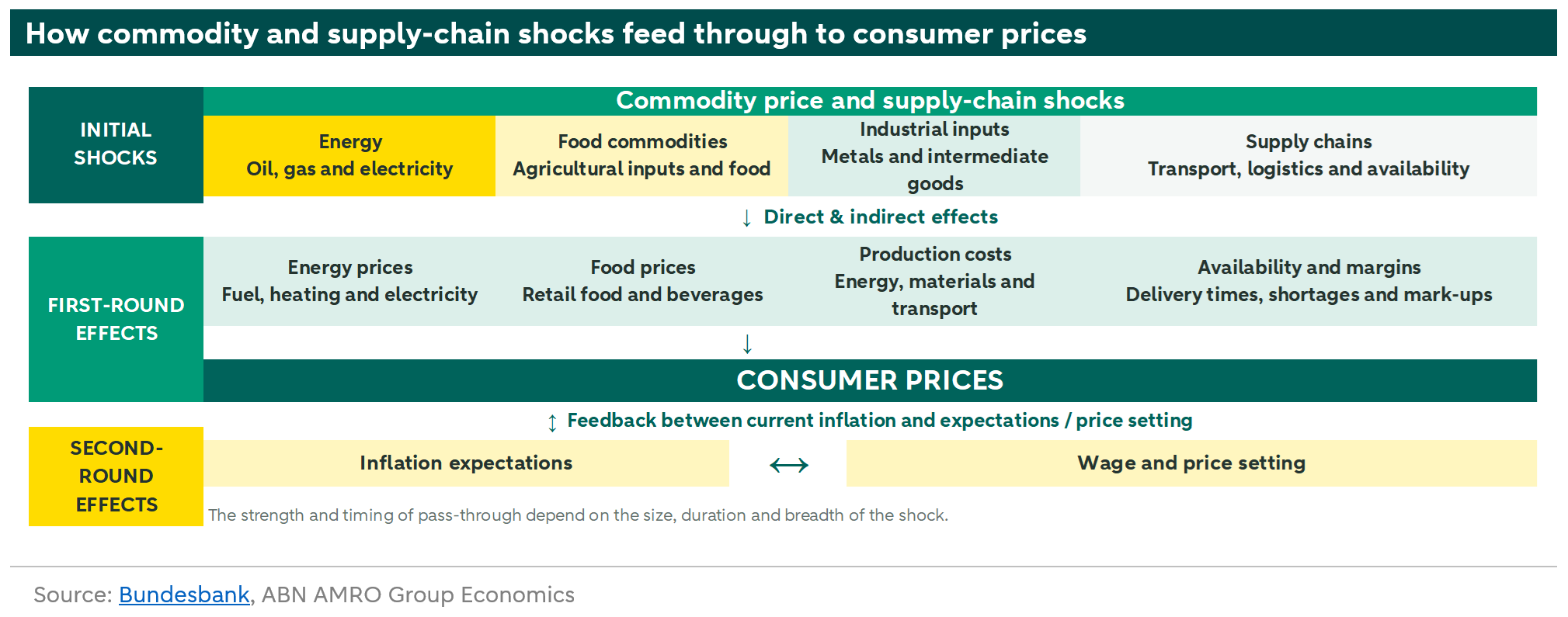
Energy shock: Petrol and diesel surge, household energy bills less so
We start by assessing the current energy price shock, which is considerably smaller and narrower than the shock experienced in 2022-23. Petrol and diesel prices have reached around 90% of peak recorded during the previous energy price shock. By contrast, natural gas and electricity prices stand at only around 30% of their earlier shock peak levels.
Across energy components, the inflationary impact also differs. Higher petrol and diesel prices pass on to consumer inflation relatively quickly and directly, immediately weighing on households’ purchasing power. The share of petrol and diesel in the inflation basket amounts to roughly 4% in the eurozone aggregate, and explain a large share of the recent rise in energy inflation. On the other hand, the transmission of wholesale gas and electricity prices is generally slower and depends on national market structures, regulatory arrangements, and utility companies’ procurement strategies. In , for instance, utilities follow relatively risk-averse procurement strategies and hedge a substantial share of their energy requirements through forward contracts. As a result, changes in spot prices reach households only gradually. Similarly, in the Netherlands, there is a large share of fixed energy price contracts, which means that households are protected against price rises for some time. Pass-through to inflation is therefore slower than for petrol and diesel. In some eurozone countries, such as Spain and Italy, the pass-through can be faster, but for the aggregate it is also gradual.
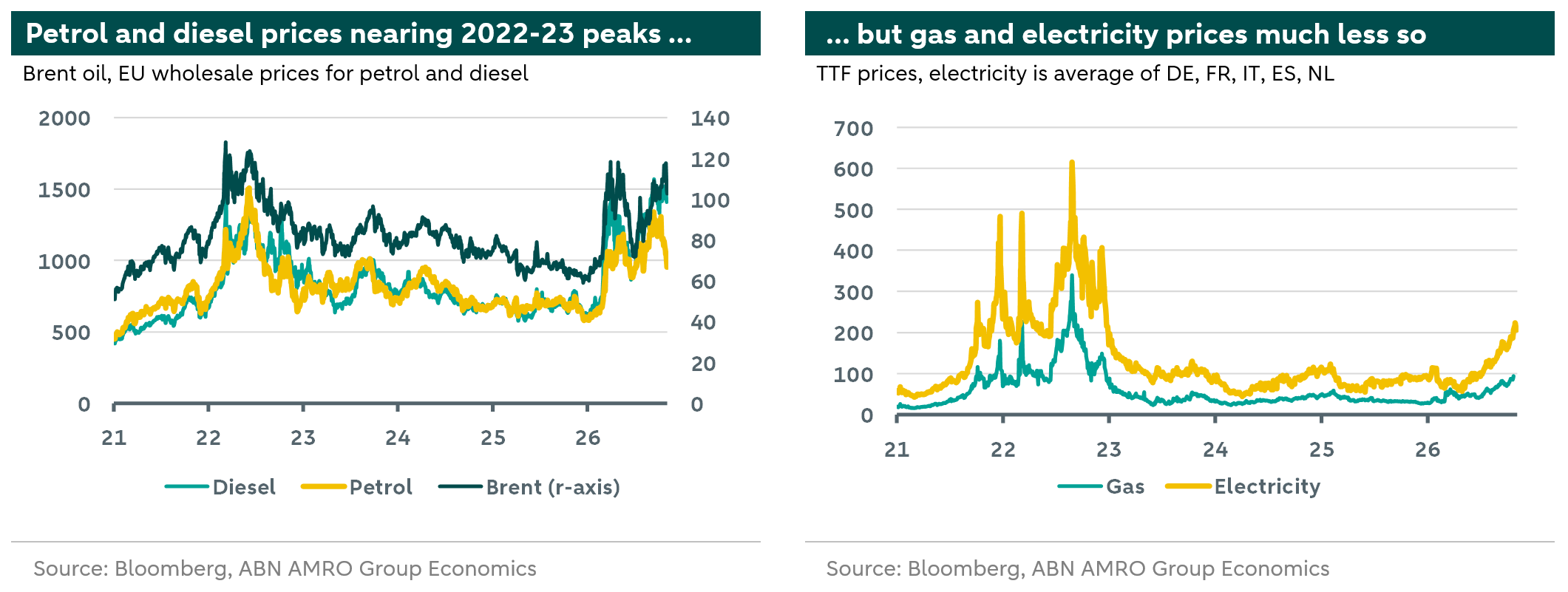
We expect easing supply shortages to bring down oil prices in the course of 2027. Similarly, new LNG capacity should lower European gas prices in 2027, although they are likely to remain above pre-war levels. Petrol and diesel prices, however, are expected to remain high through most of 2027 because of limited refinery capacity, with the market normalizing only in 2028 (read more here on our energy price outlook). Taken together, this means that energy inflation will stay elevated in 2027, and only begin to weigh on inflation in 2028. Should energy prices develop adversely to our base case, this would constitute upward pressure on our inflation figures.
Higher energy costs and rising pipeline pressures
Higher energy prices also affect inflation indirectly by raising the cost of producing goods and providing services. Think for instance of airfares and transportation. The impact depends on the energy intensity of production and the fuel type used, making the distinction between refined products, gas, and electricity prices important. The data shows that energy-intensive services prices have recently trended up, but still well below the peak in 2022-23.
Beyond energy, goods producer prices are also showing renewed upward pressure, aided by AI capex demand. This is visible in the ABN AMRO supply bottlenecks indicator, which indicates more supply bottlenecks / excess demand, and in the recent Dutch PMIs, which signal an increase in delivery times and scarcity of electronic components.
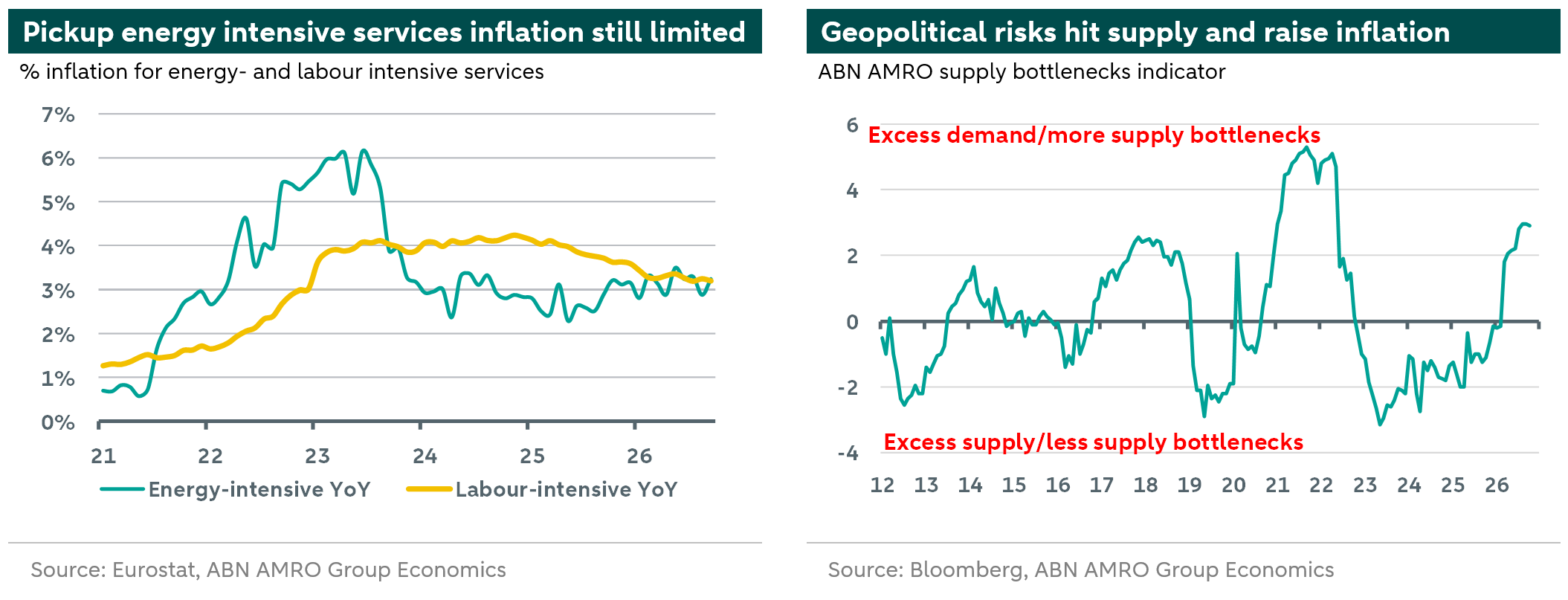
Changes in producer prices tend to precede corresponding movements in consumer prices, as firms require time to adjust their prices, while pricing power also varies. Higher input costs first feed into the production costs of consumer goods manufacturers. These producers may subsequently adjust their selling prices, which then pass through to final consumer prices with a further . The speed and extent of the pass-through also depend on the strength of aggregate demand. For instance, in the previous energy crisis, households entered with substantial excess savings and a strong willingness to pay coming out of the pandemic. encountered constrained supply, enabling firms to pass rising costs through more rapidly. The current environment is somewhat different, as there is limited pent-up household demand and geopolitical uncertainty. Reflecting the delayed transmission and forward-looking indicators, our forecast incorporates stronger pipeline pressures for goods inflation.
A perfect storm for food inflation?
Food inflation has been remarkably benign in recent quarters. However, leading indicators suggest upward pressures are building, and as discussed in our recent publication, we expect food inflation to start rising again in late 2026 and into 2027. The increase will likely be driven by higher agricultural commodity prices, weather-related disruptions, and energy-related pressures. However, the supermarket prices indicator suggests that the food-price response to the energy shock associated with the conflict in the Middle East has so far been weaker than in 2022 following Russia’s invasion of Ukraine. Repricing initially increased across a broad range of food categories but subsequently stabilised, whereas in 2022, the repricing wave went further. The eventual impact on retail food prices will depend on the duration of the shocks, harvest outcomes, and the extent to which producers and retailers absorb higher costs in their margins.
Forecasts suggest a very strong El Niño event will develop in 2026-27, potentially reaching unprecedented intensity (see ). The impact of El Niño is likely to be more mixed – not all agricultural commodities are affected in the same way – but most studies suggest a net upward effect on food prices that could persist for an extended period (for instance, see a report by the about this topic). At the same time, several factors dampen the impact on food inflation. Global inventories remain ample, many firms are protected by existing energy contracts, and retailers appear reluctant to fully pass higher costs on to consumers. As a result, increases in commodity prices usually pass through to food inflation gradually and partially. All told, our base case sees food price inflation rising from 1.3% currently to a peak of 3.8% by Q3 2027. This will add 0.5pp to eurozone HICP inflation, partially offsetting the likely drag from easing energy prices at that point.
Food inflation is particularly relevant as it plays a large role in the formation of household inflation expectations. It could therefore also influence wage demands, and thereby increase the risk of second-round effects.
Second-round effects on wage growth?
Ultimately, the persistence of higher inflation will hinge on whether higher headline inflation feeds into inflation expectations and, in turn, wage growth. With labour costs a major component of services prices, stronger wage growth is likely to keep services inflation elevated. Because services account for nearly half of the eurozone HICP basket and prices adjust relatively slowly, developments here will be crucial. This dynamic was also evident during the 2021/22 inflation surge: energy, food and goods prices rose first, but services inflation followed with a lag and ultimately proved to be the long tail of the inflation wave.
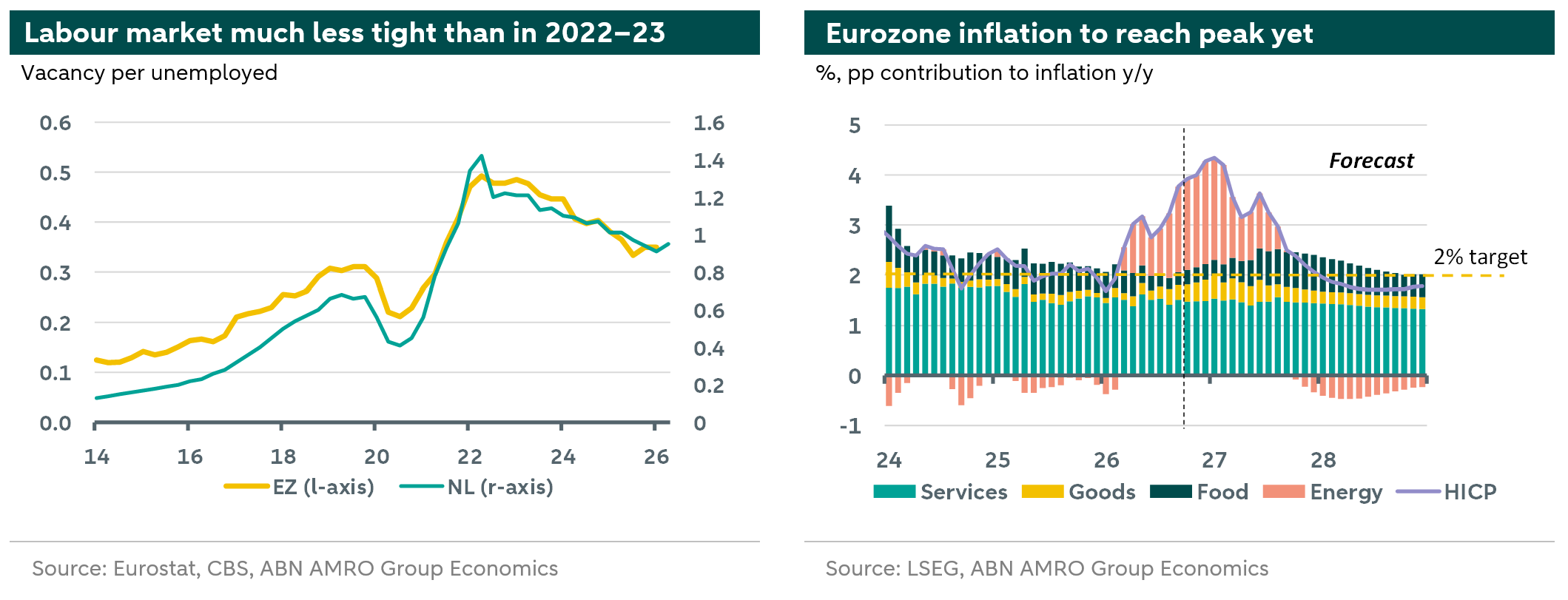
In our summer outlook in July, we concluded that wage growth would stay elevated but that we would not see a 2022-style acceleration. Since then, the energy shock has become much more prolonged in our base case, and we now expect headline inflation to peak well above 4% and to stay elevated for much of 2027. The higher and more persistent inflation we’re seeing is likely to trigger some pick-up in wage growth over the coming quarters. Still, there are three major differences between this shock and the previous one, which give us confidence that we won’t see a repeat of that episode on the same scale: 1) the current shock to energy prices is still much smaller than in 2022, 2) labour markets are still much looser than they were back then (as reflected in the job vacancy ratio, see chart below), and 3) interest rates are already much higher than they were at the beginning of the last shock, and we expect further rises – this should keep inflation expectations well anchored.
Wage growth remains an important indicator to watch, particularly given the expected surge in food inflation and the impact this can have on expectations. But our base case sees only a modest increase in wage growth. This is more likely to slow the ongoing services disinflation rather than drive a substantial renewed acceleration.
Looking forward
We expect eurozone inflation to pick up further over the coming months and to stay elevated, as higher food inflation and pipeline pressures partly offset easing energy inflation in 2027. Coming alongside prolonged elevated energy prices is the risk that higher food prices could raise household inflation expectations and wage demands. Various measures of wage growth and inflation expectations are therefore going to be key indicators to watch in 2027 for signs of an even more persistent inflation wave. Ultimately, we expect the combination of looser labour market conditions and high interest rates to keep inflation expectations well anchored, and this should prevent a repeat of the persistent inflation dynamics seen in 2022-23. Another inflation wave is coming, but it should have a shorter tail.