We need to talk about France


This is part of a series of key themes we are exploring ahead of the publication of our Global Outlook 2027 next week.
A Le Pen presidency is unlikely to lead to a crisis: market pressure and the constraints of office could produce some ‘Meloni-isation’
Our base case is continued muddling through, with a diluted 2027 budget and tactical voting leaving RN short of an Assembly majority
The tail risk is an RN majority that allows fiscal slippage and confrontation with European institutions to reinforce one another
(I) Would a president Le Pen ‘do a Meloni’?
Probably. But there are important differences between the two. Le Pen begins from a more contradictory position than Italy’s Giorgia Meloni, while the Assembly election result will be crucial in determining how much pressure her party, Rassemblement National (RN), faces to compromise.
Opinion polls suggest Marine Le Pen is likely to win the French presidential election in April. Despite her eurosceptic credentials, a Le Pen presidency need not lead to confrontation with markets or European institutions. The more benign comparison is with Italy’s Giorgia Meloni, who entered office with a long history of euroscepticism but has since pursued a relatively cautious fiscal policy, worked with the European Commission and treated Italy’s membership of the euro as settled. Could Le Pen follow the same path?
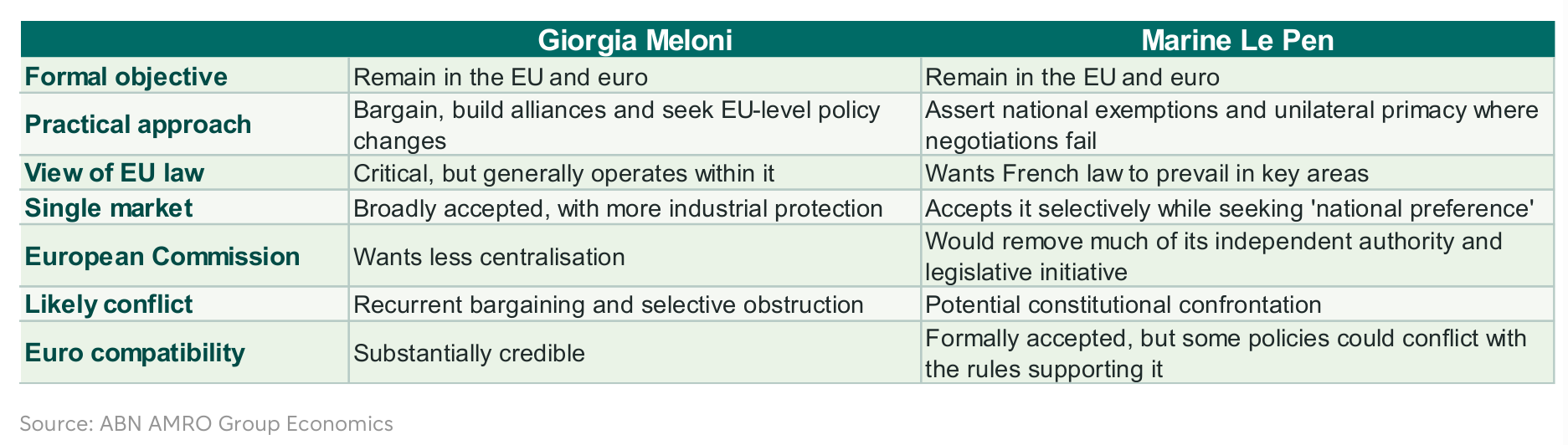
There are good reasons why she might. France’s large financing needs would make the cost of confrontation clear very quickly. A sharp rise in bond yields would increase the government’s interest bill, weaken French banks and crowd out RN’s spending priorities. A new government might also find that lower energy costs, greater industrial support (such as tackling competitive pressures with China) and tighter external borders are easier to pursue by building coalitions inside Europe than by defying it from Paris. This is broadly the lesson Meloni drew. In opposition, Brussels was a useful adversary; in government, European institutions became a source of funding, influence and policy leverage. Italy’s high debt imposed a clear market constraint, while its dependence on EU Recovery and Resilience Facility (RRF) flows gave the government a strong incentive to cooperate. To be clear: Meloni has not become a European federalist. She still favours a less centralised ‘Europe of nations’, but has mostly tried to change policy from within the existing system. Her euroscepticism is now directed against further centralisation, rather than against Italy’s membership of the EU or euro.
Le Pen would begin from an altogether more contradictory position. She has abandoned formal support for Frexit, and RN’s recent efforts to establish fiscal credibility suggest the shift might be meaningful. Yet restricting benefit entitlements for eligible EU citizens, giving French law primacy in selected areas, sharply reducing France’s EU contribution and selectively applying single market rules would require agreement from other member states or put France in breach of its obligations. Moreover, Le Pen lacks the financial incentives Meloni had to cooperate with Brussels. Italy was a major beneficiary of RRF flows, while France is a net contributor to the EU budget. France’s greater political weight might also encourage an RN government to believe that other member states would accommodate it rather than risk a systemic confrontation.
The difference is therefore both ideological and practical. Meloni has abandoned ‘exit’ euroscepticism and now seeks to reshape the EU from within. Le Pen has renounced Frexit, but parts of RN’s programme still challenge the foundations of membership, including the primacy of EU law and equal treatment within the single market. Their governing methods reflect that divide: Meloni has accepted European constraints while trying to influence policy, whereas RN has more often proposed reclaiming powers first and negotiating the consequences afterwards.
Our base case nevertheless assumes some moderation in office. Market pressure, the civil service and the practical limits of governing inside the euro would all push Le Pen towards a more cautious course. In practice, ‘Meloni-isation’ would mean delaying or diluting RN’s most expensive measures, accepting ECB independence and pursuing changes to migration, industrial and other EU policies through negotiation rather than unilateral action.
A minority government would reinforce those incentives. Without an Assembly majority, RN might be able to pass budgets through concessions and Article 49.3, provided enough opposition deputies were unwilling to bring down the government. But attempts to override EU law or force concessions from the ECB and other eurozone governments would likely lead to defeat in the Assembly or the government’s collapse.
An outright RN majority would reduce that parliamentary restraint, but it would not make confrontation inevitable. As the UK experience under Liz Truss showed, financial instability can rapidly deprive even a majority government with control over its own currency of room for manoeuvre. The relevant question is not only whether RN has the votes to pursue its programme, but how it responds when the costs become clear.
(II) Our base case: Continued muddling through
France’s fiscal outlook remains troubling, but a crisis is neither inevitable nor likely. We expect a diluted 2027 budget to pass, market access to remain intact, and the constraints of office and financial markets to produce some ‘Meloni-isation’ under a possible Le Pen presidency. An RN minority government in the Assembly should keep France on a path of muddling through and messy fiscal consolidation.
France still has time
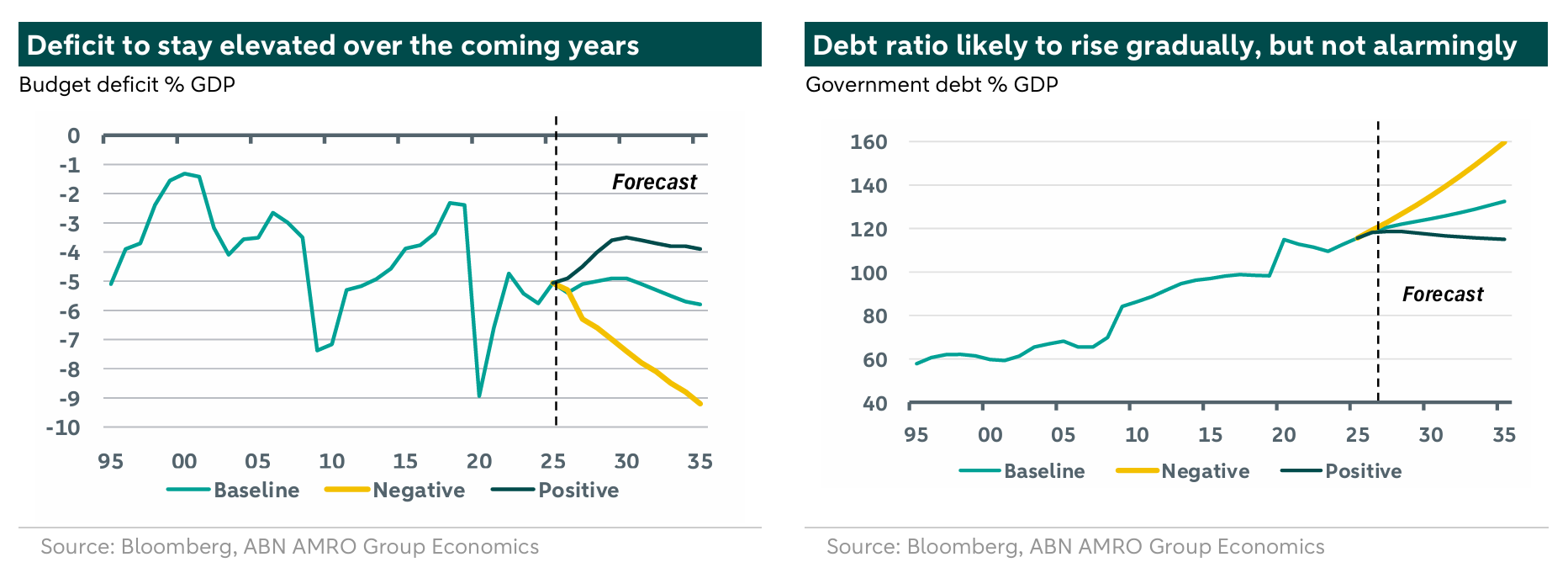
As argued in our previous note, France’s fiscal position is clearly moving in the wrong direction. Weak growth and rising interest costs are making consolidation more difficult, while the deficit remains too large to stabilise the debt ratio. But an unsustainable long-run debt path is not the same as an imminent crisis. France’s long debt maturity slows the effect of higher yields on the budget. Its bond market remains among the largest and deepest in Europe, while the ECB provides an implicit backstop against a disorderly loss of market access. These buffers buy France time, even if they do little to resolve the underlying problem.
Our base case is therefore one of fiscal drift: a deficit close to 5.4% of GDP in 2027, a debt ratio that continues to rise over the coming years, and a government bond spread vis-à-vis Germany that remain more volatile than before the political crisis began. This is a poor outcome, but it is very different from the sequence described later, in Part III.
Budget 2027: Unrest complicates things, but a budget is still likely to pass
The immediate question is whether France can pass a 2027 budget. We think it can. The government is likely to make further concessions before using Article 49.3 to force an amended package through, while Le Pen has strongly indicated a preference for some form of budget to be passed. Our base case remains that RN abstains in the subsequent confidence vote after securing sufficient concessions.
Recent unrest complicates the negotiation, but does not change this forecast. It will increase pressure to protect education and other sensitive public services, shifting the burden of adjustment elsewhere and raising the risk of execution slippage. But we still expect €25-30bn of consolidation to be delivered, leaving the deficit close to 5.4% of GDP in 2027. Passage of a budget would avoid a worsening of the deficit next year, but it would not lead to an improvement either.
Election 2027: The Assembly result will be crucial
The recent unrest probably helps Le Pen at the margin, allowing RN to present itself as the party of order. But we would not overstate the effect. The centrists have still not united around a single candidate, and a key variable will be how well – or poorly – that candidate can distance themselves from the current government. A Le Pen victory is not a foregone conclusion, even if it remains the most likely outcome (see here for more).
We expect a newly elected President Le Pen to call an immediate Assembly election. Based on current constituency models, and assuming a repeat of the tactical voting seen in 2024, our base case is that RN narrowly falls short of the 289 seats needed for a majority. This is a close judgement rather than a confident forecast: even a partial weakening of tactical withdrawals could deliver an RN majority.
The result in our base case would be another minority government: unstable and poorly placed to deliver lasting fiscal repair, but constrained from pursuing RN’s most contentious policies. Budgets could still pass through concessions and Article 49.3. Attempts to override EU law or use market pressure to force concessions from European institutions would be much harder to sustain. Together, market discipline and parliamentary constraint point towards continued fiscal drift rather than a sovereign debt crisis.
A majority would enable a crisis scenario, not make one inevitable
An outright RN majority would raise the risks by removing the main domestic constraint on RN’s programme and making budgets and a referendum on the primacy of French law easier to pass. But it would not make the Part III scenario inevitable. Le Pen could still moderate as borrowing costs rose and pressure on French banks intensified, particularly if preserving market access took priority over RN’s most contentious policies. An RN majority is therefore an enabling condition for the crisis scenario, not a sufficient one. Market pressure would still make retreat more likely. The risk is that the government instead interprets that pressure as an attack on its mandate and uses it to justify confrontation.
A majority does not confer immunity from markets
The experience of the UK under Liz Truss shows how quickly market pressure can force a change of course. Her government initially argued that markets would eventually recognise the benefits of its programme, but reversed most of its unfunded tax cuts within weeks as gilt yields rose and financial stress spread. The comparison with France is necessarily imperfect. France operates inside the eurozone, benefits from a wider European crisis-management framework and has a different political culture. Still, the relevant lesson is narrower: even a government with a parliamentary majority and control over its own currency can have little room for manoeuvre once financial instability takes hold.
This is why our base case remains relatively benign. A Le Pen presidency would create considerable fiscal and institutional uncertainty. But market pressure, a minority Assembly and the practical constraints of office should push the government towards selective compromise rather than sustained confrontation.
(III) What if it all goes wrong?
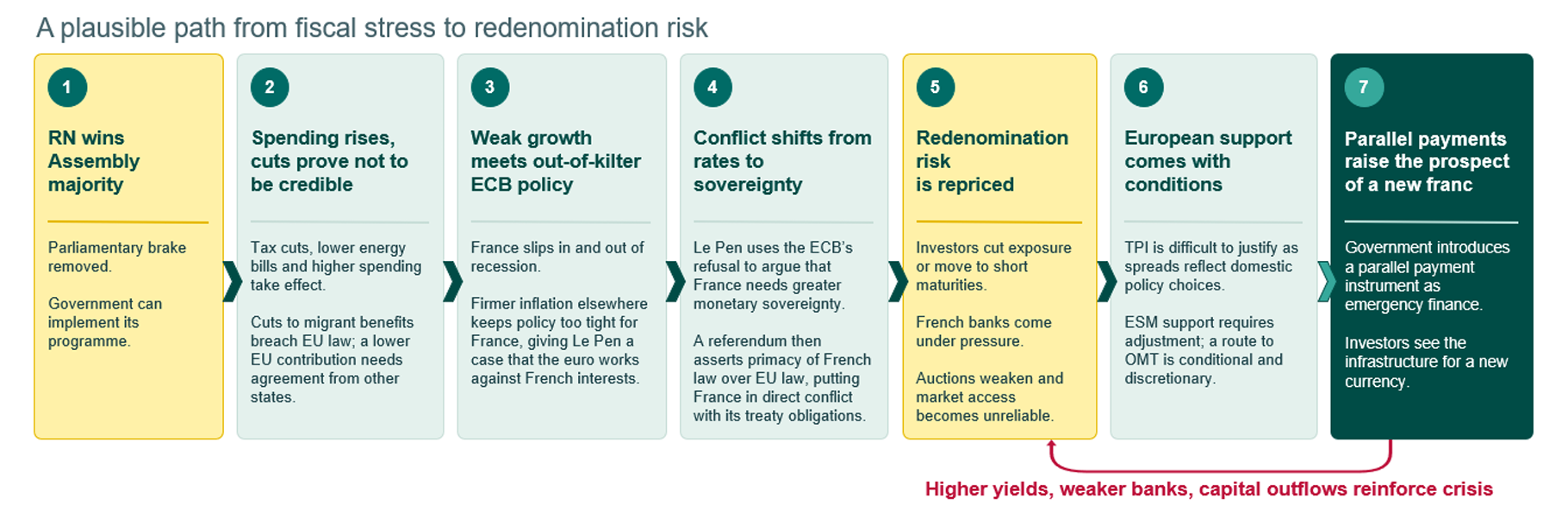
The following scenario requires several things to coincide: RN wins an Assembly majority, market pressure fails to induce moderation, and the government repeatedly chooses confrontation over compromise. This could lead markets to reconsider risks long seen as unthinkable.
October 2027
The auction was meant to be routine. France offered five- and ten-year bonds, but demand faded as the ten-year yield approached 7%. The Treasury cancelled the unsold amount and shifted issuance towards bills. It was the second weak auction in three weeks. The OAT-Bund spread moved through 400bp. No rule made that level decisive; what mattered was that France could no longer issue comfortably at the long end. Investors were no longer asking only whether France could service its debt. They were beginning to ask whether repayment in euros could still be taken entirely for granted.
The majority that markets initially welcomed
Rewind to April 2027, and Marine Le Pen had won the presidency after again ruling out Frexit. Le Pen then called an Assembly election in the summer. Anti-Le Pen tactical voting seen in 2024 failed to hold, and RN secured an outright Assembly majority. Markets initially welcomed the result: France now had a government that could get things done.
That reading missed the cost of removing parliament as a brake. The first RN budget cut taxes, subsidised household energy bills, brought the pension age back to 62, and raised spending on the police, prisons and justice system. The government planned to pay for some of this by restricting migrant access to welfare benefits and sharply reducing France’s contribution to the EU budget. Some restrictions on non-EU nationals were legally possible, but the largest claimed savings required discrimination against eligible EU citizens and therefore conflicted with EU law. The contribution cut, meanwhile, required agreement from other member states who naturally refused. The costly measures therefore took effect while the promised savings did not, widening the deficit just as debt was being refinanced at much higher yields.
A more pragmatic Le Pen might have ‘done a Meloni’ and scaled back her programme at this point, as in our base case. Instead, the government viewed the sell-off as temporary – ‘markets will come around’ – and pressed ahead.
The ECB becomes the adversary
The surge in French bond yields was amplified by high ECB policy rates. Energy costs kept headline inflation elevated, but French core inflation fell back sharply amid weak domestic demand. Core inflation elsewhere in the eurozone proved firmer, leaving ECB policy tighter than French conditions warranted. France had already experienced this out-of-kilter monetary policy in 2025, but the mismatch was now even more pronounced as the economy slipped in and out of recession. Paris called for rate cuts and more flexible bond reinvestment. When the ECB refused, Le Pen recast the dispute as one of sovereignty: French households were being forced to pay for inflation generated elsewhere. The argument did not persuade the ECB, but it gave the government a case against the monetary union as it worked in practice.
From fiscal risk to redenomination risk
Le Pen still did not call for Frexit. However, she prepared the ground for her long-promised constitutional referendum on immigration and ‘national priority’, which would establish the primacy of French law over conflicting EU rules in those areas. This would not take France out of the EU, but it challenged one of the Union’s legal foundations: a member state cannot remain bound by the treaties while deciding unilaterally when EU law applies. With RN holding an Assembly majority, investors could no longer rely on parliament to prevent the referendum.
Redenomination did not need to become likely; its probability just had to move from negligible to plausible. A 5% probability of conversion into a new franc, followed by a 25% depreciation, implies an expected loss of 1.25% of principal; at a 10% probability, the loss rises to 2.5%. Even a low probability of redenomination could cause a material fall in bond prices. A previously remote tail risk had become large enough to price.
Foreign investors cut their exposure or moved into short maturities. French savers shifted funds to other eurozone jurisdictions. French banks came under pressure through their sovereign holdings, collateral values and wholesale funding costs; credit tightened, growth weakened and tax receipts fell. This pushed yields higher still, making debt even more unsustainable. France was now in the throes of a vicious cycle.
Europe offers support, with conditions
The first question was whether the ECB would activate its Transmission Protection Instrument. But TPI was designed to counter market moves not justified by domestic fundamentals; the ECB could hardly ignore that the French government’s own choices were driving the sell-off.
By this stage, the pressure to compromise was immense. Governments in previous eurozone crises ultimately accepted European conditions once the alternatives narrowed. The most likely outcome at this point would also have been compromise. The scenario continued only because the RN government remained ideologically committed to reclaiming French sovereignty and judged that retreat would betray the mandate on which it had been elected.
European support remained available, but not unconditionally. A precautionary ESM credit line would require upfront policy commitments and corrective measures reversing parts of the RN budget, while access to ECB Outright Monetary Transactions would also be conditional and discretionary. If that proved insufficient and France lost market access, it would need a full ESM adjustment programme, with financing released in stages against agreed fiscal measures and regular reviews. Le Pen rejected what the government called ‘foreign administration’; France’s partners refused large-scale support without adjustment. The programme intended to keep France inside the euro would also strengthen Le Pen’s claim that membership had stripped the country of control over its budget.
Emergency finance, or a shadow currency?
The RN majority made the confrontation durable. The government refused to reverse its budget or accept the conditions attached to European support. It then authorised a parallel payment instrument, echoing the government IOUs considered during the Greek crisis and Italy’s later ‘mini-BOT’ proposal. Officials presented it as a temporary way to pay suppliers and settle future tax bills. Investors could not rule out that it might provide the foundations for a new franc.
France did not need to choose Frexit. Markets only needed to stop treating it as unthinkable.