Eurozone - Towards cautious optimism

Q1 GDP (+0.3% qoq) surprised to the upside. We raise our 2024 GDP forecast from 0.4% to 0.7%. Growth is expected to remain slightly positive in Q2 as the outlook improves further, but remain below the trend rate. Disinflation in the eurozone is still on track, but services inflation remains firm due to high wage growth. The first rate cut by the ECB looks to be a done deal next week on 6 June, with attention shifting already to the pace of rate cuts that is likely to follow.


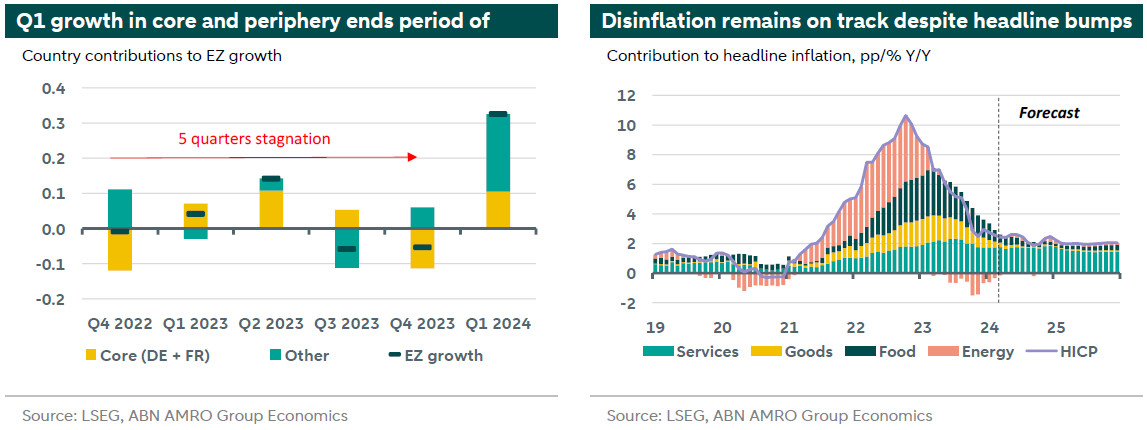
Q1 GDP data gave us reason for cautious optimism over the bloc’s economic activity in 2024. After a weak 2023 with a technical recession in H2, the eurozone surprised to the upside and expanded by 0.3% qoq in Q1. Growth was driven by net exports, spending from the European recovery fund and temporary factors such as higher services consumption due to an earlier easter as well as stronger construction activity – particularly in Germany – due to mild weather conditions. With tourism spending and recovery fund investment providing particular support to activity in southern eurozone countries, the periphery continued to outperform the core. Despite upbeat signs, a strong recovery this year is not expected as the bloc’s industrial sector is still very much in recessionary territory, as confirmed by May’s manufacturing PMIs, and although industrial demand seems to be stabilising, a strong pick-up is required for the sector to stop being a drag on overall GDP. Also, the loss of purchasing power and uneven recovery of real incomes across the eurozone combined with low consumer confidence and an elevated savings rate means private consumption is set to increase but remains very weak for the time being. As support from the temporary factors such as high construction activity and higher services consumption falls away, we expect a slight pullback in growth in the second quarter. Still, in the middle of the second quarter, the May PMI’s, confirmed that the recovery is continuing, driven by the services sector. We expect the recovery to pick up momentum in H2 of 2024, as high wage growth across the euro area supports real incomes and rate cuts start to give some stimulus to demand and lending.
April inflation data were in line with our expectations, with disinflation still broadly on track to reach 2% in Q3 of this year. In year-on-year terms inflation in the coming months will likely rise a bit as favorable base effects from energy unwind. With regards services inflation, the April figure was flattered by the earlier Easter, helping it to dip clearly below 4% for the first time in nearly two years. Going forward, services inflation will take longer to normalise given still strong wage growth in the eurozone. This also means core inflation will take longer to return to the 2% target.
With disinflation on track and the near-term bounce in annual inflation likely fully expected by the ECB, the June start to rate cuts is unlikely to be derailed. The path after the June meeting is more uncertain, and some ECB officials have tried to play down expectations for back-to-back rate cuts. However, as the three conditions set by the ECB during the April meeting – the inflation outlook, the trend of underlying inflation and the strength of monetary policy transmission – are still largely met, and given the policy rate after the June cut will still be deep in restrictive territory, the rationale for rate cuts after June remains in place. Our base case continues to see the ECB cutting rates at each meeting from June onwards, for a total of 125bp of rate cuts over the course of 2024.