First far-right government after agreement has been reached

PVV, VVD, NSC and BBB came to a coalition agreement, the next step is to fill cabinet positions. The title of the agreement is ‘Hope, Courage and Pride’. The plan focusses on curtailing migration, lower taxation, business climate, the agricultural sector, housing construction and public policy. Given the ambitious plans, the risk of underspending, similar to the previous government, remains high. Regarding government finances, parties commit to a maximum deficit of -2.8% of GDP and to hold debt below 60% of GDP. Adjustments to the new pension law are not part of the agreement, more clarity on this topic is expected the coming days. We will come with a more detailed update on the plans today or tomorrow.


Jaap Teerhuis
Senior Fixed Income Strategist
Yes… to a shotgun marriage
Since our last note in March, where we signalled increased probability of a right-wing coalition, talks between election winner PVV (far-right), outgoing prime minister Rutte’s VVD (liberal centre-right) and newcomers the Farmer Citizen Movement (BBB, right) and New Social Contract (NSC, centre-right) have progressed with ups and downs. Given the shift to the right in the elections last November, this coalition was the most likely outcome. So the parties were expected to form a coalition, despite significant differences.
Agreement is pro-business, lower taxes and less ambitious climate policy
Last night, the coalition parties came to an agreement titled ‘Hope, Courage and Pride’. The programme features a lot of ambitions. Ranging from lower taxation for businesses and higher purchasing power for middle-income households to improving the business climate, and from less ambitious climate policy to more housing construction. Also very ambitious policies to reign in migration are put forward, which was the major theme in the elections.
We will publish a more detailed analysis of the budget in the coming days but a few points stand out already. When it comes to the negotiations, it seems clear that the PVV has given up a lot of their plans. The PVV’s party programme was Eurosceptic, very costly, featured anti-climate policy and opposed support for Ukraine. Instead, the coalition agreement includes climate goals staying intact, support for Ukraine is solidified in the budget, euroskepticism is not explicitly mentioned and fiscal prudence is clearly committed to (read more below). The VVD, the NSC and the BBB all gained parts important to their voter base.
Prudent parties have won the finances debate
Given costly party programmes of especially the PVV and the BBB, and the fact that these parties refused to participate in independent analyses of the effects of the policies performed by the CPB (the Dutch Central Planning Bureau), a lot was unsure about the course of the government finances. The reached agreement shows clearly that the more fiscal prudent parties have won the negotiations. Parties commit to curtail EMU-deficits to a maximum of -2.8% of GDP while they commit to stay below a 60% debt share of GDP. Given the uncertainty of budget forecasts it is important to note what the new coalition intends to do in case of under- or overspending. Also here fiscal prudence seems to have prevailed. In case of a higher expected deficit than 3%, the coalition clearly agrees to abide by the limits set by the Stability and Growth pact and cut spending.
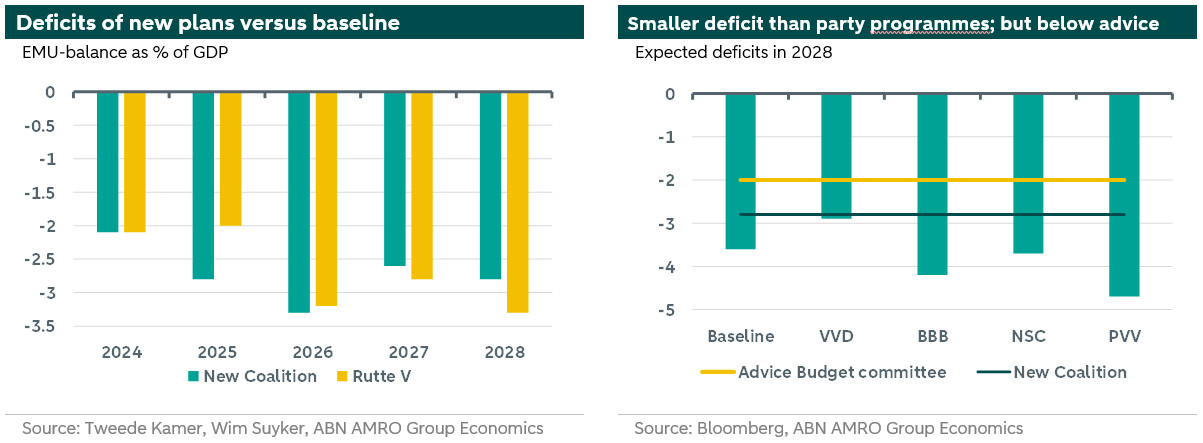
Still, given the state of the economy, which is close to capacity limits with a historical tight labour market, the country runs significant deficits. Similar to the last few years the risk of underspending remains high. The type of spending matters here, some measures on taxation run a lower risk of underspending, but especially investments in police and defence require labour to enact and thus we doubt whether the coalition can fulfil its ambitions here.
Adjustments pension reforms not part of deal
In the agreement of the four coalition parties there is no mention of adjusting the new pension law that came into force last year. Three of the four coalition parties have indicated that they want to modify or even reverse the upcoming pension reform, which will see the Dutch pension sector change from a Defined Benefit to a Defined Contribution framework. Only the VVD is in favour of the current law. At the moment, it is not clear that the four parties have agreed whether this issue is part of the outline agreement. If this is not the case, there will be another debate on this, in which the four parties may vote differently. As such, there still is no complete clarity for the pension sector who are currently in the middle of the transition phase.