France: Not yet a crisis, but pressure is building

France’s bond market stress has escalated sharply in recent days. In this first in a series of notes, we lay out the current state of fiscal play, previewing what to expect from the 2027 budget negotiations as well as next year’s presidential election. France faces a toxic combination of rising interest rates, weak growth, political paralysis, and limited room to raise revenues. PM Lecornu has announced a €54bn fiscal effort (1.7% of GDP) with the goal of containing the deficit to 5% of GDP for 2027. Fiscal consolidation is likely to be considerably diluted, but we do expect a 2027 budget to be pushed through in some form this year. Le Pen continues to lead polling for the 2027 presidential election. Despite attempts to convince markets she is a fiscal hawk, generous promises around pensions continue to suggest otherwise.


Adrian Quinn
Economist Intern
Introduction
It might not be a crisis just yet, but France’s debt woes have escalated rapidly in recent days. Amid a broad sustained sell-off in government bond markets over the past year, investors have sharpened their focus on France as the most vulnerable of sovereigns. France’s vulnerability stems from a toxic combination of high debt & deficits, political paralysis, low growth and limited room to raise revenues. This combination was also at play last year, but now we add to this mix a surge in interest rates – driven to a large extent by factors out of France’s control – and the risk has grown that markets take on a self-reinforcing vicious cycle of higher rates and an increasingly unsustainable debt trajectory. France is in the wrong place at the wrong time, to put it mildly.
France has to run just to stand still
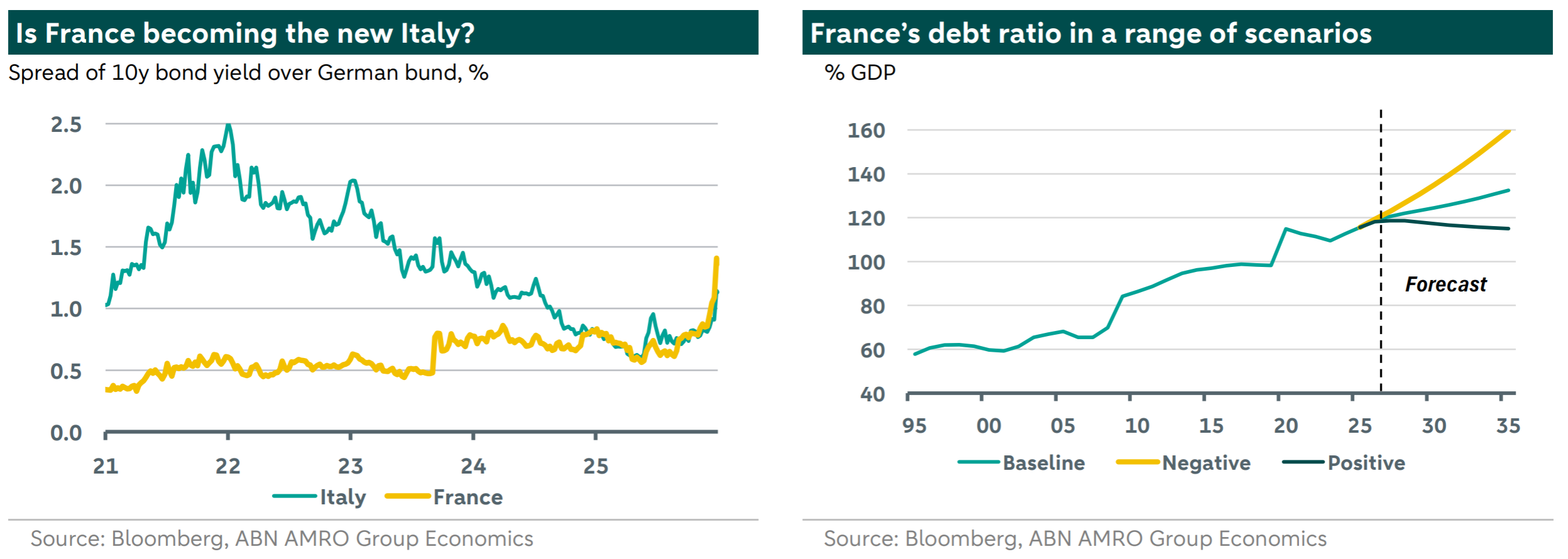
In our Ugly Contest note last year, we argued that France has to implement significant fiscal consolidation measures merely to keep the budget deficit where it is – let alone bring it down to the c3% needed to stabilise the debt ratio. This is largely because France’s interest burden is set to double over the next decade, from around 2% of GDP in 2025 to a historic high of 4% by the mid-2030s. But in the near term, it is also because the macro environment has become more unfavourable. According to France’s fiscal watchdog, the Haut Conseil des finances publiques, despite fiscal consolidation of some 0.8% GDP in 2026, weaker than expected growth this year is subtracting 0.4pp from the primary balance, with a higher interest burden offsetting the remainder of the fiscal consolidation effort this year. This explains why the government now expects a budget deficit of -5.4% of GDP in 2026 – actually worse than the 2025 outturn (-5.1%). At the moment, France is not running just to stand still, but is actually going backwards.
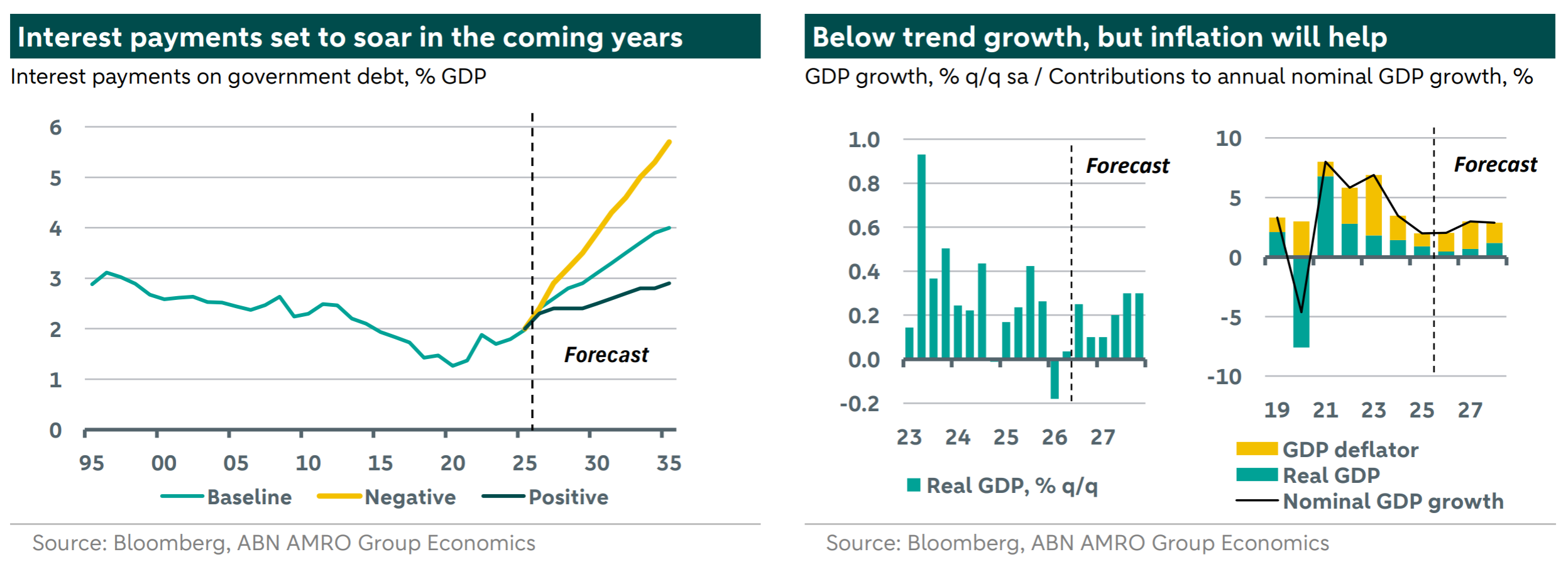
These forces are unlikely to relent in the near-term. Upward pressure on bond yields is continuing, leading us to significantly raise the assumed yields used for our negative debt sustainability scenario (see Box on page 4). The economy is also struggling in the face of ongoing fiscal tightening, rising interest rates, as well as the energy shock and political uncertainty linked to both the 2027 budget process and the presidential election. All told, after skirting recession in the first half of 2026, we expect the French economy to continue growing at a well below trend pace over the coming quarters, with growth expected to pick up only modestly from the expected 0.5% growth in 2026, to 0.7% in 2027. The one silver lining from the energy shock is somewhat higher inflation, which will give a modest lift to nominal GDP growth.
In the near-term, the focus for financial markets will be on: 1) budget 2027 negotiations between the minority government and those most likely to support the government (or at least, abstain from bringing down the government in the event of a no confidence vote), and 2) the presidential election in April 2027, and specifically, the prospects of a Le Pen victory and the credibility of her fiscal consolidation plans.
Budget 2027: A watered-down package the most likely outcome
Last Thursday, Prime Minister Sebastien Lecornu announced a budget containing €43bn in new fiscal consolidation measures, taking the total proposed fiscal effort to €54bn for 2027 – a massive 1.7% of GDP. This effort is measured against the government’s no-policy-change baseline, aimed at reducing the deficit to 5% of GDP in 2027 from an expected deterioration to 5.4% of GDP for 2026. The package is primarily expenditure-led, although the government also foresees higher revenues from tax receipts. Measures include a freeze in the public-sector wage indexation, changes to pension indexation, savings from sick-leave compensation, and tighter spending across government departments. Defence spending is an exception, with an additional €6.4bn increase planned. The current government estimates that an absence of measures to contain an automatic increase in spending could lead to a deficit reaching around 6.6% of GDP for 2027. If the 5% target is met next year, Finance Minister Roland Lescure believes that the long-term target of reducing the deficit to 3% of GDP is still possible.
Lecornu faces considerable political challenges to pass the budget. As with last year’s budget, the PM does not hold a parliamentary majority and requires sufficient support – or at least that the government is not brought down in a confidence vote – to avoid the budget being blocked. The budget must be passed by December to avoid relying on use of Article 49.3 to force it through. While Lecornu received the support of the Socialists last year by postponing an increase in the retirement age, Lecornu will probably struggle to offer something so emblematic to the left this time around. All told, we judge that the most likely pathway for the budget is some form of concessions to Le Pen’s Rassemblement National (RN), that a majority of the Assembly (including RN) still votes against the budget, but that Lecornu forces it through via Article 49.3. In this scenario, assuming sufficient concessions to RN, we expect Le Pen to abstain in any confidence vote, given her stated desire to see some form of 2027 budget, even if imperfect. [1] In our base case, we assume €35-40bn of the €54bn proposed consolidation to survive the negotiation process, and allowing for execution slippage, €25-30bn in actual fiscal consolidation in 2027. This would see the overall budget deficit holding around the likely 2026 level of c5.4% GDP in 2027. Should this scenario play out, it would likely be positively received by financial markets, though it is clearly not without risks, and we do not rule out a scenario that the 2026 budget is rolled over to 2027. In this scenario, social spending continues to rise and the budget deficit widens to over 6% of GDP next year.
Election 2027: A fragmented centre raises the risk of a polarised run-off
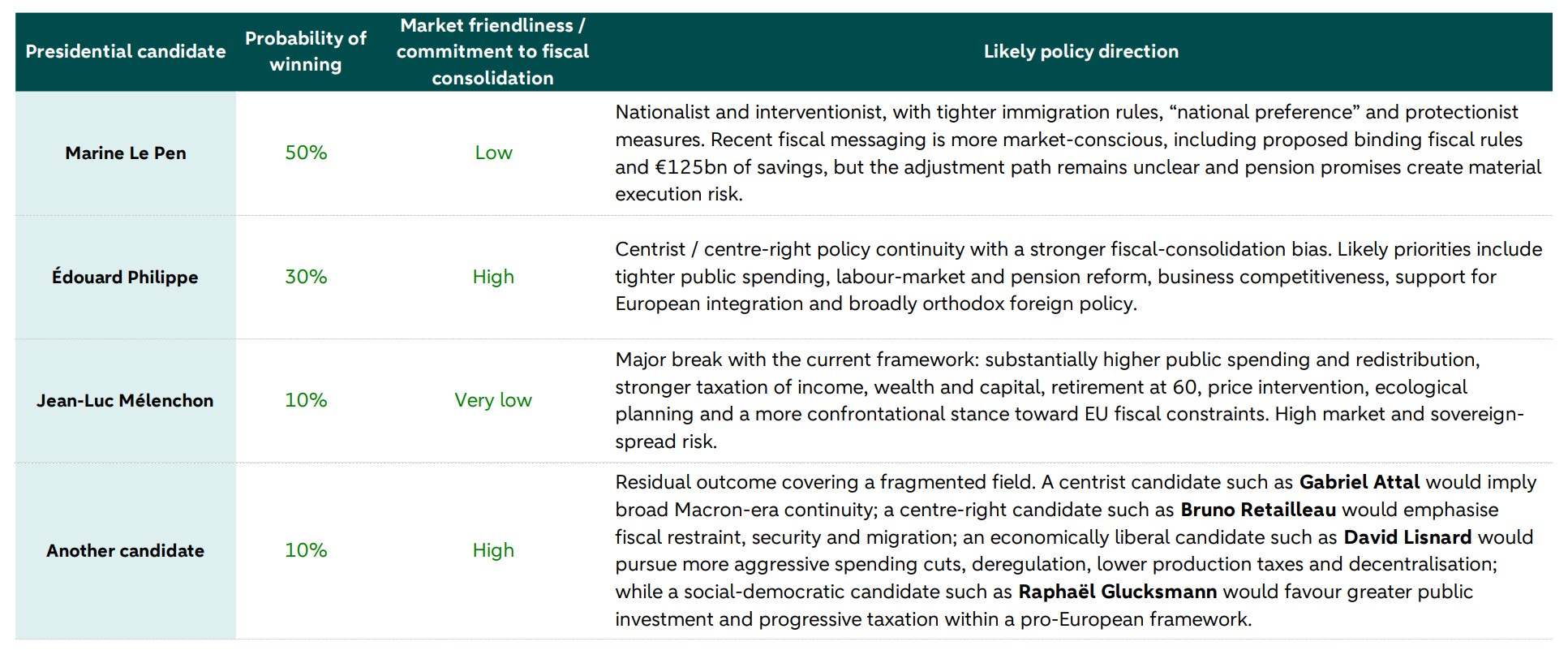
France will hold the first round of its presidential election on April 18th, 2027, with a second round run-off vote to follow on May 2nd given that no candidate is likely to get an absolute majority in the first round. Current polling places Marine Le Pen’s Rassemblement National ahead of far left candidate Jean-Luc Melenchon, and a fragmented centre of Edouard Philippe and Gabriel Attal. Recent first round polling places Le Pen in front with around 34% with Mélenchon and Philippe neck-and-neck for second place. Le Pen is still positioned in the lead in second round polling, although the race looks much closer in a head-to-head with Philippe than for other candidates.
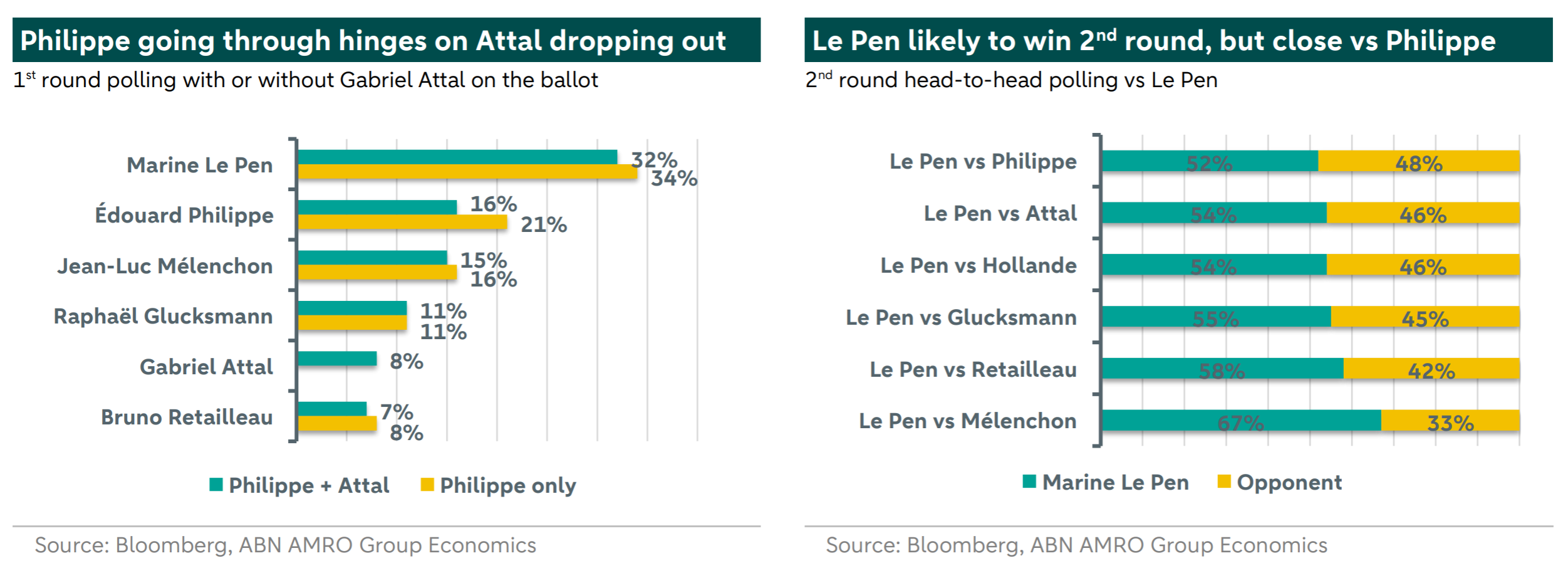
A key permutation in the race is the fragmentation of the Macron-aligned centrists. Phillipe is the leading centrist candidate in first round polling, and he also comes closest to beating Le Pen in second round head-to-heads. But unless centrist rival Attal drops out of the race to endorse Philippe, there is a very high risk that both centrists will lose to Le Pen and Mélenchon. In this scenario, Mélenchon looks almost certain to lose in a second round vote against Le Pen, with polls currently suggesting around 2/3 of voters would support Le Pen. However, a Le Pen vs Mélenchon second round would mean zero chance of a moderate taking the presidency, and even though his victory would be unlikely, politics can be unpredictable and financial markets would price in some risk of Mélenchon winning. We therefore view this as the most negative scenario for financial markets, given some of Mélenchon’s extreme views. Following the election, the president elect is likely to capitalise on their winning momentum and immediately call an Assembly election, particularly given that no Assembly bloc currently holds a working majority.
A centrist outcome would provide the greatest degree of policy continuity, working towards fiscal consolidation efforts, and providing more stability to financial markets. A victory for Le Pen remains something of a black box, with a much wider range of possible outcomes. For instance, Le Pen has made overtures to financial markets of late, proposing strict fiscal rules that would be enshrined in the constitution subject to a referendum. While the rules sound strict on paper, the pathway between now and when the rules could feasibly take full effect remains fraught with hurdles. In terms of fiscal consolidation, she has proposed some €125bn in spending cuts (the detail of which is set to be announced on the day of publication), but at the same time she has made very generous promises around pensions for instance. It therefore remains to be seen how credible her fiscal credentials are. On the one hand, we could see a repeat of the situation with Italy’s Meloni, who proved to be more fiscally hawkish and less of a Brussels troublemaker than was feared at the time of her election. On the other hand, Le Pen may be merely trying to smooth talk markets to avoid taking office with a bond market crisis on her hands. A Mélenchon victory would be the biggest departure from the current fiscal framework, with his programme seeking substantial increases in public spending and redistribution, as well as cancelling part of France’s national debt. To say markets would view this negatively would be an understatement.
In the table on page 4, we list the key presidential candidates, their likely policy direction, market friendliness and our assessment of their probability of winning.
Coming up: Rates implications
In future notes, our rates strategists will explore the implications of France’s fiscal stress on the outlook for government bond yields and spreads. Look out for updates over the coming days.
Box: What positive or negative scenarios might look like for French government debt
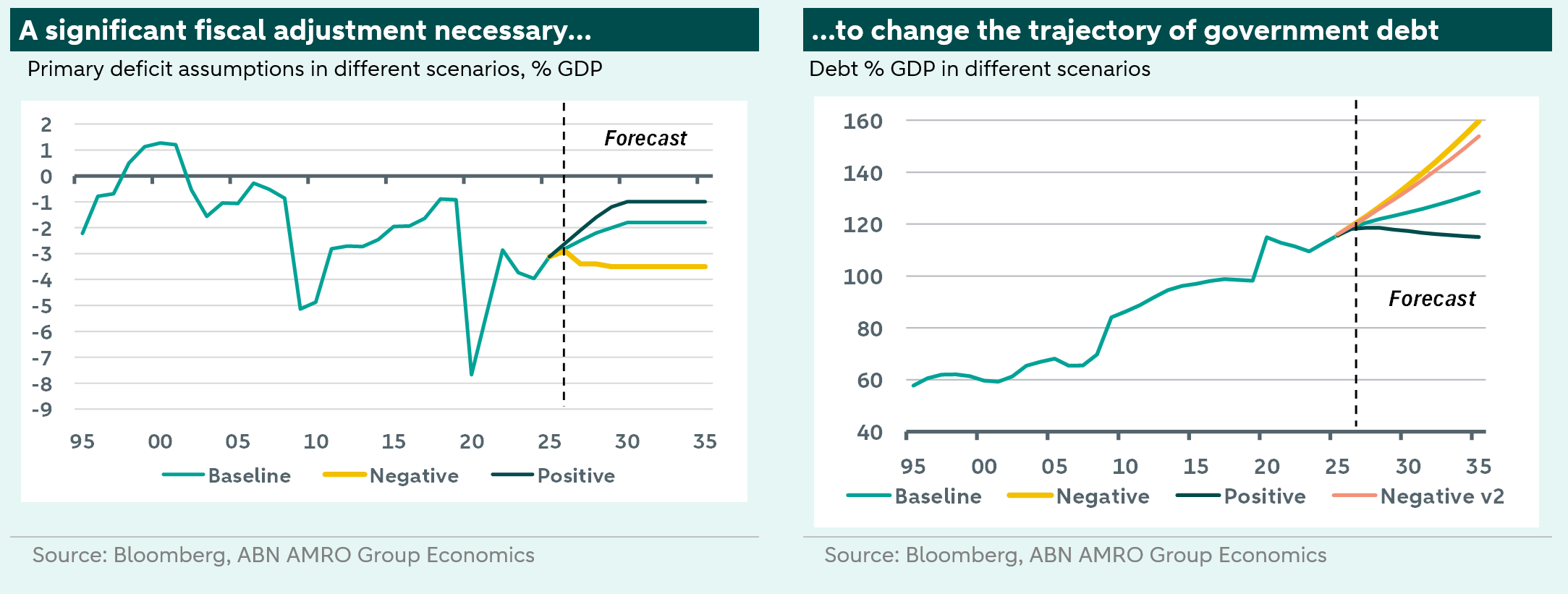
Debt ratio forecasts are subject to a lot of moving parts, with sometimes small shifts in underlying assumptions completely shifting the trajectory. In our baseline of somewhat below trend growth, higher inflation in the near-term, rising interest rates, and a ‘muddling through’ fiscal consolidation of the primary balance, France’s debt ratio continues to rise over the coming years. While debt is unsustainable over the long-run, it is probably not enough by itself to trigger a severe bond market crisis. What if circumstances are more – or less – benign than in our baseline scenario?
In the below scenarios we illustrate what different assumptions around interest rates, deficit reduction and economic conditions would mean for debt sustainability. A key insight from this is that even with more benign assumptions for growth, inflation and interest rates (the positive scenario), a sizable adjustment in the primary balance (c3pp) would still be necessary to return debt to a downward sloping trajectory. In a more negative scenario, we now (compared with last year’s analysis) assume very weak fiscal consolidation which leads to essentially no adjustment in the primary balance. This is accompanied by even weaker growth and inflation, alongside higher interest rates. In this scenario, debt rises very rapidly, reaching nearly 160% of GDP by the mid-2030s.
Alternative negative scenario with rates unchanged: Debt ratio still hits 150% GDP by 2035
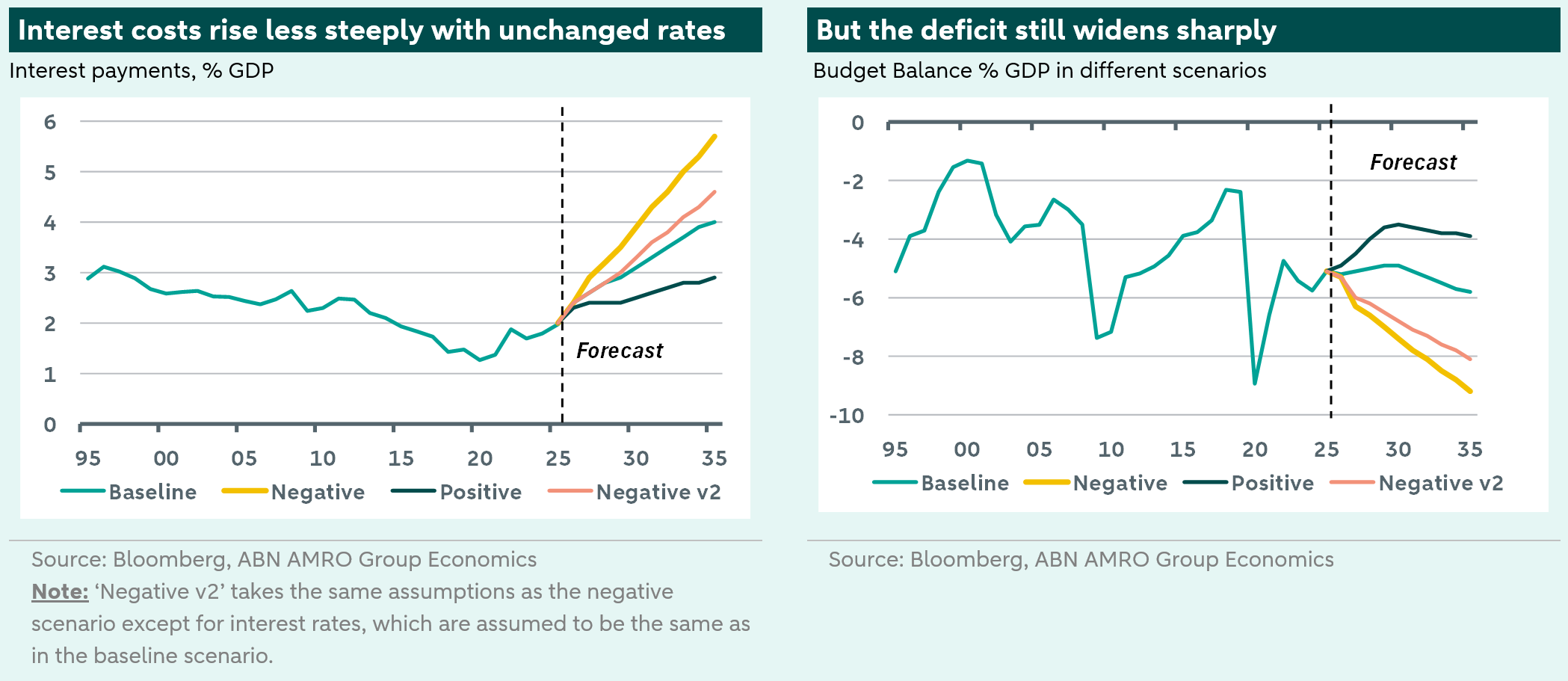
In our new debt sustainability analysis, we add an extra alternative negative scenario that keeps interest rates the same as in the base case. This is in order to isolate the impact of a failed fiscal adjustment and weaker macroeconomic variables. We find that even under a more benign interest rate scenario, a failure to bring down the primary deficit, alongside weaker growth and inflation means that, although the interest payments share of GDP rises rather less sharply than in a classical negative scenario, the budget deficit continues to widen sharply – to over 8% of GDP by 2035 – and this combination puts the debt ratio on course to exceed 150% of GDP by 2035.