Transaction Trends - From Hormuz to the Pump - Fuel Tourism in the Belgian Border Region
Due to the war in Iran, fuel prices have shot up, while gasoline prices in Belgium are up to 55 cents per liter lower. As a result, about 15% of gasoline consumption in the border region has shifted to Belgium, a change largely caused by a relatively small share of households. This effect is consistent for households living up to 30 kilometers from the border, meaning that not only gas stations near the border but also those further away may experience revenue losses. Nevertheless, the overall nationwide loss of excise tax revenue for the government remains limited.


Rising prices at the pump
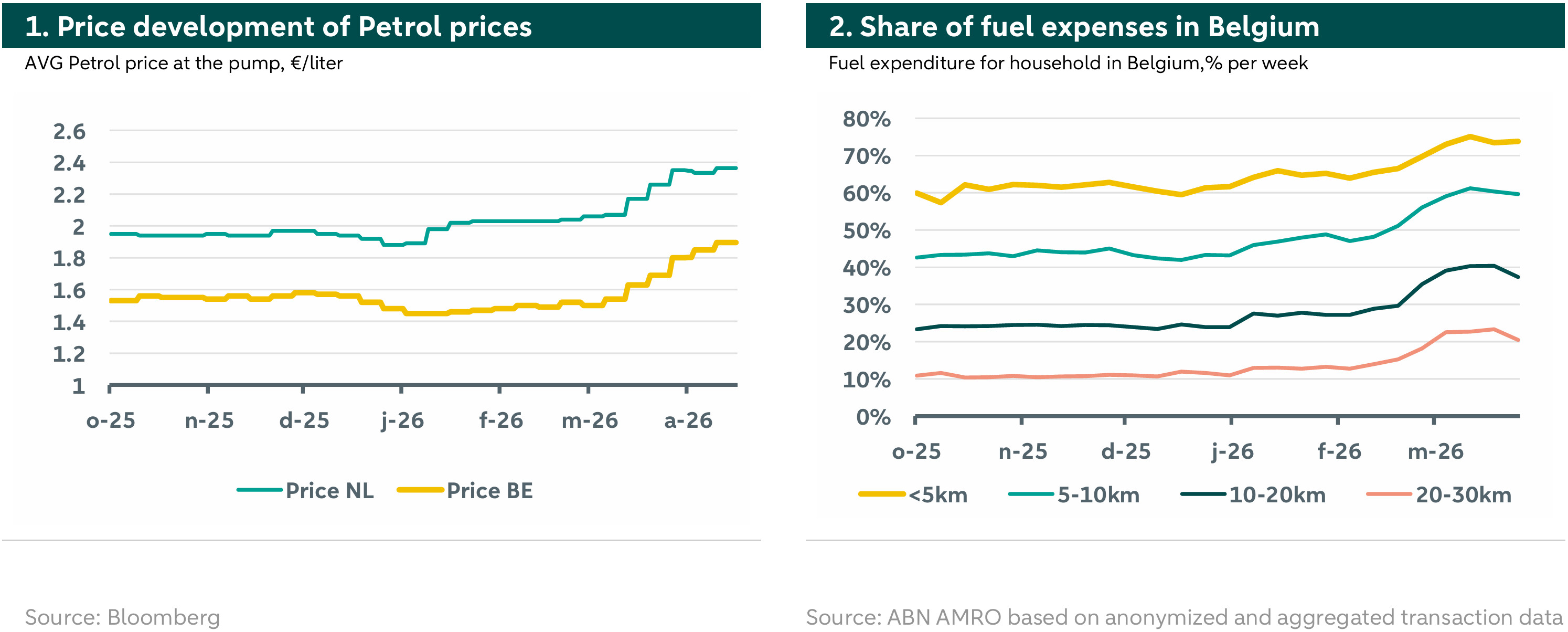
The war in Iran has global economic consequences. For example, the war leads to increased uncertainty, higher inflation, and lower GDP growth in the Netherlands (see here). The first effects of the war are especially noticeable for Dutch consumers in energy prices. The global oil market is reacting strongly to the conflict, partly because of the closure of the Strait of Hormuz and damage to key oil installations in the Gulf region. As a result, the price for a barrel of Brent crude oil has lingered around $100 for weeks. This increase quickly translates to the pump, where the average price for a liter of E10 gasoline has risen from about EUR 1.90 to nearly EUR 2.40 (see Figure 1). Gasoline prices in Belgium are up to 55 cents lower. This is mainly due to lower excise duties and a government-set maximum price. For an average Dutch car, this saves about EUR 25 to EUR 30 per full tank. Because of the significant price difference and rising prices, more and more border residents are choosing to fill up in Belgium (see Figure 2). This increase in 'fuel tourism' is once again fueling the debate in the media and politics about cross-border refueling and tax reductions. Since Germany announced a temporary reduction in excise duties on gasoline and diesel last week, it is conceivable that the same phenomenon will soon occur at the German border. Especially now that the cabinet, in the recently presented support package, has opted for other forms of support instead of direct reductions at the pump.
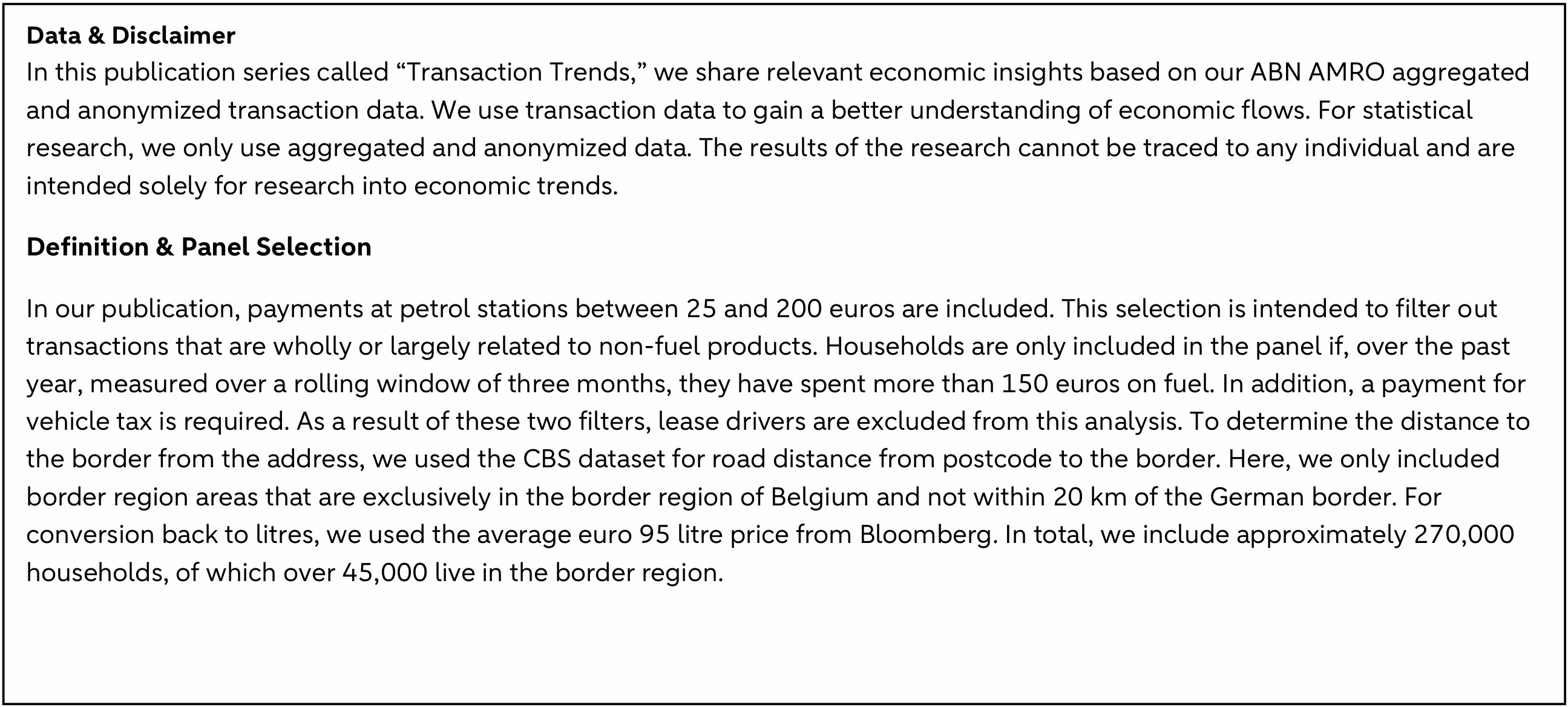
To gain a clear picture of fuel tourism along the Belgian border, we use anonymized and aggregated transaction data to examine fuel spending by households in the border region. We look at how different groups, from people living just 5 kilometers to as far as 30 kilometers from the border, adjust their refueling behavior in response to fuel price differences. We do this by determining in which country these households make their transactions at the pump. To avoid including unrelated purchases at gas stations, we only consider transactions between EUR 25 and EUR 200. In addition, these households must spend at least EUR 150 on fuel every three months and must pay road tax. We do this to ensure we only include households that actively use their car. To estimate the number of liters refueled based on the transaction amount, we convert this back to liters using the weekly average price per liter for E10 in the country of purchase [1].
Figure 1 shows that in January 2026, the price difference with Belgium increased. This was due to the rise in fuel excise taxes in the Netherlands. From March onward, the sharp increase in fuel prices because of the war becomes visible. Figure 2 displays the share of fuel expenditures in Belgium for people living in the border region. Even before prices started rising in January 2026, households living less than 10 kilometers from the Belgian border made more than half of their total fuel expenditures in Belgium. For people living between 20 and 30 kilometers from the border, this was clearly less.
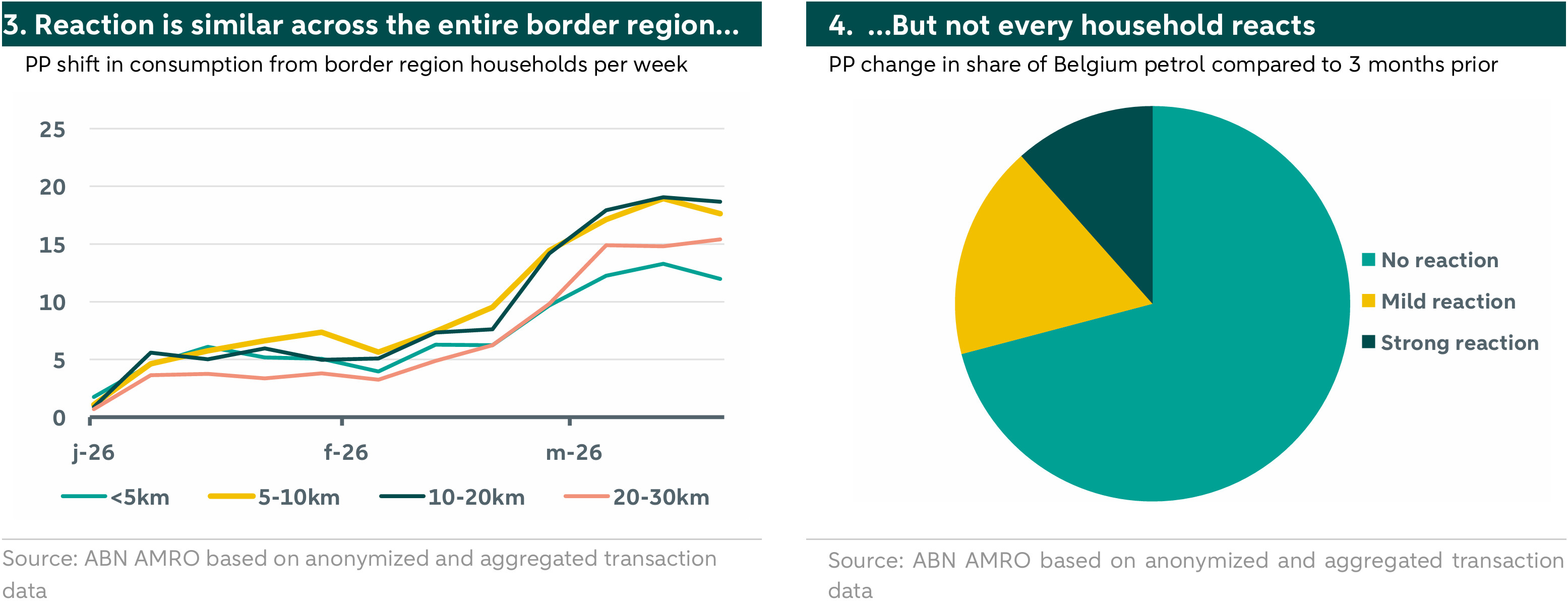
Starting in January, these households began buying about 5 percent more gasoline in Belgium (Figure 3). When the war in Iran broke out, all groups added another 10 percentage points. This effect is similar regardless of the distance to the border. In total, this means households now fill up about 4 to 5 extra liters per week in Belgium.
Looking at Figure 4, which shows how individual households in the border region respond to relative price changes, we distinguish three groups: households that do not react (those who shift less than 10% of their consumption), households that react mildly (10-30% shift), and households that react very strongly (more than 30% shift). The first group is by far the largest (70%) and demonstrates that not all households in the border region are massively shifting their consumption. Within this first group, there are two types: households living closer to the border (less than 10 km) who already bought more than half of their fuel in Belgium before prices increased and therefore had little consumption left to shift. This is roughly one-third of the 70%. The remaining part of the 70% mainly consists of households living farther from the border (more than 10 km), who purchased minimal amounts of fuel across the border both before and after the price increases. These households appear inelastic to price differences. The group that reacts strongly to price differences, about 10% of households, is responsible for nearly 50% of the total effect.
Conclusion
Due to rising gasoline prices and the growing price gap between the Netherlands and Belgium, there is a clear shift of about 15% of gasoline consumption in the border region toward Belgium. This shift is fairly consistent across all observed groups within the border region. For households living very close to the border, the share they refuel in Belgium was already high. This group is now choosing the Belgian gas stations even more often. Households living somewhat farther from the border are now also refueling in Belgium more frequently. For this group, the percentage refueled in Belgium has even doubled. Locally, this means that gas stations slightly farther from the border, which previously experienced little impact from 'fuel tourism,' are now facing competition from Belgian gas stations. Observing a behavioral change now does not necessarily mean this effect will be permanent.
Fuel tourism is often cited as an argument for lowering fuel excise taxes. However, excise policy is broader than just what is happening in the border region. The IMF advises against discounts on fuel excise taxes, for example, because such measures keep demand for oil and diesel steady during times when energy supply is constrained. In a the CPB also emphasizes the broader policy considerations. According to the CPB, generic price-suppressing policies are inefficient because they are very costly and also provide support to households and businesses that do not directly need it, and because they weaken price incentives that encourage energy saving and sustainability. Increasing the resilience of households and businesses against price shocks actually requires reducing dependence on fossil energy. Therefore, support policies should be temporary and targeted.
In addition, the rise in fuel tourism has a budgetary impact on tax revenues for the Dutch government. However, the decline in tax income remains marginal compared to the total national revenues, as it only concerns a limited number of liters in a specific part of the Netherlands.