FX Weekly - Currencies on the move

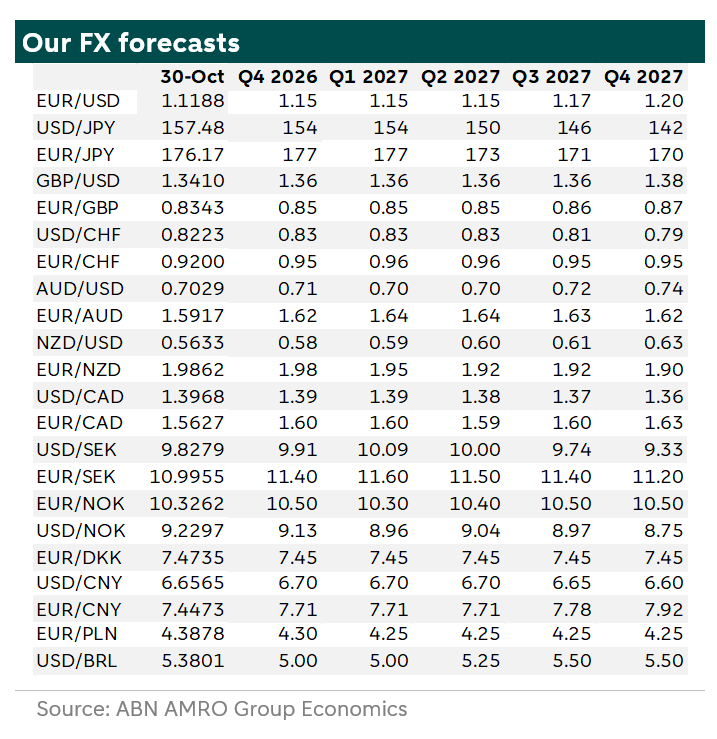
Brazil’s unexpected election result triggered a sharp fall in the real: it dropped 12% before recovering to 8% below Friday’s 23 October close. We see scope for the real to recover, supported by high real rates and less political instability. Investors favour the US dollar ahead and mid-term US elections. Speculative community has their highest net short positions in the euro since November 2016. RBNZ, Fed, ECB and BoJ kept rates unchanged; BoC hiked.

Brazil shock
Currency markets saw major developments this week. Brazil’s presidential runoff produced an unexpected result over the weekend, with the incumbent president Lula defeating the Flavio Bolsonaro (son of a former president). Financial markets had expected Bolsonaro, if elected, to reform public finances and pensions, privatise and reform state-owned companies, reduce government spending and the size of the state, introduce clear rules for managing public finances. So investors had positioned themselves for Bolsonaro to win and implement these measures. When markets opened on Monday, the unexpected result prompted investors to unwind those positions. The Brazilian real is less liquid than major currencies such as the euro, yen and US dollar, so movements could be larger. It therefore opened sharply lower on Monday morning (there was a large gap in prices). At its weakest point, it was 12% below the closing level of 23 October, erasing all its gains since the start of 2026. It has since then recovered some ground but remains 8% below the close of 23 October against the US dollar. This decline reflects both weakness in the real and strength in the dollar (more on this below). Following the election victory, Lula now needs to reassure investors that Brazil’s public finances can improve. We believe the sell-off has been excessive and that the real could recover. Brazil’s central bank remains committed to tackling inflation, and interest rates adjusted for inflation are at very attractive levels. We also expect the political situation to stabilise.
Investors favoured US dollar
The US dollar has performed well this week, although it initially weakened alongside US technology stocks. As market concerns increased, the dollar began to strengthen, while oil prices also rose again. Interestingly, a subsequent recovery in sentiment towards US technology stocks also supported the dollar against the euro, even though interest rate differentials were no longer moving in the dollar’s favour. This suggests that investors prefer to hold dollars ahead of the US mid-term elections. It remains to be seen whether the dollar’s strength versus the euro will continue. Investors already hold unusually large net-short positions in euro and sterling. Indeed, speculative net-short positions in the euro are at their highest level since November 2016. In contrast, they hold net-long position in the yen, which is surprising at its current exchange rate.
RBNZ, Fed, ECB and BoJ kept rates unchanged; BoC hiked
Several major central banks made monetary policy decisions this week. Earlier in the week, the Reserve Bank of New Zealand kept its policy rate unchanged at 2.75%, although markets had expected a rise of 25 basis points. This prompted a sharp fall in the New Zealand dollar. On Wednesday, the Bank of Canada raised its policy rate by 25bp to 2.5% and expectations of more rate hikes to come supported the Canadian dollar. Later that day, the Federal Reserve’s Federal Open Market Committee (FOMC) maintained the target range for the federal funds rate at 3.75–4.00% (see more here), broadly in line with expectations. The US dollar gave up some of its gains after the meeting. Attention then shifted to the European Central Bank (ECB), which also left its policy rates unchanged on Thursday. The euro initially fell after the decision but recovered during the press conference (see more here). With the ECB’s decision out of the way, the attention turned to the Bank of Japan (BoJ). Overnight, the Bank of Japan left interest rates unchanged. It also declared for the first time that it had met its 2% inflation target.
Looking ahead, we expect the BoJ to continue raising rates, with the next increase likely around the turn of the year. This is in line with the consensus forecast and market pricing. Key inflation measures have risen in recent months and are now above the BoJ’s 2% target. However, we do not expect rapid rate increases, such as hikes at consecutive meetings. The BoJ is likely to continue balancing its goal of returning monetary policy to more normal settings with concerns about financial stability. (Arjen van Dijkhuizen)