FX Weekly - Policy risks for the dollar

FX options markets signalled renewed dollar strength. Markets viewed Warsh’s message as hawkish, raising the probability of a September Fed rate hike to over 65% and supporting the dollar. Dollar strength may prove temporary if the Fed keeps rates unchanged…and/or if higher US yields mainly reflect deficit concerns and a higher risk premium. No Fed rate hike and a possible Bank of Japan rate hike in September could support the yen.

FX Options markets signalled renewed dollar strength
Last week, sentiment in the EUR/USD options market gradually shifted, with investors showing less preference for calls (upside) over puts (downside). This move became more pronounced on Friday morning. Just before Federal Reserve Chair Kevin Warsh’s speech, the one-month measure switched to negative, indicating a small preference for a downward move in EUR/USD. While before there was a clear preference for calls. The graph below on the left shows the market action from 24 August until the close 28 August. The red vertical line is the starting time of Fed Chair’s Warsh speech. This suggested that the EUR/USD options market expected the dollar to strengthen against the euro during and after Warsh’s speech. Similar divergences between spot and options markets have occurred before, and the options market has often proved correct about the direction of the move. This was also the case this time.
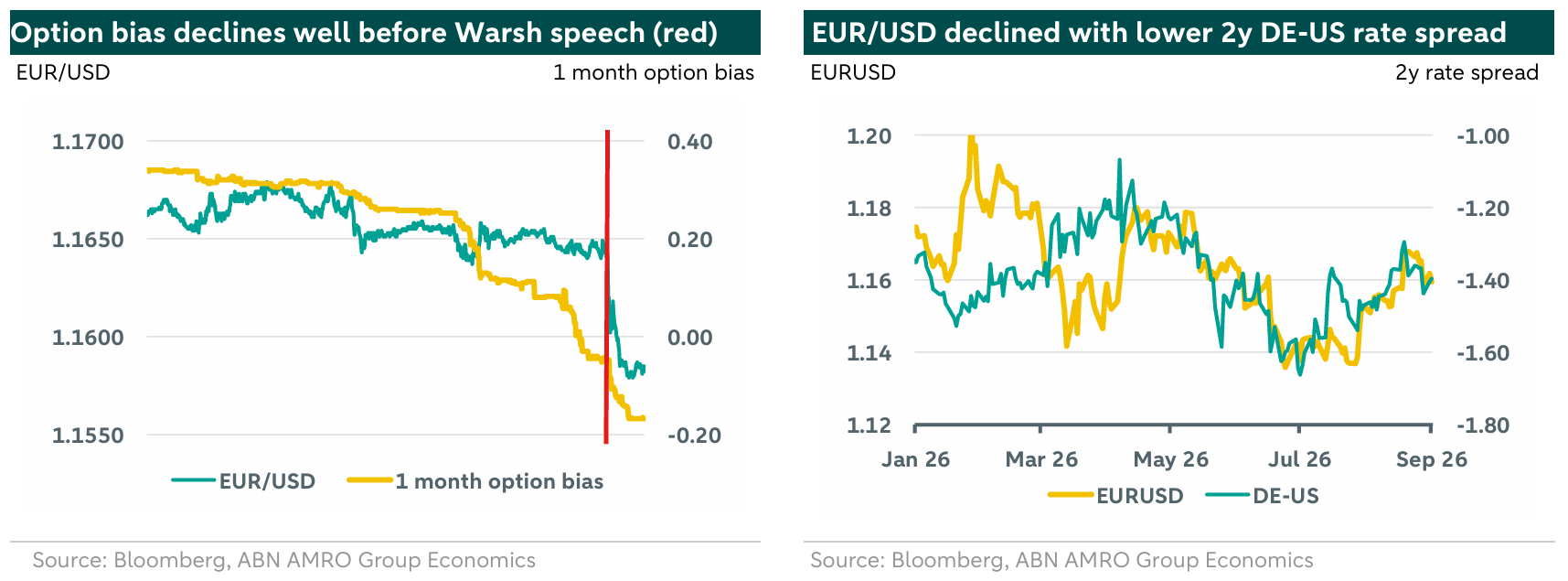
Fed’s Chair Warsh message lifts rate expectations and the dollar
Interest rate and currency markets interpreted his comments as hawkish (see more ). The market now assigns about two-third chance of a 25-basis-point Fed rate hike at its 16 September meeting. In other words, 17 basis points of the possible 25-basis-point increase are now priced in, compared with only 8 basis points before the speech. Expectations of higher interest rates have supported the US dollar broadly. EUR/USD has fallen below 1.16, while USD/JPY is again approaching 160.
Dollar support depends on the source of higher yields
Higher short-term interest rate expectations generally support the dollar. However, higher government bond yields do not automatically strengthen the currency, especially when they reflect a higher risk premium. The market is now cautiously expecting the possibility of a Fed rate hike in September, particularly if inflation data do not surprise to the downside in the coming weeks. If the Fed does not raise rates, the dollar could quickly give back its recent gains and EUR/USD could rise towards 1.18. If at the same time US Treasury yields also increase because of deficit concerns and a higher risk premium, dollar weakness could be more substantial.
Policy divergence could support a yen recovery
Renewed dollar weakness would give the Japanese yen more room to recover. Financial markets are still testing whether the United States and Japan are willing to intervene jointly again. Intervention may not be necessary if the Bank of Japan raises rates at 18 September meeting while the Fed keeps rates unchanged. However, action to support the yen in such an environment could have a stronger impact on currency markets. It would accelerate the broader trend of dollar weakness and yen recovery.
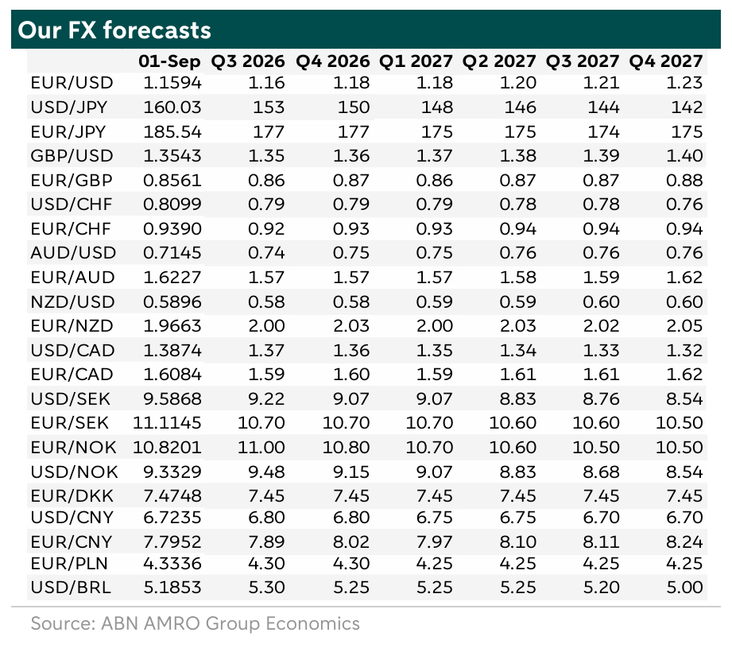
Our end-2026 FX outlook
We maintain our views of a higher EUR/USD towards the end of 2026 and a lower USD/JPY. Our forecasts for end of 2026 stands at 1.18 in EUR/USD and 150 USD/JPY.