FX Weekly - Pressure on the dollar builds

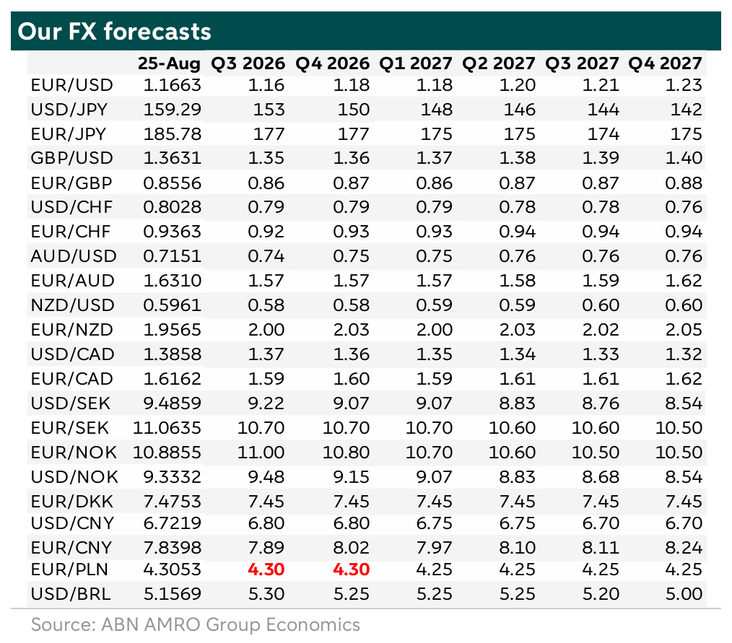
US dollar sentiment is weakening, as US Treasury yields have been volatile and fiscal concerns remain elevated. The Treasury’s larger buyback programme has not reassured markets, and investors still worry about US debt dynamics and rising risk premia. The euro has benefited from dollar weakness, and further dollar downside could support EUR/USD. EUR/PLN has moved higher as central bank expectations diverge, with the NBP seen as potentially more dovish while the ECB is expected to hike once more.

Sentiment towards the dollar is weakening
Last week, the US Treasury announced that it would at least double the maximum size of its liquidity support buyback operations for US Treasuries with maturities of 10 to 30 years, to USD 4bn. The programme will start on 9 September and run until 4 November. The Treasury’s interventions have had only short-lived effects because they do not come with a credible promise of overwhelming financial firepower (see more here).
Even before the announcement, the US dollar was struggling despite higher US Treasury yields, as investors were concerned about fiscal deficits and rising risk premia. After the announcement, US Treasury yields fell and the US dollar came under even more pressure across the board. This suggests that investors remain worried about US debt dynamics and higher risk premia. In this environment, the risk premium appears to be a more important driver of the US dollar than nominal yields. Indeed, since the start of July, the US term premium has been on an upward trend, while the US dollar has moved lower. Despite volatility in the US Treasury bond market, the dollar has continued to weaken. The euro has benefited from this dollar weakness and is likely to continue doing so if the dollar falls further.
So far, Bessent’s small scale ‘twist’ has not improved the outlook for the dollar. Attention now turns to Fed Chair Warsh’s speech at Jackson Hole on Friday. If his comments do not calm the US Treasury market and do not support the dollar, investors are likely to sell the dollars they bought earlier. According to the latest futures market data, speculators hold moderate net long US dollar positions, while they are net short yen, euro and sterling. These data are up to last Tuesday and will be updated on Friday.
Central bank policy divergence drive EUR/PLN
Since the start of June, the Polish złoty has fallen by 3% against the euro. Interest rate expectations in the eurozone and Poland have been an important driver for direction in EUR/PLN. The National Bank of Poland (NBP) left its policy rate unchanged at 3.75% on 7-8 July. It said that economic activity remains subdued and that inflation is higher than at the start of the year. The NBP also stated that future decisions will depend on incoming information about the outlook for inflation and economic activity. Its medium-term inflation target is 2.5%, with a symmetric tolerance band of +/-1 percentage point. In July, the NBP governor said that he may submit a motion to cut the benchmark rate by 25bp after the summer. However, the Monetary Policy Council appears to be divided, and the market consensus is for no rate cut in September. Meanwhile, we expect the ECB to hike once more, bringing the deposit rate to 2.5% on 10 September, although this move is already priced in by the market. Expectations that the NBP and the ECB will move in opposite directions have pushed EUR/PLN higher, meaning a weaker złoty. We have upgraded our EUR/PLN forecasts to reflect this policy divergence for this year. If the NBP sounds more dovish than expected, EUR/PLN could move towards 4.40.