FX Weekly - US dollar slips on election surprise

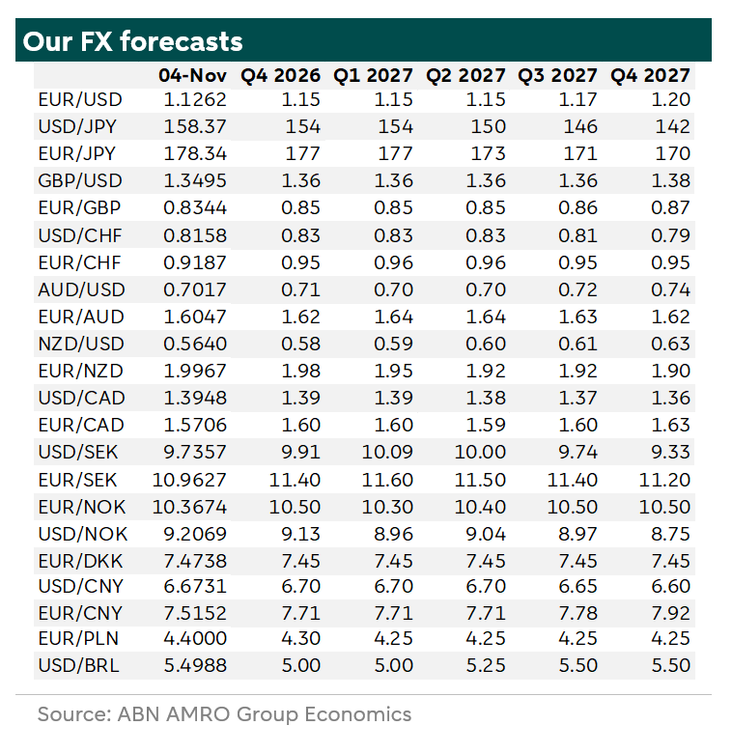
US election surprises weakened the dollar, pushing EUR/USD above 1.1250 because of concerns over political deadlock. The Riksbank raised its policy rate by 25 basis points. Strong fundamentals support the Swedish krona, but slower rate hikes compared to ECB and global risks limit near-term gains.

Impact of the US mid-term elections
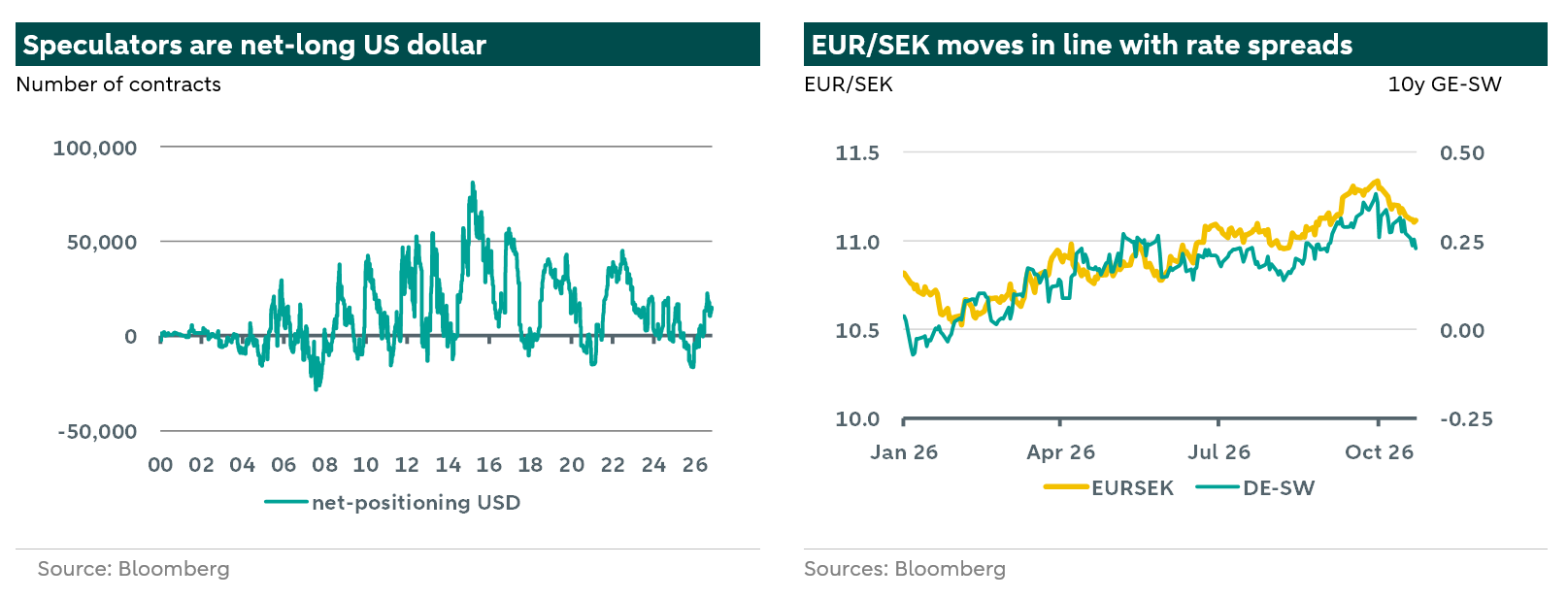
In recent weeks, foreign exchange markets focused on challenges in France and elsewhere. The US mid-term elections have shifted attention back to the US. Ahead of the elections, investors held positions that would benefit from a stronger dollar (see the chart below on the left). Markets had expected the Democrats to win the House of Representatives and possibly the Senate, but the scale of their projected victory came as a surprise. The US dollar fell in response. This reflected concerns about political deadlock, with the Democrats expected to control both the House and the Senate, while the Republicans retain the presidency. Such a divide would likely make it harder to implement policies. As a result, EUR/USD rose above 1.1250. President Trump congratulated the Democrats on their victory and said he was prepared to work with them. Markets now need time to assess the implications of the results and how the relationship between the Democrats and the president will develop.
Riksbank raises policy rate by 25 basis points
Between the start of 2026 and the end of September, the Swedish krona weakened by more than 7% against the euro. Since then, it has recovered by 3%. The krona generally performs well when global trade and growth are strong, investors are willing to take risks, equity markets are rising globally, and the Riksbank raises interest rates faster than the ECB and the Fed. Sweden also has a large current account surplus and a relatively small fiscal deficit of around 2.5% of GDP. The US-Iran war has created considerable uncertainty in financial markets. Sweden is a net exporter of electricity but imports oil. Renewable energy accounts for 65% of its energy mix, well above the EU average, while its dependence on oil and gas imports is much lower than the EU average. These factors should make the krona less sensitive to developments in the Middle East.
Why, then, was the krona so weak in the first three quarters of this year? The chart above on the right offers an explanation: EUR/SEK moved in line with the difference between German and Swedish 10-year government bond yields. The differences in 10-year inflation-adjusted yields and 2-year nominal yields show the same pattern. This suggests that interest rate differences have been the main driver of EUR/SEK this year. The krona was also seen as an attractive funding currency for carry trades, which involve borrowing in a lower-interest-rate currency to invest in a higher-yielding one, as the Japanese yen became less attractive for this purpose. This morning the Riksbank raised the policy rate by 26 basis points to 2%. With the Riksbank now raising rates again, the krona is likely to become less attractive as a funding currency for these trades.
Looking ahead, we do not expect the Swedish krona to strengthen significantly in the near term, as opposing forces are likely to limit both gains and losses. On the positive side, Sweden’s long-term economic fundamentals, including its current account position, remain strong, and the krona appears undervalued.
However, we expect the Riksbank to raise interest rates more slowly than the ECB, although it may continue raising them for longer. Market expectations for the ECB and the Riksbank are in line with our view. Sweden’s economy also relies heavily on global trade and growth, so a slowdown in the world economy would typically weaken the krona. In addition, like the Norwegian krone, the Swedish krona is less actively traded than major currencies. This means its value could fall quickly if investors become more cautious.