Gas market update - European gas regains momentum but high storage retains a lid on prices

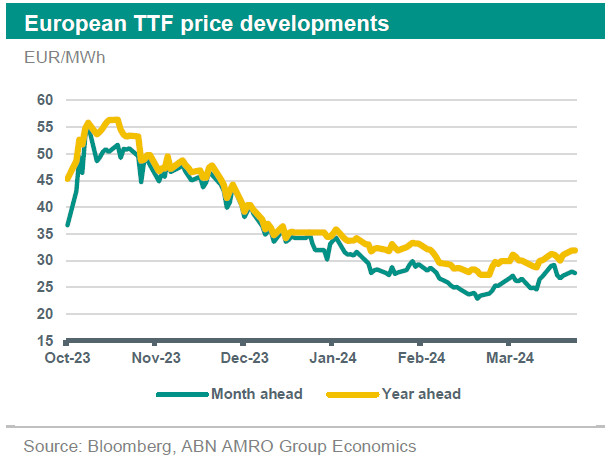
European gas prices reached a new low of 22.8 EUR/MWh in February. The rise of coal prices and threats to supplies from the US, along with attacks on energy infrastructure in Russia and Ukraine, put some upward pressure on prices last week, but this effect is not expected to sustain. All in all, Europe consumption across the continent fell to its lowest level in 10 years, with almost a 20% reduction during the last two years. The current storage levels give the region a comfortable starting point ahead of the summer and increase the probability of meeting the European filling target way in advance than planned.

European gas prices sustained the downward trend that has been in place since mid-October. The European month ahead TTF price averaged 27.6 EUR/MWh (year ahead averaged 31.2 EUR/MWh) since the start of 2024, touching a new low of 22.8 EUR/MWh in the second half of February despite disruptions due to Red Sea attacks. Higher than average storage level for this time of year boosted market confidence and mitigated the impacts of these attacks. However, prices witnessed a surge more recently driven by signals of low supplies from the US, a rise in coal prices, and escalations in the Ukrainian war with energy infrastructure being hit on both sides of the conflict, which made gas more advantageous than coal and boosted its demand for power generation.
The Red Sea situation witnessed an escalation with the US and the UK striking different targets of the Houthi group. The group retaliated by intensifying its attacks on different vessels. The tension remains high and no solution appears to be on the horizon. Accordingly, many LNG tankers, of which those coming from Qatar to Europe, were halted for a while or took the long journey around the southern tip of Africa. Though the impact on prices has been limited as the European heating season approaches its end and market participants appear to consider European supplies sufficiently high to manage those risks or any delay in delivery.
All in all, consumption across Europe fell to its lowest level in 10 years, with almost a 20% reduction during the last two years. According to Bloomberg, heating demand has been 25% below the long term average in Frankfurt in Germany and 14% below the average in London.
From the demand side, our expectation for the start of interest rates cuts on both sides of the Atlantic remains in June and the impact of monetary easing will take time to feed through to demand. On the other hand, there are signs that inventory cycle in the global industrial sector is turning. Overall, we expect sluggishness in industrial demand in the coming quarter dominating any increase in output driven by lower prices and higher competitiveness. In the power sector, output from renewable power resources has been increasing with more deployments of solar and wind projects, which reduces gas demand for conventional power generation, however, this also means higher vulnerability to weather conditions for gas markets. At the same time, a surge in coal prices, following escalations in the Ukrainian war, made gas more attractive for power generation which induced a surge in TTF price last week. Another factor that also put an upward pressure on prices is the decrease in gas flows to the Corpus Christi LNG export terminal in the US, one of Europe’s biggest suppliers of LNG. We perceive these episodes to be temporary and do not expect their effects to persist.
Now that the heating season is coming to an end, attention is shifting to the refill of storage in time for the upcoming Winter. Europe is approaching its spring season with high storage levels (storage stood at 59.18% at the time of writing), thanks to the sustained supplies, suppressed demand for industrial purposes, and the milder than usual weather that had prevailed over winter months in the region. The current levels give the region comfortable stance at the start of summer and increase the probability of meeting the European filling target (90%) way in advance than planned (1st of November).
Outlook
Given the aforementioned developments, our outlook for the TTF year ahead contract is to average around 30 EUR/MWh during the second quarter of 2024. Bearing in mind that prices remain responsive to any escalations of geopolitical risks. As the industrial demand starts to bottom out, the anticipation of economic recovery spurred by the anticipated cuts in interest rates in the second half of 2024, we expect to see gas prices reaching 40 EUR/MWh by the end of 2024 (1).
(1) Assuming storage will be filled in time and that no supply disruptions will take place as the continent enters the upcoming Winter.