Global Daily – Do virus developments challenge our base case?
Global Macro: Near term weakness largely priced into our central scenario – Across a number of large economies, the virus continues to rage, putting pressure on hospital capacity and leading to extension or stepping up of lockdowns in many cases. At the same time, there are new risks on the horizon. The new B.1.1.7 variant of Covid-19 (also known as the UK variant) is significantly more transmissible than its ancestry – around 70% more so. This means that in all countries where it gains a toehold, it will outcompete and ultimately supersede existing variants.


So far, it has been detected in at least 35 countries, including the US and most European countries. It is already dominant in most of the UK, and is about to become so in Ireland. For other countries, in France it is expected to be the dominant strain by February, and in the US by March. While there is no indication that vaccines are not as effective against the new variant, nor that it causes more serious disease, the much higher transmissibility of the variant means that even with strict lockdowns, it is likely to put significant strain on healthcare systems until the vaccine rollout inoculates the bulk of the vulnerable proportion. What do these developments mean for the economic outlook?
For the eurozone, we are already assuming relatively long and strict lockdowns. In our scenario we had already assumed that the lockdowns would not be lifted significantly before the end of Q1. As a result we are projecting a cumulative fall in GDP of around 4% over Q4 of last year and Q1 of this year. However, the lockdown index is somewhat higher than assumed in our base case (around 70 versus 78 in the latest outcome), leading to some additional weakness in activity. At the same time, the eurozone data for Q4 were not quite as weak as we expected. Against this background, we think the cumulative fall in GDP will be similar to our base case but the distribution will differ. We have revised our forecast for 2021Q1 GDP down, to a contraction of around 1.5% qoq from a contraction of around 0.8%. At the same time, we have raised our forecast for GDP in 2020Q4, from a contraction of -3.8% qoq to a contraction of around -2.5% as growth the industrial sector has turned out to be more resilient than we had anticipated.
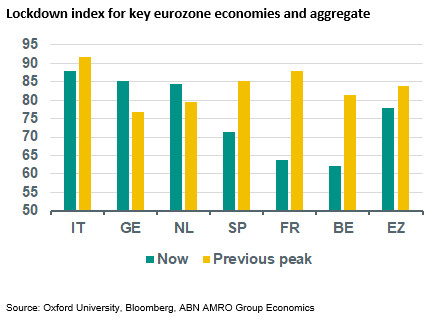
After these revisions in our forecasts for GDP growth in 2020Q4 and 2021Q1, the expected shortfall of GDP compared to the trend level at the end of 2021 has not significantly changed and is still around 4.5%. Overall we think that the decline in GDP during the second wave of the pandemic (around 4% in total in 2020Q4-2021Q1) will be much more modest than the decline during the first wave (of 15% during 2020 Q1-Q2). This is largely due to the fact that the industrial sector has not been hit by lockdown measures or supply chain disruptions stemming from China during the second wave. On top of that, activity in large parts of the services sector had remained limited by social distancing measures before the start of the second wave, so that the decline is coming from already low levels of activity.
Meanwhile, developments in the US economy have been more positive than we have assumed. Despite worrying virus trends, the US has not imposed the kind of strict lockdowns that have been necessary in Europe. This appears to be due to the more even spread of the virus than that seen in earlier waves of the pandemic, with the result that hospital capacity is being challenged in only some select states (most notably California). As a result activity has been more resilient than expected so far and taken together with more substantial fiscal stimulus, we are in the process of revising our US economic forecasts higher (see ).
In the US, around 10mn people have been vaccinated so far. Vaccinations are currently running at a 700k per day pace, and this is expected to accelerate to 1mn per day in the next week, according to the Health Secretary Alex Azar. On this trajectory, around 7% of the US population would be vaccinated by the beginning of March (i.e. have received two doses), and around 12% would be by the end of March. Many more would have had at least one dose, which by itself affords significant protection. By the time the new variant takes hold, it is likely that much of the most vulnerable in the population will have either had the virus, or been vaccinated. While a long way from herd immunity levels, this would already significantly reduce the burden on the healthcare system. Taken together, and despite the continued worsening of the pandemic in the US, the later spread of the new variant there means that it looks likely to avoid the kind of widespread lockdowns that have been seen in Europe. However, there is a risk of wider lockdowns should the pace of vaccinations fall short, or the new variant more rapidly takes hold in the country.
Looking further forward, our conviction that advanced economies will grow rapidly in the second half of the year remains high. We continue to judge that the vaccine roll out will allow for a significant lifting of restrictions in Q2 and especially in Q3 of this year. In addition, significant fiscal stimulus, and accommodative financial conditions should also support demand. (Bill Diviney, Aline Schuiling and Nick Kounis)