Global Daily – Eurozone wages signal weak inflationary pressures
Euro Macro: Wage growth drops lower – Eurostat published its report on quarterly hourly labour costs for 2021Q1 today.


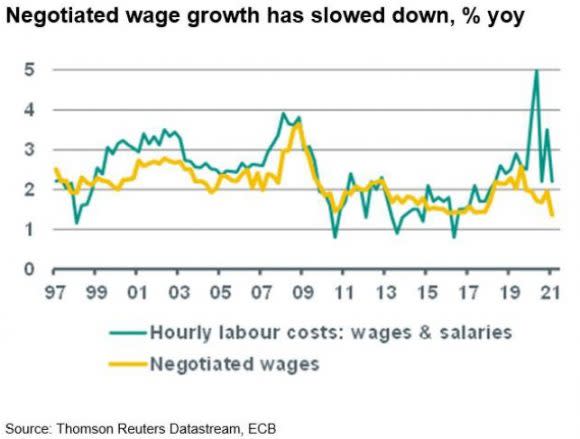
The costs are corrected for the impact of tax changes and government subsidised short-time work schemes, which means that they reflect the labour costs that actually have to be paid by companies. The rise in total labour costs slowed down markedly, to 1.5% yoy in 2021Q1, down from 2.8% in 2020Q4 (revised lower from 3.0%). The breakdown of the main components shows that the rise in hourly wages and salaries decreased to 2.2%, down from 3.5%, while non-wage labour costs (which largely reflects the impact of taxes and government subsidies) dropped to -0.9%, down from +0.8%. The impact of the short-term work schemes clearly is illustrated by the change in the non-wage labour costs in the sectors that were impacted most heavily by lockdown measures, with non-wage labour costs plummeting by more than 19% yoy in Arts, entertainment and recreation and falling by 10.5% in Accommodation and food services activities.
As this measure of wage growth is also impacted by the number of hours worked and not only by the change in wages, alternative measures can give more information about underlying wage pressure in the eurozone. Indeed, the ECB prefers to look at the change in negotiated wages as it excludes the impact of wage-drift and one-off factors. It tends to reflect changes in supply and demand for labour and the resulting bargaining power of employees. As such, it is a good indicator for the tightness in the labour market and underlying wage pressure, which in turn is a main driver for inflation in the medium term. The graph below shows that negotiated wage growth has slowed down noticeably since the middle of 2019 (from 2.6% in 2019Q3 to 1.4% in 2021Q1). Looking forward we expect negotiated wage growth to remain at low levels in the coming quarters as a lot of slack has built up in the eurozone labour market since the start of the pandemic. This supports the view that underlying inflationary pressures will remain weak over the medium term. (Aline Schuiling)
China Macro: May activity data weaker than expected – China’s monthly activity data for May published earlier today generally came in weaker compared to April and to consensus expectations. Industrial production growth slowed to 8.8% yoy (April: 9.8%, consensus: 9.2%). Fixed investment growth dropped to 15.4% yoy in January-May (consensus: 17.0%), versus 19.9% yoy in January-April. In annual terms, private investment continues to grow faster than state-led investment so far this year. Retail sales slowed to 12.4% yoy (April: 17.7%, consensus: 14.0%). However, on a monthly basis the total value of retail sales picked up again (+8.4% mom), after having dropped by 6.6% mom in April. Meanwhile, the surveyed unemployment rate in urban areas fell further below pre-corona levels, to 5.0% in May (versus 5.2% in December 2019). Bloomberg’s monthly GDP annual growth estimate dropped to 7.9% (April: 8.9%). We should add that annual growth numbers are still to a large extent impacted by base effects, reflecting the sharp swings in activity following the initial Covid-19 shock last year. In sequential terms, we expect quarterly growth to pick up somewhat in Q2, after a retightening of mobility restrictions and new regional lockdowns formed a drag on activity in Q1. See for more background our China note here published earlier today. (Arjen van Dijkhuizen)