Rise in EZ composite PMI probably temporary

Composite PMI rises, but services will be hit by Delta going forward

The eurozone PMIs came in stronger than expected in November. The composite PMI increased to 55.8, up from 54.2 in October. The composite PMI is a weighted average of the manufacturing PMI and the services PMI, and its rise was mainly due to a jump in the services PMI (up to 56.6 from 54.6 in October). The manufacturing PMI rose much more modestly, to 58.6 from 58.3.
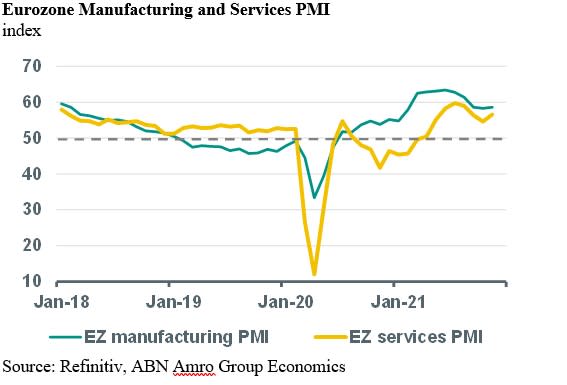
The details of the report show that the jump in the services PMI was totally due to higher ‘current business activity’, whereas the forward looking part of the services PMI (‘business expectations’) dropped by 2.4 points to its lowest levels since February. This drop in the business expectations in services probably is related to the rapid spreading of the Delta variant in a large number of eurozone member states. As was shown in an earlier publication yesterday, the spreading of the Delta variant and the re-introduction of containment measures in a number of countries has contributed to a drop in eurozone consumer sentiment in November (see ). Therefore, it seems likely that the rise in the services PMI in November will be followed by a decline in the final month of the year. Given the heavy weight of the services PMI in the composite PMI, is seems likely that the composite PMI will ease as well.
The main message of the manufacturing PMI remained that production continues to rise, but that growth in the sector is still hindered by supply bottlenecks and shortages of material and/or equipment. Supplier’s delivery times continued to lengthen at a steep rate in November, easing only slightly compared to October. Meanwhile, the sub-index for backlogs of work stayed at a high level, although it fell somewhat compared to October. Overall, the PMI report is in line with our view that economic growth will slow down markedly in Q4 (we have pencilled in 0.7% qoq) after GDP expanded by 2.2% qoq in Q3.