Global Daily – Is the ECB serious about curbing bond yields?
ECB View: Executive Board views are key and we are close to level that will trigger action. There has been a cacophony of ECB voices on recent bond market moves and the central bank’s reaction function to them (see table below) in the past couple of weeks. The message so far has been far from clear, with differences in emphasis between real yield moves versus nominal yield moves, the importance of bond yields versus overall financial conditions and whether current yield levels should trigger action.

In addition, there are differences in terms of what action the ECB should take. For instance, on the need to recalibrate the PEPP envelope versus using the flexibility within the envelope and whether a deposit rate cut could also be an option.
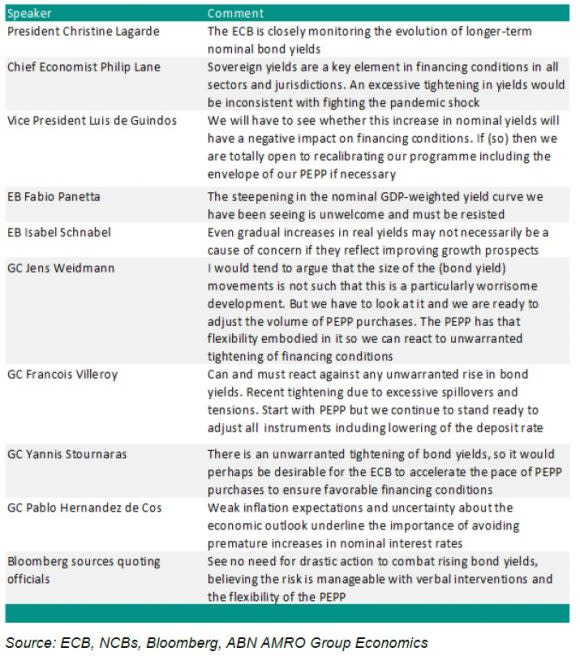
How do we interpret these disparate voices? First, it is important to clarify who decides what. Although the Governing Council decides on new policy proposals, for instance whether to change the asset purchase envelope or the deposit rate, the decision on the pace of PEPP purchases within the envelope is a decision for the Executive Board. The legal basis for the establishment of the programme notes that ‘the Governing Council delegates to the Executive Board the power to set the appropriate pace and composition of PEPP monthly purchases within the total overall envelope…in particular, the purchase allocation may be adjusted under the PEPP to allow for fluctuations in the distribution of purchase flows, over time, across asset classes and among jurisdictions’.
Five of the six EB members have made statements on recent bond market moves as shown in the table above. While Mr Panetta is on one side of the spectrum in being explicit that yield rises are already problematic, Ms Schnabel is on the other side in seeming to suggest that they are not and focusing on real yield moves. The other three that have spoken (Lagarde, Lane and de Guindos) have not been as explicit as Mr Panetta, however they have highlighted the importance of rising nominal yields, signalling that we are at least approaching areas where the move would become problematic.
This raises the question of what level of bond yields would trigger an EB decision to act. Given the mixed commentary above, this is obviously not a straightforward issue, but we take a shot based on the ECB’s behaviour over the last year. We compare the pace of net asset purchases with the level of the eurozone average yield in the chart below. As might be expected, the ECB had a high pace of purchases when average yields were high earlier in the year (reflecting elevated spreads) and moved to more moderate pace once yields settled at low levels.
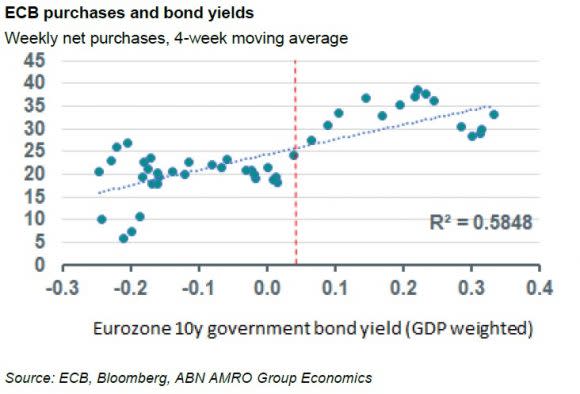
Last week, the average bond yield moved up to above 10bp, compared to levels of around -0.2% at the end of January. However, this week yields dropped again to levels of around 5bp (shown by the red dotted line in the chart). As can be seen, this is getting quite close to the level, which has been consistent with an acceleration in the pace of net purchases in the past. So we may not be too far off more decisive action.
The yield levels the ECB finds acceptable is also determined by the growth and inflation outlook. For instance, if the ECB becomes more optimistic about the inflation outlook, it would likely be more comfortable with a tightening of financial conditions and vice versa. Although the ECB will likely raise its inflation forecast for 2021 in its upcoming macro projections, we think that if anything the outlook for 2022 and 2023 has deteriorated given the rise in yields, the euro exchange rate and oil prices, which each will weigh on economic growth. As such the ECB is likely to remain committed to fighting against any further rise in bond yields.
We think a step up in the pace of net asset purchases is the first and most obvious point of call for the ECB. Raising the size of the PEPP envelope does not seem necessary at this point given the ammunition that is already in place. Another additional option for the central bank is to strengthen its forward guidance (see here for more) in order to reign in expectations of relatively early ECB deposit rate hikes. Finally, the ECB has kept the option of cutting the deposit rate on the table, however we think this is more likely to be last resort, given the negative externalities this could have on the banking sector.