Global Daily – Three scenarios for OPEC+
OPEC+ postpones its meeting until further notice – During the OPEC+ Joint Ministerial Monitoring Committee (JMMC) consultations last week, it already became clear that it would not be easy to find an agreement on production levels.

ABN AMRO Group Economics
Author has left Group Economics, see text
This article is written by Hans van Cleef
In particular, the United Arab Emirates, Iraq and Kazakhstan wanted an adjustment of the base level from which production should be calculated. This disagreement led to a postponement of the official OPEC+ decision until today after no agreement could be found on Thursday and Friday. However, again, no compromise has been reached today and the talks have been suspended until further notice.
The conflict was triggered by the fact that the UAE wanted an increase in its reference production level. This was set in April 2020 at a production capacity of about 3.2 million barrels per day (mb/d). But as production capacity has since been increased to 4 mb/d, the UAE wants an adjustment. This would mean that in addition to a joint production increase, they would be allowed to produce additional oil.Major importers like India, China and the US are calling on OPEC+ to increase oil production. The International Energy Agency has also called on OPEC+ to increase production to halt the price rise. But with the failure of the talks, oil prices jumped to their highest level in six years before the move subsequently ran out of steam and eased again somewhat.
As the current production agreement runs until the end of July, there is still time to reach an agreement for August and beyond. We see three scenarios for the coming weeks:
1) OPEC+ come to an agreement in the coming days/weeks (before Aug 1). Oil production is increased as proposed and the deal is extended to December 2022. The production cut agreement would then be fully reversed by the end of 2022 and producers would then be producing at similar levels as before the April 2020 corona measures. The oil price would fall. (50% probability)
2) OPEC+ sticks to the current July 2021 agreement. This further increases scarcity in the market as oil demand continues to pick up. The oil price rises and breaks through the long-term downward trend that started in 2008. The upside price potential would then be high (at least to USD 86-87/barrel = 100% retracement level and highest level in 2018). (20% probability)
3) There is no agreement and the OPEC+ cooperation is dissolved. Each country will, as in March 2020, again produce at its own discretion. Oil production will increase rapidly and oil prices will fall sharply. (30% probability)
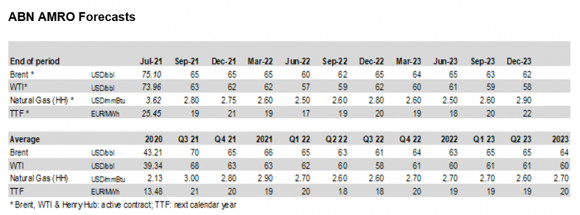
Our oil price estimates have recently been revised. Although the risks of alternative scenarios have now increased, we are sticking to our current base case for the time being. The current estimates are show in the table below. (Hans van Cleef)