Housing market monitor - Lower housing costs for those who can afford it

Housing affordability is a central theme in the public debate. It is often assessed based on aggregate indicators such as home prices and average incomes. In recent years these indicators have painted a seemingly reassuring picture, despite a doubling of home prices. Income growth outpaced rising housing costs, causing average housing cost ratios to decline. However, this picture masks the significant differences between households. The Dutch housing market is characterized by clear dividing lines. Homeowners accumulate an advantage over time because their incomes rise while their mortgage payments remain relatively stable. Meanwhile, renters and first-time homebuyers are confronted with rent increases and rising house prices. Furthermore, there are significant differences between the major cities and the rest of the Netherlands. It is therefore necessary to look beyond averages and break down housing costs by rental versus ownership, young versus old, and by region. This analysis shows that the perceived improvement in housing costs is unevenly distributed. Existing homeowners benefit the most, while first-time homebuyers and young renters—particularly in the four major cities—saw their housing cost ratios rise or barely decline. At the same time, it appears that younger buyers and renters are achieving their seemingly stable or declining housing costs in part by downsizing. When living space is considered, they are paying more per square meter. The general, aggregated picture of declining housing costs thus masks a growing gap in affordability and housing quality between groups of households. Average trends therefore provide insufficient insight into who is actually better off.

Mike Langen
Senior Economist Housing Market

Putting house price increases into perspective
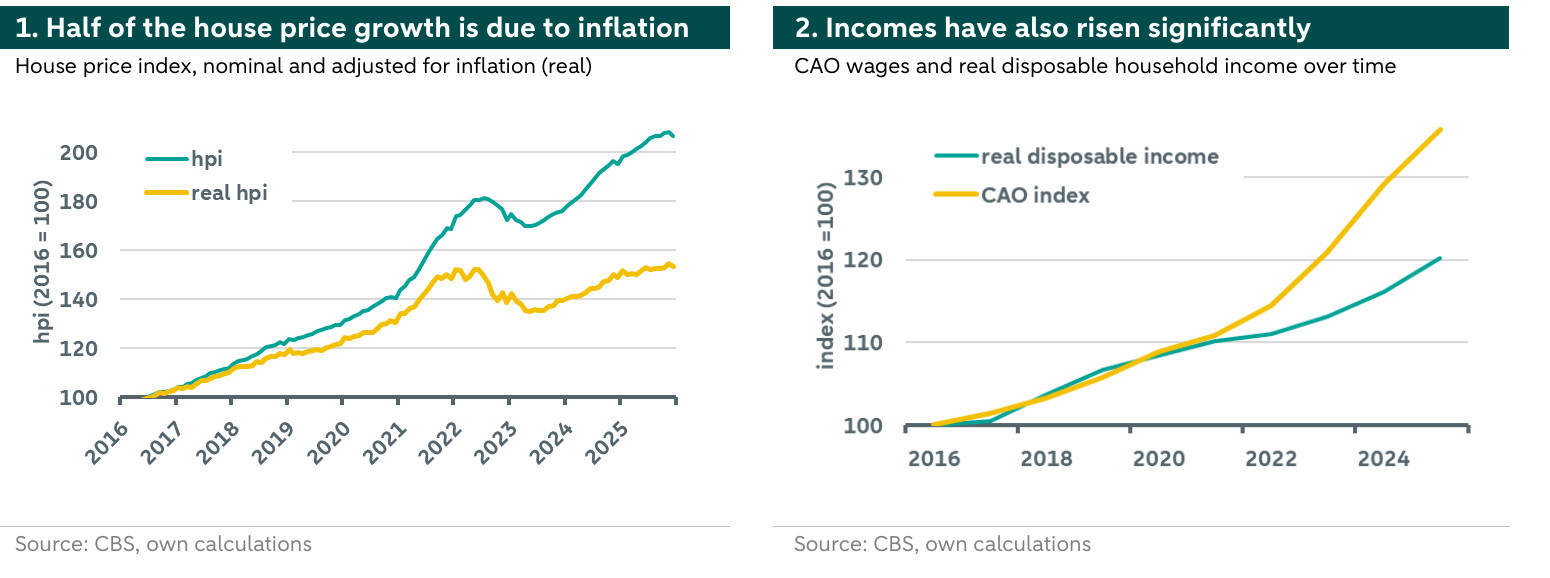
Half of the rise in Dutch home prices can be attributed to inflation. Dutch home prices have more than doubled over the past ten years, causing many households to worry about the affordability of owner-occupied homes. Young people are particularly concerned because they often feel more pressure to move, for example, due to a job change or a change in their household situation. At the same time, they often lack the financial means to do so. However, the past decade has also been characterized by abnormally high inflation. How does this fit together? In the public debate, the emphasis is usually on the nominal rise in home prices, without taking into account the effect of inflation. Figure 1 shows the Dutch nominal house price index (HPI) as published by Statistics Netherlands (CBS) and frequently used in the media. In addition, the figure shows the real increase in house prices, i.e., house prices adjusted for inflation. While nominal house prices rose by approximately 100%, real house prices increased by about 50% over the same period. Thus, roughly half of the nominal price increase can be attributed to inflation.
Just like home prices, incomes have also risen sharply over the past decade. Although homebuyers may not immediately see the difference between nominal and real home prices, this distinction is important. Over a longer period, inflation is accompanied by income growth. Pensions and wages, particularly those covered by collective bargaining agreements (CAOs), are regularly adjusted to maintain purchasing power. Figure 2 shows two income indicators over the past ten years. The first is the CBS CAO index, which tracks average wage growth under collective bargaining agreements. This index rose by approximately 35%, which is significant, as the increase was only 15.5% during the 2005–2015 period. In addition, we show real disposable household income as a second indicator. This broader measure not only adjusts for inflation but also accounts for changes in the tax and benefit systems. Real disposable income has risen by about 20% over the past ten years, 1 significantly higher than in the previous ten years, when real income grew by 4.3%. Due to this historically high income growth households can borrow more and demand for housing has increased.
Comparing housing costs at the household level is a better way to avoid the insider-outsider trap. In real terms, house prices have thus also risen faster than income growth, but by a much smaller amount than in nominal terms. However, these aggregated price and income indices paint an incomplete picture. The Dutch housing market faces a problem that is not sufficiently reflected in statistics on national averages: the insider-outsider problem. Insiders, most homeowners, have relatively favourable housing costs: their income typically rises over time, while their mortgage payments remain the same or decrease. On the other hand, there are outsiders who want to buy a home but are finding it increasingly difficult to enter the housing market due to rising home prices. It is therefore possible that the consequences of the trends shown have a different impact on insiders and outsiders. When discussing housing affordability, it is therefore better to look at housing costs at the household level. To do this, we calculate actual housing costs as a percentage of income, all at the household level. This avoids comparisons between different groups.
We map out the housing costs of owners and renters in the private sector. In this edition of the housing market monitor, we examine housing cost ratios. We focus on regional differences, differences between first-time buyers and existing homeowners, and differences between homeowners and renters in the private rental market. Our goal is to compare these groups and paint a picture of housing costs and their development over time. We focus on homeowners and renters in the private rental sector. Only homeowners with an outstanding mortgage who are employed are included. Homeowners who have paid off their mortgage, are self-employed, or receive a pension are not included. We focus on tenants in the private rental sector and not on tenants in the social housing sector, because tenants in the private rental sector generally share more similarities with homeowners. They are the most likely to be the next group to enter the owners market. Furthermore, renting in the private sector is often seen as a temporary solution before purchasing a home. We use aggregated and anonymized bank transaction data as a basis to estimate the housing cost ratios of approximately 200,000 households. This publication builds on a previous analysis, in which we discuss the methodology in greater detail. For a summary of the methodology also see the information box below.
Overall, we see declining housing cost ratios across all regions
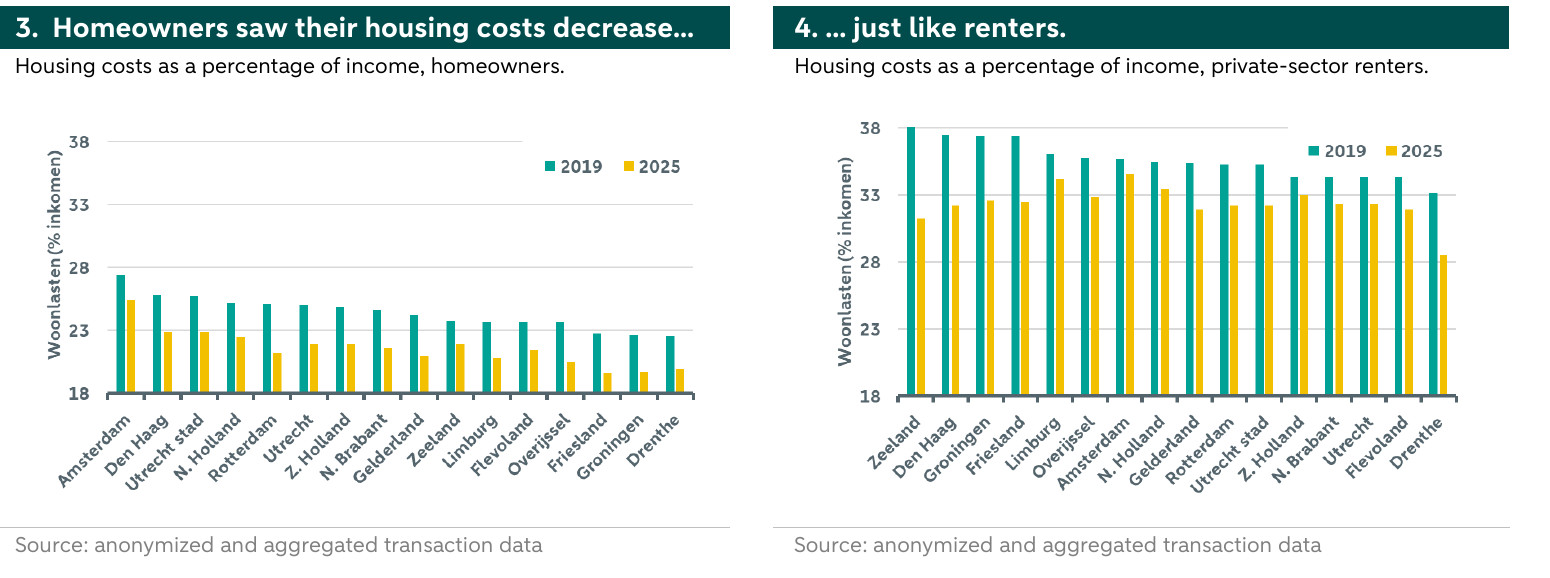
Homeowners have much lower housing costs than tenants in the private rental sector. Just as home prices vary significantly across the Netherlands and over time, we can expect similar regional differences in housing cost ratios. Figure 3 shows the median housing cost ratios for homeowners with a mortgage by region in 2019 and 2025. The median housing cost ratios range from 20 to 28 percent. Housing cost ratios declined in all regions over time. The largest cities consistently show the highest ratios: Amsterdam, The Hague, and Utrecht remain at the top throughout the entire period. Rotterdam stands out for having the largest decline. Median housing cost ratios have fallen by nearly 15.5 percentage points over six years. As a result, some rural provinces, such as Zeeland, North Brabant, and Flevoland, show higher ratios than Rotterdam these days. Figure 4 shows the housing cost ratios for private-sector renters. Here, too, we see that the ratios have fallen in all regions. In general, renters have much higher housing cost ratios, ranging from 28 to 38 percent. Except for Amsterdam, the major cities are not among the regions with the highest housing cost ratios for renters in 2025.
Incomes rose faster than housing costs, but this does not necessarily apply to all households. Changes in housing cost ratios over time can be explained by the interplay between increases in housing costs and income. To illustrate this for homeowners, Rotterdam, saw the strongest median income growth between 2019 and 2025 (by about 26%), followed by Amsterdam and Flevoland. Housing costs rose the most in Amsterdam (by approximately 13%), followed by Flevoland and Rotterdam. Utrecht is the outlier in the opposite direction: it experienced both the lowest income growth and the lowest 2 growth in housing costs, resulting in a more modest but still positive decline in the housing cost ratio. However, median income growth is not necessarily explained by the increase in income among existing households, but may also be the result of the influx of new, high-income households. One example of this may be Flevoland, where many households have moved to from the Amsterdam region. Additionally, we see an increase in the average age of mortgage holders in the four largest cities, indicating a demographic shift toward more older homeowners.
First-time buyers experience declining housing cost ratios less frequently than older homeowners
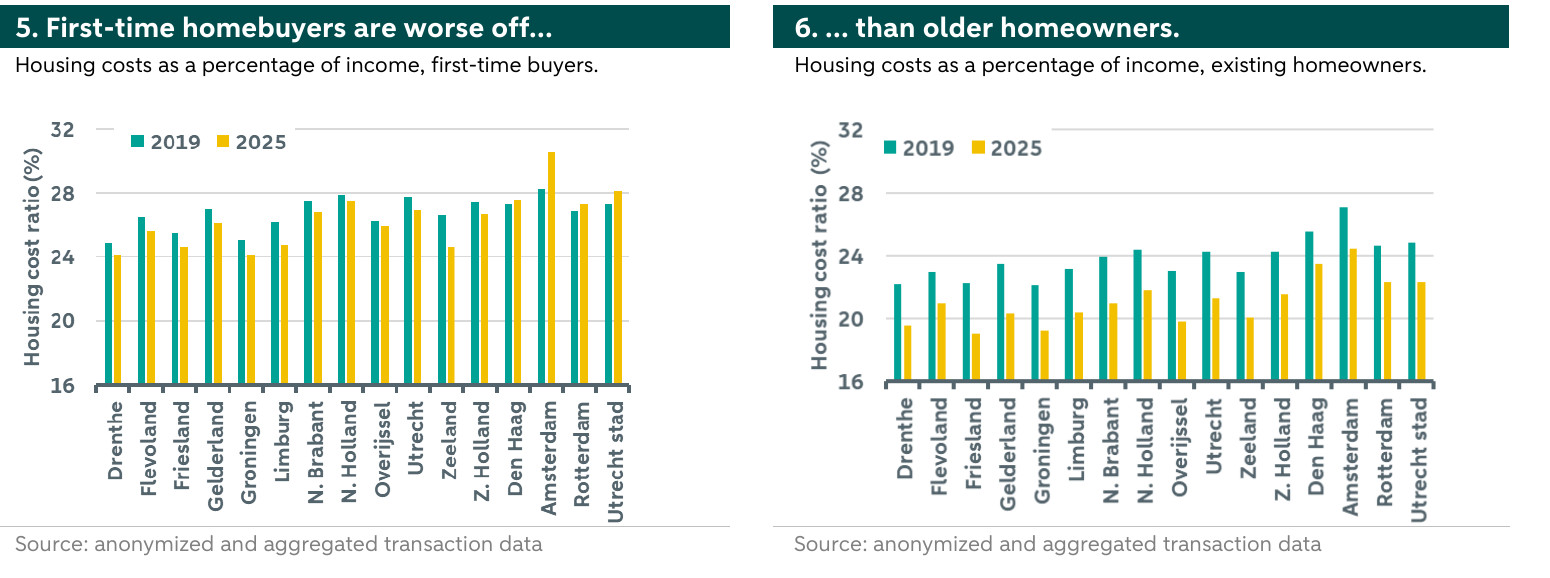
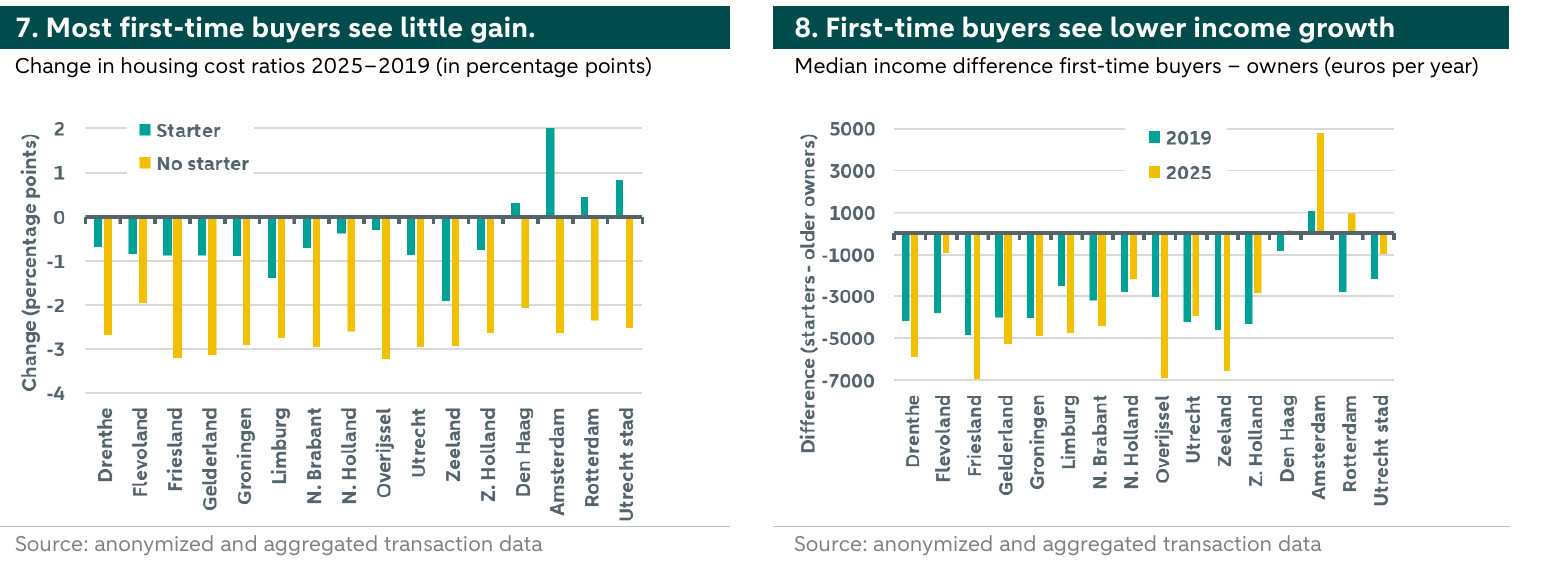
First-time homebuyers have higher housing cost ratios than older homeowners. In addition to differences in housing costs between renters and buyers, we also see generational differences. Younger households often have fewer financial resources and are faced with high home prices. Furthermore, part of the decline in housing cost ratios is explained by homeowners paying off their mortgages or moving and using equity to reduce their mortgage costs. That is why we distinguish in Figures 5 and 6 between regional housing cost ratios for first-time buyers and non-first-time buyers.[1] The figures show that first-time buyers in all regions have consistently higher housing costs than existing homeowners. While housing cost ratios for first-time buyers declined in most provinces, they rose in the major cities. Figure 6 shows that housing cost ratios for existing homeowners declined in all regions. The magnitude of the change in housing costs is summarized in Figure 7. In the period 2019–2025, housing cost ratios for existing homeowners fell, allowing this group to spend 2 to 3 percent of their net income on other things. For first-time buyers, that percentage is much lower: about 1 percentage point. First-time buyers in major cities have to pay more, up to 2 percentage points more in Amsterdam.
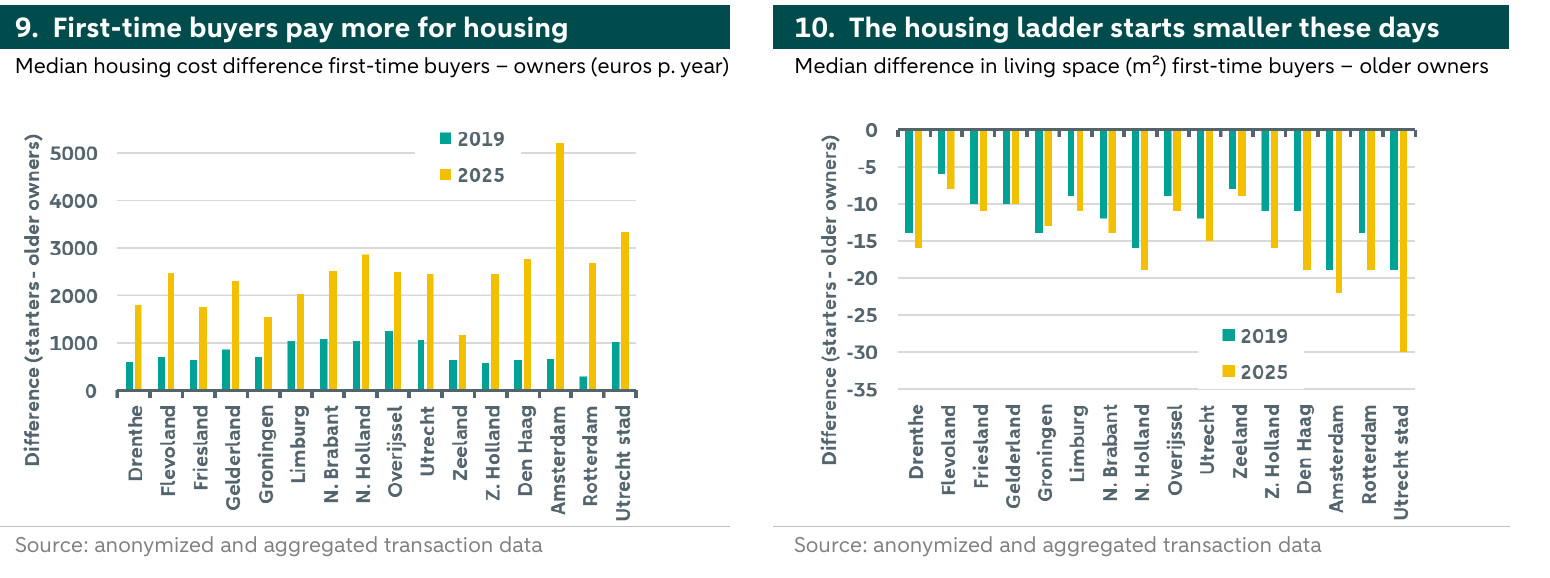
The gap between first-time homebuyers and older homeowners is widening over time. Figures 8, 9, and 10 show the differences in income, housing costs, and living space between first-time homebuyers and established homeowners. Figure 8 shows that first-time homebuyers generally have lower incomes than older homeowners. It is striking that in most regions, this difference has increased slightly over time. Once again, the major cities present a different picture. There, income differences are decreasing. In Amsterdam and Rotterdam, the median income of first-time buyers is even higher today, pointing at a selection effect: Only those with a substantial income can afford to buy a home. Figure 9 shows that the difference in housing costs between existing homeowners and first-time buyers has increased in most regions. In Amsterdam, first-time buyers pay an average of 5,000 euros more per year, followed by Utrecht at 3,000 euros. Figure 10 shows that homes of first-time buyers are on average 10 to 15 m² smaller than those of existing homeowners. It is striking that this difference has increased everywhere. In Utrecht, the difference has even increased by 12 m2.
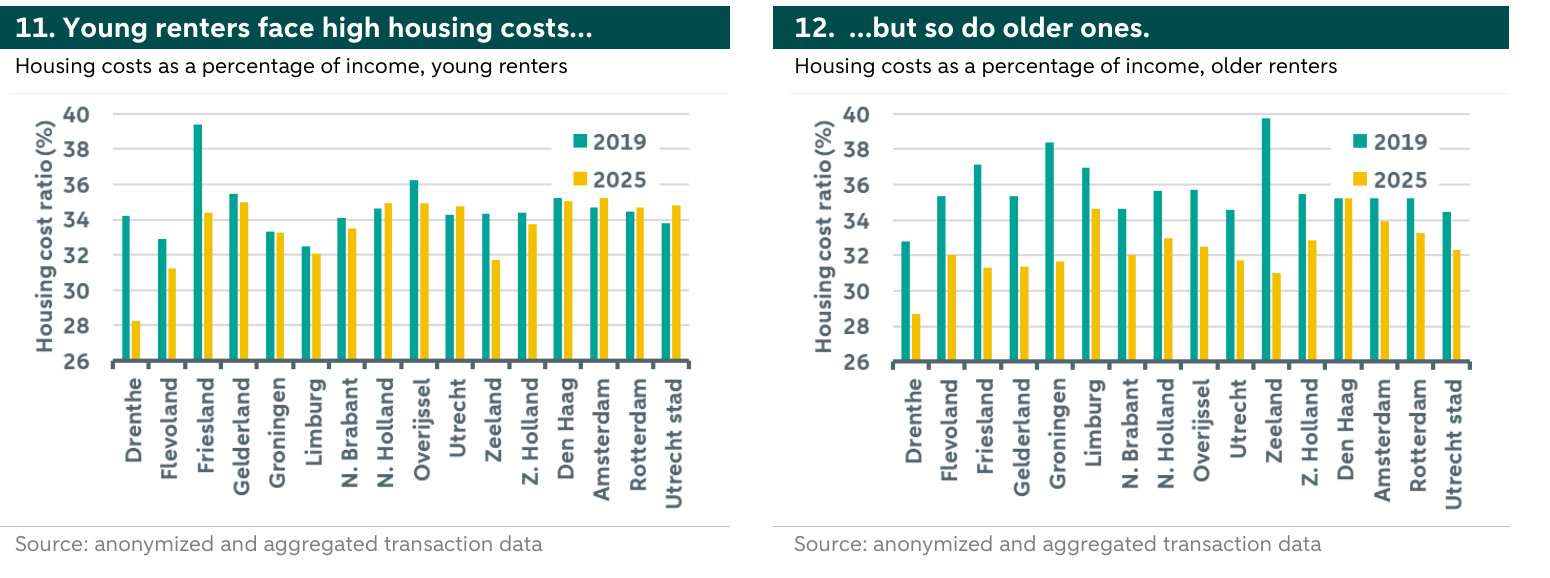
Among renters, generational differences are much less pronounced. We also examine the generational difference in the private rental market. To do so, we form two groups, young renters and old renters, using the same age cutoff as for homebuyers. Figures 11 and 12 show the housing cost ratios for these groups. When we compare the two figures, we see that the generational gap in the private rental segment is limited. This makes sense, since renters do not accumulate an age related advantage by, for example, paying off their mortgage. Nevertheless, we observe that some differences emerge over time. Except for Drenthe and Friesland, there is hardly any improvement in housing cost ratios among young renters. Worse still, in Amsterdam, Rotterdam, and Utrecht, these ratios are increasing. Among older renters, however, there is an improvement in all regions. The dynamics are similar to those in the owner-occupied segment. The income of older tenants has increased more significantly. Additionally, older tenants often have long-term leases that, while adjusted annually for inflation and other factors, result in lower rent increases than those in new leases.
The transition from renting to buying is becoming increasingly difficult
First-time homebuyers have a lower housing cost ratio than their peers who rent. Anecdotal evidence suggests that renting in the open market is just as expensive as buying a home. This is particularly true when rental prices are compared to monthly mortgage payments adjusted for mortgage interest deductions. That is why some people consider renting a waste of money. But is renting or buying really just a lifestyle choice, or do these groups exhibit different characteristics in terms of income and expenses? We investigate this by comparing the income and expenses of young renters and first-time homebuyers. When we compare Figures 5 and 11, we see that first-time buyers have lower housing cost ratios than their young peers who rent. For most regions, however, the difference is small, often only 2 to 5 percentage points of income. In 4 principle, buying is therefore cheaper. But when we take income differences into account, the housing cost ratios can be misleading.
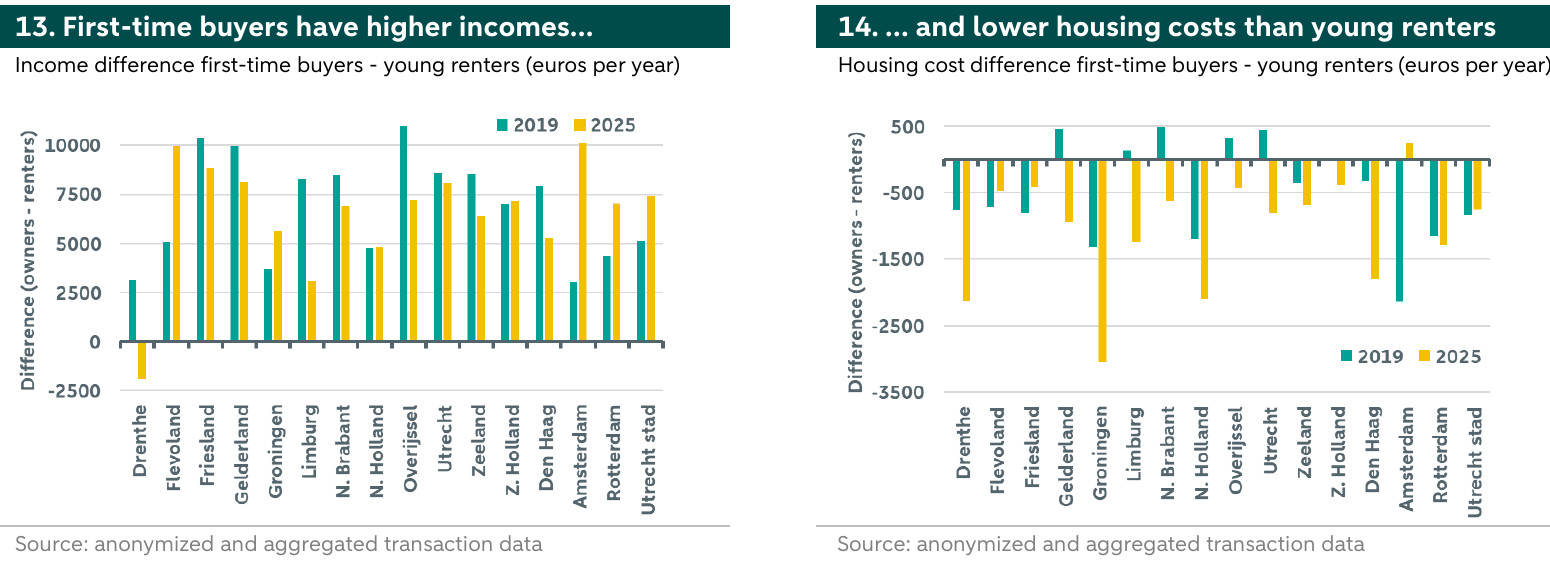
First-time homebuyers earn slightly more and are slightly older than their peers who rent. Figure 13 shows the median income difference between first-time homebuyers and young renters by region over time. With one exception, first-time homebuyers have a higher income than young renters. No clear overall trend over time is observable, but regional patterns vary. In some regions, the gap is narrowing, while in others, such as Amsterdam, Rotterdam, and Utrecht, it is widening. In 2025, the gap was largest in Amsterdam, where first-time homebuyers earned more than €10,000 per year more than young renters. Figure 14 shows the corresponding difference in housing costs. It is striking that this difference is negative for most regions, meaning that first-time homebuyers pay less per year than young renters. However, the difference is modest in most regions, around €1,000 per year. Two other aspects, which are not shown here due to space constraints, complement this picture. First-time homebuyers are on average 1 to 2.5 years older than young renters (increasing over time), and they live in larger homes, with the difference ranging from 10 to 30 m2.
The transition from renting on the private market to homeownership is less straightforward than is often suggested. Based on housing costs, buying appears to be cheaper than renting. However, differences in income and age also point to a gap between buyers and renters. The transition from the private rental market to homeownership seems to require a slightly higher income. Note also that we do not look at upfront purchasing costs here. Combined with the fact that there is an age difference, this may indicate that young buyers need more time to accumulate the necessary equity. The shifts in income and age differences over time suggest that the transition from renting to buying has become more difficult. The narrowing income gaps observable in some regions also fit this reasoning. High-income renters who would previously have made the move to homeownership are now being held back, for example by high prices or insufficient savings. As a result, they remain in the private rental market longer and indirectly contribute to an increase in the median income in the private rental segment. We conclude that there is currently a significant income gap between the private rental market and the owner occupied market, which justifies the existence of a well-functioning private rental market.
Despite generally lower housing cost ratios, first-time buyers now pay more per square meter
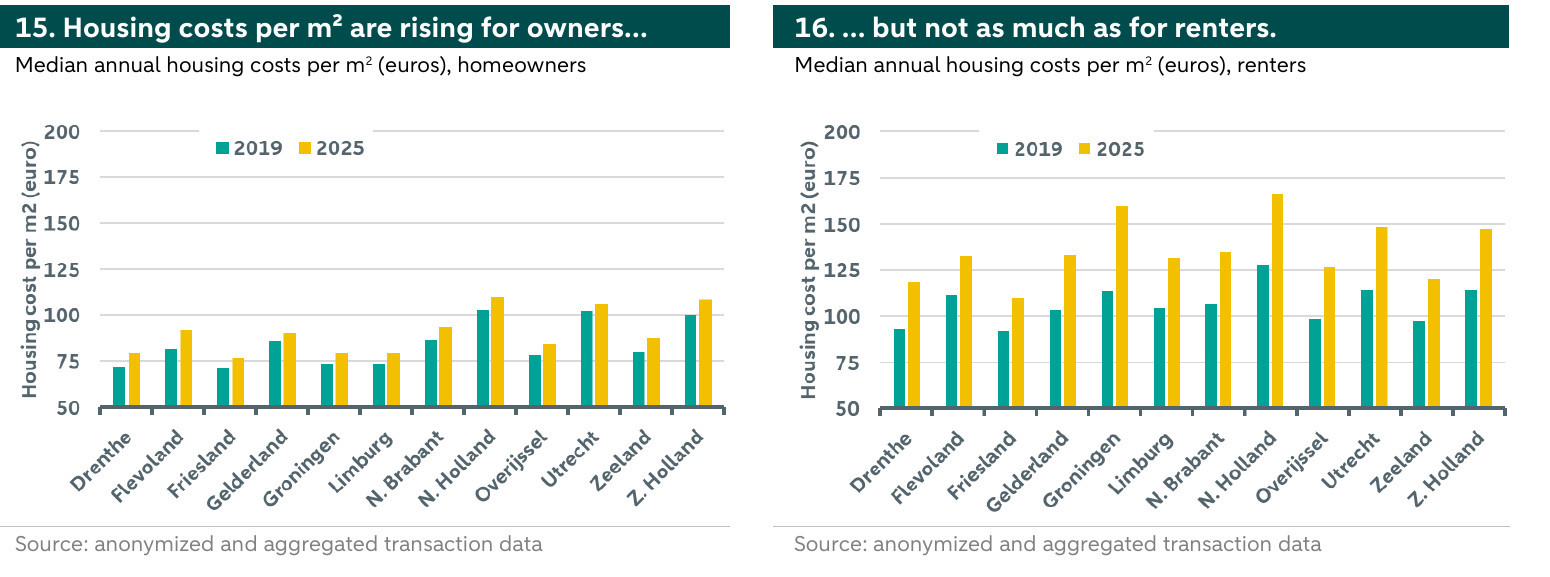
Tenants pay more per square meter than homeowners. In Figure 10, we saw that the difference in living space is increasing between first-time buyers and older homeowners. This raises the question happens to housing cost ratios when we adjust for the size (quality) of homes? As smaller homes become increasingly common, particularly in urban areas, a stable or declining housing cost in euros may mask a rising price per square meter. To illustrate this, we calculate the housing cost per square meter at the household level. Figures 15 and 16 show the annual housing costs per square meter in euros for homeowners and renters. We see that the differences between the groups persist, with renters having significantly higher housing costs than homeowners. Over the years, housing costs per square meter for renters have also risen more sharply than those for homeowners. One reason for the overall difference between the groups is that costs per square meter decrease as homes become larger. Since owner-occupied homes are generally larger, this is a possible explanation.
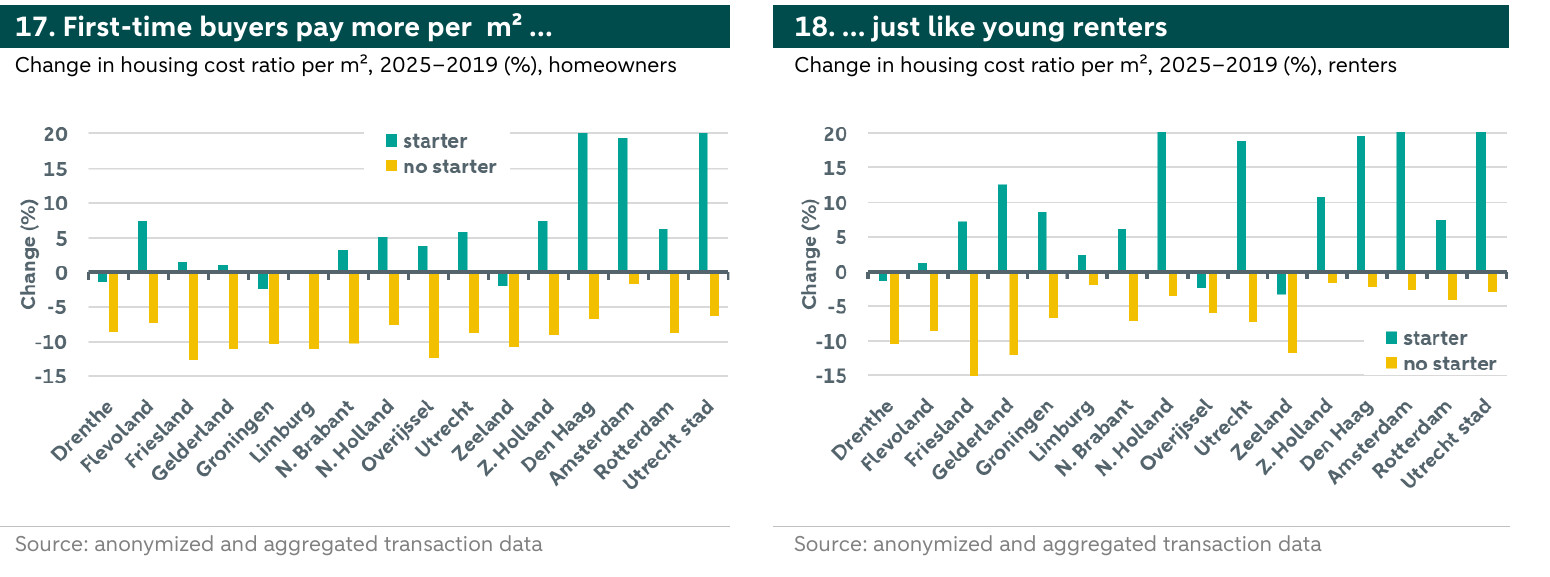
First-time buyers are paying more per m2. Figures 17 and 18 show the median change in the housing cost ratio per m² for homeowners and renters, respectively. The results differ somewhat from previous findings. While older homeowners and older renters continue to see an improvement in their housing cost ratio over time, the overall picture is different for first time homebuyers and young renters. In many regions, particularly in the four major cities, the size-adjusted housing cost ratio has risen or remained the same. First-time homebuyers and young renters now pay more per square meter than in 2019. In the major cities, first-time homebuyers pay up to 20% more, while young renters pay up to 30% more per square meter. Yet their total housing cost ratios are falling because they live in smaller homes. It is difficult to put these findings into proper perspective. Lower total housing cost ratios appear to be accompanied by lower housing quality (size). However, it could also be a natural demographic trend, in which the supply of small homes is increasing in response to the rise in the share of single-person households. In other words: the increase in the share of smaller homes is not necessarily problematic but rather aligns well with the changing needs of households. We cannot answer this question, as our data does not indicate how many members are in a household.
House prices have little impact on housing costs for existing homeowners
We examine the relationship between house prices and housing cost ratios. Finally, we want to return to house prices and their relationship with housing costs. A recurring theme in the analysis is the gap between insiders and outsiders. Housing costs for households that own their homes are generally manageable and decline over time, while those seeking to enter the housing market face a very different situation. An obvious question is whether these dynamics are also visible at the local level. We therefore focus on the municipal level and examine the relationship between housing cost ratios and median home prices in 2019 and 2025. Since the situation for renters is less straightforward, we focus exclusively on two types of buyers: first-time buyers and existing homeowners.
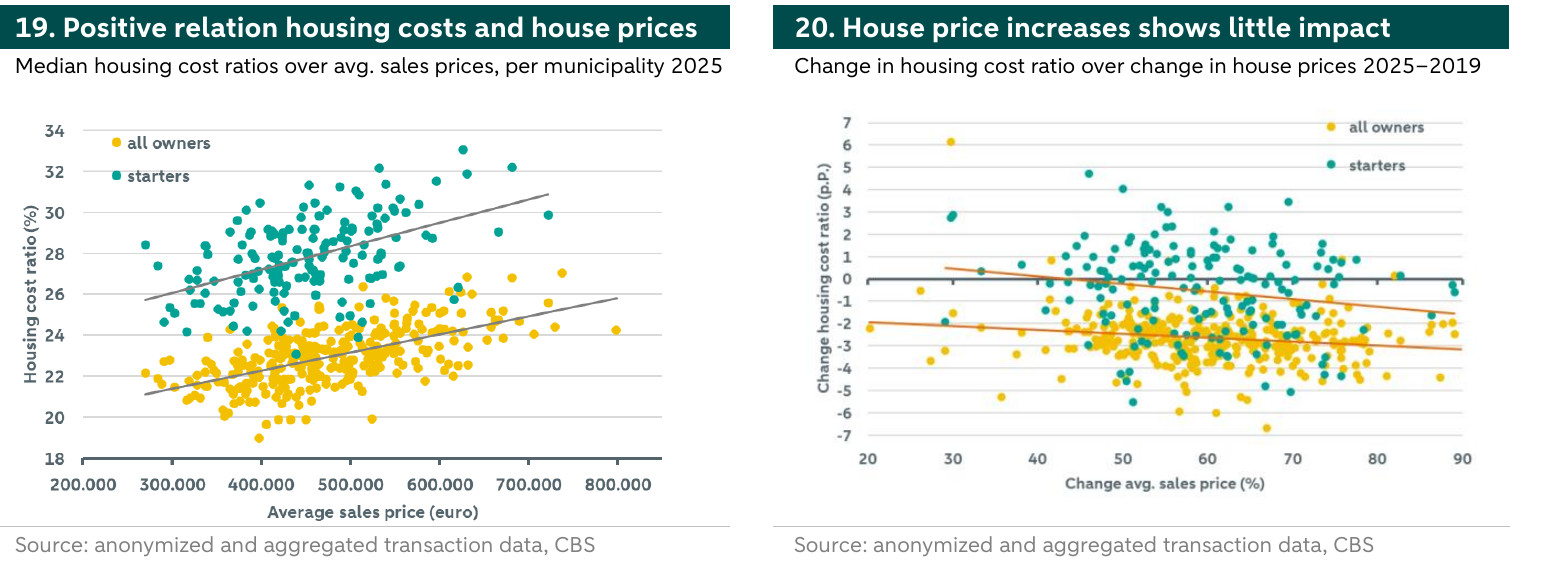
There is a weak correlation between housing cost ratios and home prices. Figure 19 shows the relationship between the average home sales price per municipality and the median housing cost ratios for first-time buyers and all homeowners in 2025. We see a positive correlation, indicating that municipalities with higher home prices also have higher housing cost ratios. The line for first-time buyers is shifted slightly upward, suggesting that they face higher housing costs in the same regions. For first-time homebuyers, the slope is also slightly steeper, indicating greater sensitivity. This makes sense, as their housing cost ratios are more closely linked to current home prices, whereas for older homeowners, housing costs, particularly mortgage payments, are more often linked to past home prices. Figure 20 shows the relationship between the change in the average sales price and the change in the housing cost ratio per municipality between 2025 and 2019. For all homeowners, we see a relatively flat line, indicating that housing cost ratios are declining almost independently of price changes. For first-time homebuyers, we observe a slightly negative relationship, although it is barely significant. This negative correlation may be caused by the so-called selection effect, whereby first-time homebuyers move to (rural) municipalities that were originally relatively inexpensive, and where housing prices—partly due to their arrival—have caught up and risen relatively sharply.
Conclusion
Our analysis shows that housing cost ratios fell between 2019 and 2025 in virtually all regions and for virtually every group. Both mortgage holders and private-sector renters saw improvements, as incomes rose faster than mortgage/rental costs. At first glance, this is favourable for the Dutch housing market. However, this improvement masks an unequal underlying dynamic. Beneath the surface, we see that the gains are unevenly distributed. The insider-outsider divide exists not only between renters and buyers but also within these groups. Housing cost ratios improved less significantly for renters in the private sector than for homeowners, and less for first-time buyers than for existing homeowners. In the four major cities, first-time homebuyers and young renters saw their ratios worsen. Furthermore, first-time buyers and young renters now pay more per square meter than in 2019. Their apparent improvement is partly due to smaller homes, meaning less space for the same money. For the debate on housing affordability, the division between insiders and outsiders is too simplistic. Who counts as an “insider” depends on age, housing type, and region. Policy discussions and affordability metrics must explicitly take this into account. Furthermore, the quality of housing must also be considered, not just the price.
[1] First-time homebuyers are defined as households headed by people aged 35 or younger, while non-first-time homebuyers are those aged 35 or older.