Warsh inherits Powell’s unfinished legacy
Tomorrow, Kevin Warsh will be sworn in as the new Chairman of the Federal Reserve. This is the first time in 40 years that the ceremony will be held at the White House. The last chairmen were all sworn in at the Fed, without the attendance of the President. Even if this is not the first time in history, the inauguration at the White House does send a signal, at a delicate moment. Insisting on normal procedure was a chance for Warsh to more cleanly distance himself from the White House, in a time where pressure on the Fed’s independence remains. Indeed, it is for that very reason that the former Chairman, Jerome Powell, decided to keep his position on the Federal Reserve Board until legal attacks on his position are resolved.


Rose Heaulme
Research Intern
The legacy of Powell
Jerome Powell’s legacy is difficult to assess cleanly, because of the simple fact that his tenure covered a very tumultuous period. He led the Federal Reserve through a sequence of very different shocks and policy regimes, from late-cycle normalization to the pandemic response and then the sharpest inflation surge in decades. The FOMC’s emergency response to the pandemic was widely praised at the time, but the insistence for too long that inflation would prove transitory will likely remain the central criticism of his chairmanship. He is rightly praised for his communication in trying times, being clear and to the point, not hiding behind technical jargon. Indeed, improvements in communication were one of the central tenants of his tenure, increasing both the frequency and the clarity of post-FOMC press conferences. We saw this again recently, in a video response to the lawsuits initiated against him in an attack on Fed independence, but the most memorable moment was his statement around the time when the Fed did start hiking in response to the post-pandemic inflation, where he made clear that these higher rates would hurt.
The pain was less than anticipated, and no recession materialized despite the historic tightening. There is a case for giving Powell substantial credit for steering the economy toward something close to a soft landing after a historic tightening cycle. At the same time, inflation has not disappeared. One could easily point at fiscal policy and supply-side shocks as the cause, but at this point, it remains unclear whether disinflation process will prove durable.
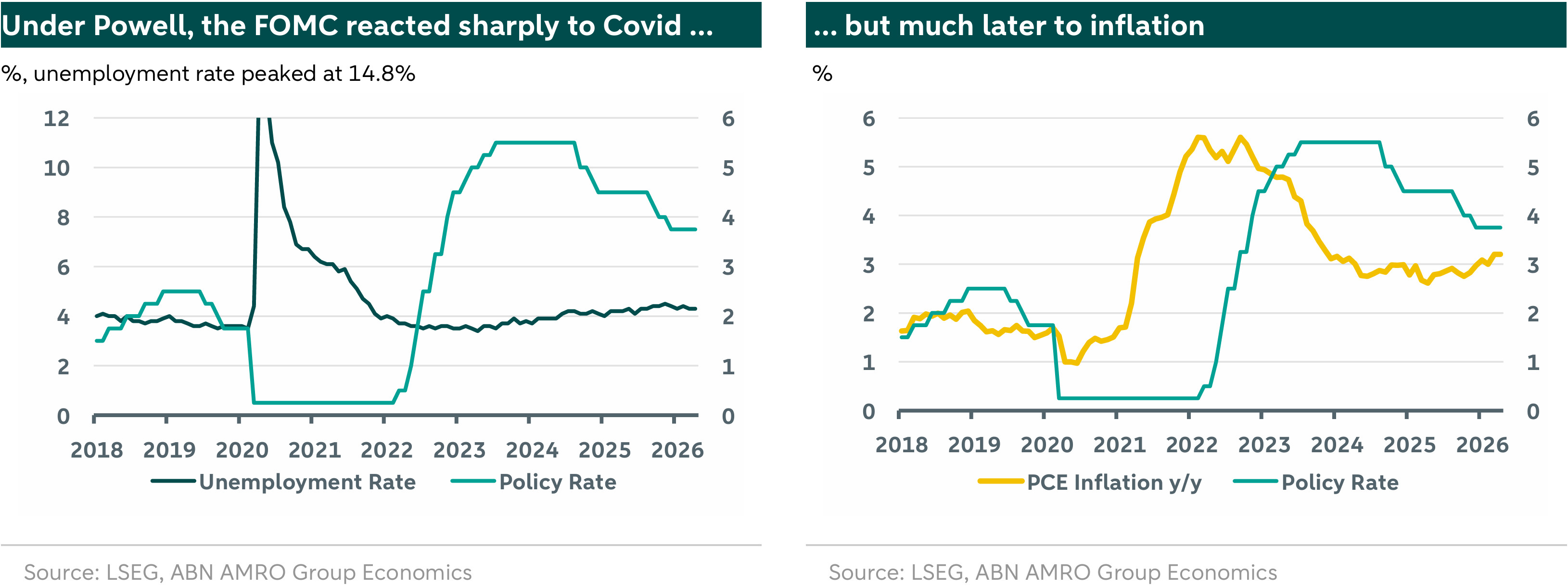
Powell’s Fed was also marked by an unusually consensus-driven style. Dissents were rare, but that may also have contributed to policy moving too slowly when conditions were shifting rapidly. The framework review that led to the adoption of flexible average inflation targeting reinforced that tendency and was part of the reason the Fed fell behind the curve when inflation accelerated.
Still, once the Fed recognized the inflation problem, it moved aggressively, delivering 525 basis points of tightening over a short period. Once conditions appeared to change again, the Powell FOMC was willing to pivot quickly, including the infamous 50bp ‘jumbo’ cut in September 2024. It shows a chair prepared to respond to new data rather than defend past errors indefinitely. But his actions also revealed an asymmetry in reaction function, with a greater sensitivity to labour-market weakness than to upside inflation surprises. That asymmetry may ultimately define how history remembers him.
The outlook for Warsh
Kevin Warsh inherits a difficult environment. Inflation looks likely to remain above target for an extended period, while political pressure runs in the opposite direction. Powell staunchly defended the Fed’s independence, but there does seem to be an implicit expectation from the Trump administration that Kevin Warsh will deliver on lowering rates. An FOMC unwilling to deliver them would leave any incoming chair in a difficult position. He could hold rates steady and wait, but that would quickly invite political backlash, much as Powell himself became a target within months when he became chair. Alternatively, he could push for easing against committee resistance, but that would risk exposing the limits of his power. Either route would make him look constrained.
In his communication before and since the nomination process, Warsh has been quite clear on a number of his goals. The first is that he wishes to lower rates on the back of a golden era of productivity growth induced by AI. There is very little support for this view, from us, but more importantly in the FOMC. In the current environment with elevated inflation, the potential inflationary pressures that higher business investment and consumer spending related to AI entail are simply more pressing. His second goal is reducing the footprint of the Fed on markets by shrinking the balance sheet. Here, as we’ve previously written, market constraints will prevent any quick action or success. Then there is his view that the Fed is ‘hyper-talkative.’ He argues that the chairman, and especially other FOMC members communicate too frequently. In an oft-cited 2025 speech he noted that ‘once policymakers reveal their economic forecast, they can become prisoners of their own words.’ We see this as the only place where he can quickly instil ‘regime-change’ and garner some quick successes. We think it likely that we’ll see some action on this front in the next 6 to 12 months.
What could we expect from a change in communication? A clear first target is the set of projections that is published on a quarterly basis, which contains a distribution of FOMC members’ forecasts for growth, inflation and the unemployment rate, as well as the dot plot, which signals where individual FOMC members see the policy rate at specific points in the future. This report may be partly or fully abolished, or simply altered. A second clear target is stricter regulation of public appearances and speeches by FOMC members. Over the past years, there have been frequent appearances by FOMC members in panels and keynotes where they communicate their own view on the economy, which provides the distribution around the consensus view. Sometimes these move markets, even if their views are not shared by the entire FOMC. A final avenue are his own press conferences. Powell instigated press conferences accompanying every FOMC meeting in 2019. Before that, then Fed chairman Bernanke introduced conferences following half the meetings in 2011. We do not expect a return to no press conferences, but halving the number of press conferences is an actual possibility. Academic research could even support some of these changes [1]. Fed communication has become policy tool in its own right, but it really tends to be the press conference by the chair that provides a strong signal, while many of the individual FOMC members appearances merely add noise to that signal. Reducing transparency may therefore lower internal noise, but it could also weaken an important channel of policy transmission. At the very least, it would elevate the impact of the moments where the Fed does communicate, potentially leading to larger and more abrupt changes
Beyond his major pillars, we think Warsh could seek to leave his mark, and appease the Trump administration, through an investigation into the building renovation that was used as a precursor for attacks on Powell, or, more importantly, an external review of the Fed’s framework. There was no external review of the Fed’s policy response to the pandemic and inflation overshoot, which has led to quite some criticism. It would fit a chair intent on signalling a break with the Powell era, especially after criticism that the Fed did not interrogate its own mistakes forcefully enough when inflation first proved persistent. Ultimately, such a report may provide fuel for other sweeping changes to the Fed’s monetary policy framework, opening the door for his other goals.
The move from Powell to Warsh is unlikely to simply be a change of personnel. Powell’s legacy remains unfinished because inflation has reaccelerated before the story could close cleanly. Warsh is in a difficult position. He could help restore credibility that he has advocated the Fed lacks by finishing the inflation fight. But he could also repeat the same mistakes in a different form. Too much confidence in a benign supply story could lead to the Warsh Fed facing the same black spot on the Powell Fed’s record: a repeat of the post-pandemic saga with inflation picking up strongly and the Fed falling behind the curve.