I’m dreaming of a mild winter
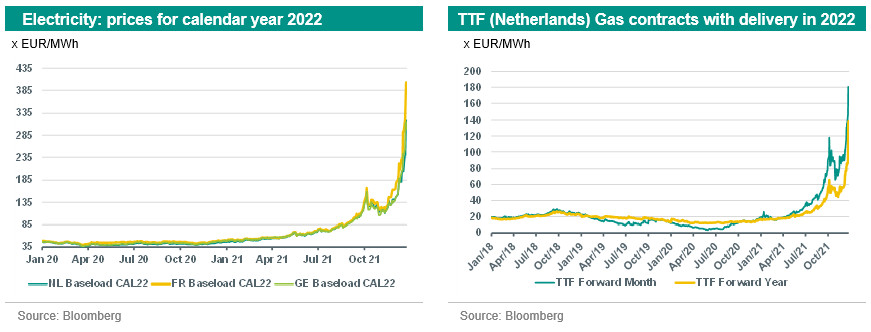
Just before Christmas, there is usually plenty of speculation as to whether it will snow or not. A white Christmas brings the ultimate Christmas feeling for many. However, today many consumers are mainly concerned about their energy bills. Dreaming of a white Christmas' is being replaced by 'hoping for a mild winter'. After all, energy prices are skyrocketing. Not only have Title Transfer Facility (TTF) gas prices reached new record heights and have risen by 800% since the start of the year before easing somewhat, while coal prices are also still relatively high. The relatively low availability of sustainable energy in recent weeks has increased the demand for energy from coal and gas-fired power stations. At the same time, this has caused the demand for CO2 rights under the European Emissions Trading System (EU ETS) to rise sharply. Here too, new record prices have been set recently. On top of that, some French nuclear power plants were shut down last week due to unexpected maintenance. All this leads to tightness in the supply of electricity and have risen with more than 550% since the start of the year to reach record highs.

ABN AMRO Group Economics
Author has left Group Economics, see text
Author: Hans van Cleef
Biggest energy crisis in decades
Energy prices are skyrocketing. Not only have Title Transfer Facility (TTF) gas prices reached new record heights and have risen by 800% since the start of the year before easing somewhat, while coal prices are also still relatively high. The relatively low availability of sustainable energy in recent weeks has increased the demand for energy from coal and gas-fired power stations. At the same time, this has caused the demand for CO2 rights under the European Emissions Trading System (EU ETS) to rise sharply. Here too, new record prices have been set recently. On top of that, some French nuclear power plants were shut down last week due to unexpected maintenance. All this leads to tightness in the supply of electricity and have risen with more than 550% since the start of the year to reach record highs. Significant price fluctuations are not unusual in the energy market. However, this time the price fluctuations are unprecedented. Even more worrying is that this time the security of supply can no longer be guaranteed at all times. The latter makes the markets nervous, and creates even more upward price pressure.
I'm dreaming of a mild winter'.
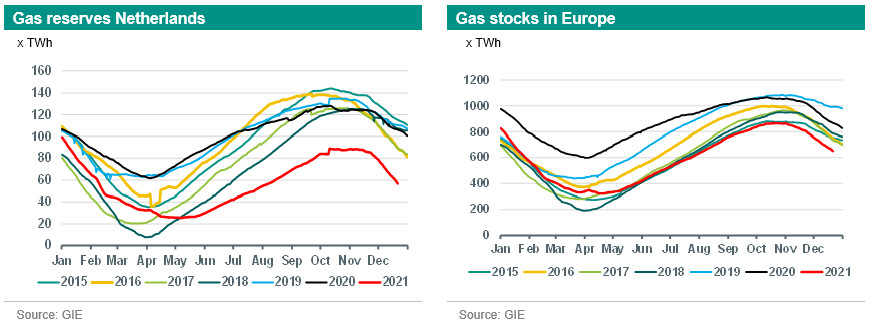
Just before Christmas, there is usually plenty of speculation as to whether it will snow or not. A white Christmas brings the ultimate Christmas feeling for many. However, today many consumers are mainly concerned about their energy bills. Dreaming of a white Christmas' is being replaced by 'hoping for a mild winter'. Only in the event of a mild winter gas inventories will possibly be just enough to prevent major problems. As can be seen from the figures below, gas stocks are at a particularly low level at the start of the winter. The chances of replenishing them in time are fading by the day. Europe does not have very many other options for importing gas. So, we will have to hope for a mild winter to limit consumption and imports as much as possible.
Gas is traded through futures contracts or at the spot market. In recent months, we have seen that virtually all the gas that was available on the spot market was shipped towards Asia. That was not surprising as the price paid in China was structurally higher than in Europe/Netherlands. But for more than a week now, the TTF (Title Transfer Facility) gas price has been higher than the price of JK LNG (Japan Korea Liquified Natural Gas). This means that the liquefied natural gas that has not yet been contracted is being shipped to Europe for the first time in ages. This is welcome as gas exports from Russia to Europe have fallen even further.
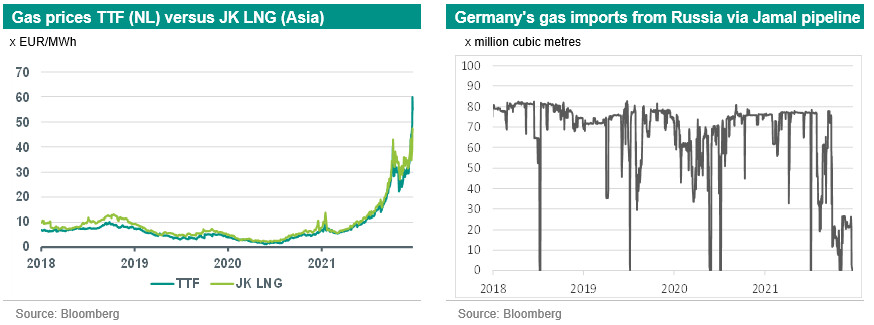
It is claimed that the Russia is consuming more domestically due to local harsh weather conditions. In addition, they are currently filling the controversial NordStream 2 pipeline with natural gas. This would make it technically possible to export gas to Germany from early January. But since the permit process has not yet been completed, this alternative does not seem politically feasible. In Europe, lower exports from Russia to Europe are seen as political pressure to get the NordStream 2 pipeline up and running more quickly, making the existing infrastructure through Ukraine redundant. This is difficult to substantiate, however, since Russia is honouring its existing contracts. Europe, on the other hand, has in recent years been less inclined to conclude long-term contracts and to renew expiring contracts.
CO2 prices very volatile
Another factor that has added to the rise of electricity prices is the rise in carbon prices. On 8 December, the price for CO2 allowances (EU ETS) reached an intraday record high of EUR 91.19/tonne. By comparison, in January of this year the average price was still around EUR 34/tonne. The European Commission's more ambitious carbon reduction strategy, which will reduce the number of emission rights at an accelerated pace in the coming years provided a first reason for price increases. As high gas prices make the burning of coal more attractive, we also saw an increase in the demand for emission rights by coal-fired power stations. Finally, these emission rights became more and more popular among speculative investors. The latter category in particular ensured that prices could rise... and fall again very quickly. Because after the record prices were reached on 8 December, a sharp drop began. Due to profit taking on speculative long positions (speculating on price increases), the price quickly fell again. On 17 December, the price was quoted at EUR 73/tonne. Since then, the price has risen only marginally as can be seen in the figure below.
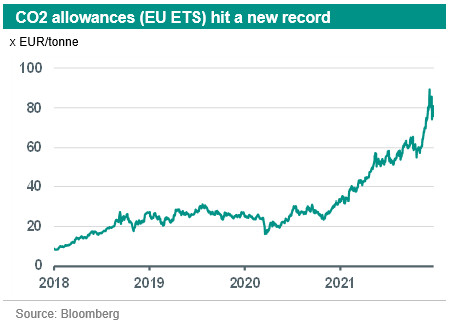
Currently, the European Commission is discussing banning this kind of market speculation. The EU ETS is an instrument that allows companies with surplus emission rights to trade them with companies that have shortages. The instrument is not primarily intended for market speculators. The fact that speculators now find the instrument very attractive means that price movements can be very erratic and unpredictable. In particular, too sharp an increase in the CO2 price would hinder rather than help investments in sustainability. Some countries like the Czech Republic, Denmark, Spain and Poland therefore argue for a ban on market speculation. However, a decision on this is not expected in the near term.
Electricity prices across Europe are skyrocketing
The problem of low gas supplies, low availability of renewable energy, the unexpected closure of four nuclear power plants in France, the restrictions on the use of coal-fired power plants and the high CO2 price is causing high electricity prices throughout Europe. Despite the fact that the electricity mix differs greatly from country to country, the prices are moving fairly hand in hand. The increasing connection between countries (import and export of electricity throughout Europe) makes the electricity more and more a regional market. As a result, a supply problem in country A can also have consequences for the electricity price in country B (see also figure on page 1). For the first quarter of 2022, the following scenarios apply (assuming average renewable energy yields and no further disruptions to generation from coal, nuclear and other energy sources):
1) We will have a mild winter. The current gas reserves - possibly supplemented with imports of available LNG - appear to be sufficient to prevent shortages. The shutdown of various sectors does not appear necessary. However, stocks will be very low after the winter, so that full efforts will have to be made to replenish them before the next winter of 2022-23.
2) We are going to have a harsh winter. The current gas reserves prove to be insufficient. The other energy sources (nuclear power stations, coal-fired power stations, etc.) are running at full capacity to generate enough electricity to meet demand. Gas is also needed for heating. The shortages can be met by:A) Scaling down certain companies/sectors. The Dutch government is working on a plan on how such a scenario will take place. B) Greater commitment to LNG imports. That means that buyers in Europe will need to pay a higher price than those in Asia. Question is whether that will be enough to meet demand. C) Reaching an agreement with Russia. This could be executed via I) the existing infrastructure through Ukraine and/or Belarus and Poland. Or II) via the NordStream 2 pipeline. Russia will have a strong preference for the latter. Technically it should be possible, but then the German regulators and the European Commission would have to make an exception to the licensing process. They will only do so in extreme cases. Many of these problems appear to be temporary. The inspection of the four nuclear power plants will determine how long they will be unavailable. The lower-than-average yield of renewable energy can be solved as soon as we have a period with, for example, more wind. However, some other factors are probably less temporary in nature. Solving the problem of low gas supply will unlikely occur before the winter is over. And it is questionable, in the current market conditions, to what extent we will be able to replenish stocks in time for the next winter. Gas and electricity prices are also rising rapidly for delivery in the coming year. Governments will therefore need to look, together with the business community, at how we can a) keep consumption in check, while b) making a greater and more conscious effort to purchase sufficient gas, and c) devising a procedure for deploying back-up capacity from other energy sources at times of possible shortage. And this, of course, in addition to the major efforts to expand the supply of renewable energy. A course of action that is determined more by the longer-term energy policy.