Ireland volatility masks solid underlying eurozone growth

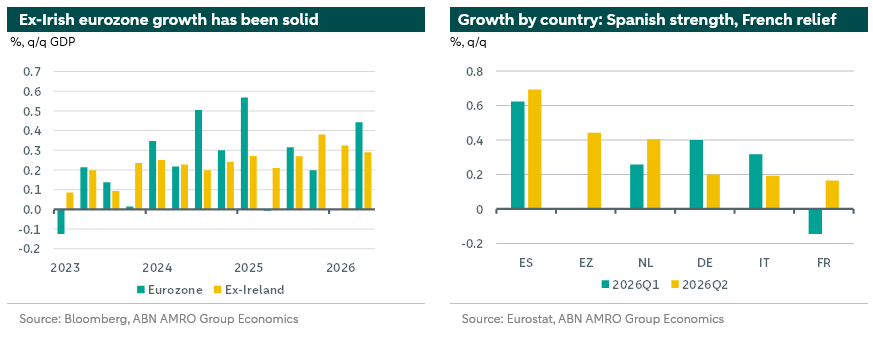
Eurozone Q2 GDP surprised to the upside at 0.4% q/q (consensus: 0.2%/ABN: 0.3%), and Q1 GDP was revised considerably higher – from a 0.2% contraction to a flat reading. Unsurprisingly, much of the surprise and the backward revision was driven by Ireland, with Q1’s massive contraction seeing yet another big revision to -7% q/q (from -12%). However, underlying growth was also revised a little higher, with Germany’s Q1 GDP growth revised up to 0.4% from 0.3%.


Germany’s recent GDP strength has been partly driven by likely temporary strength in the chemicals sector. Although chemicals suffers the same structural competitiveness problems as before from high energy prices, in Q1 the sector benefited from disruptions to flows through the Strait of Hormuz. This strength is likely to unwind over the coming quarters as Hormuz flows normalise (as we assume). With that said, German industry is seeing some general stabilisation after years of weakness, and this is being helped by the ongoing rollout of higher defence and infrastructure spending.
With regards the Q2 upside surprise, the primary driver was again Ireland, where GDP jumped 3.9% q/q, but also Germany saw growth somewhat higher than expected at 0.2%, above our 0.1% expectation. Spain again saw very strong growth of 0.7%, likely helped by a rush of spending ahead of the looming end of RRF disbursement (which ends officially in August). Decent French growth of 0.2% also comes as a relief following the 0.1% contraction in Q1. All told, eurozone GDP growth excluding the highly volatile Ireland series came in at 0.3% q/q, the same solid underlying growth reading as in Q1. The overall picture is one of resilience in the face of the global energy shock, and our base case sees that resilience broadly continuing over the coming quarters. With today’s data, our headline 2026 growth forecast reverts back to 0.8% (we had previously downgraded to 0.5% following the plunge in Irish GDP). We keep our 2027 forecast unchanged at 1.2%. (Bill Diviney & Nils Sonnenberg)
Dutch economy delivered a robust first half of 2026
Against the backdrop of continued resilience across the eurozone, the Dutch economy remained on a solid growth trajectory in Q2. Preliminary estimates show GDP expanded by 0.4% q/q, following an upwardly revised 0.3% q/q increase in Q1. The result caps a stronger-than-expected first half of 2026, particularly given the geopolitical uncertainty and higher inflation that emerged following the outbreak of the Iran conflict in February.
Recent data had already pointed to upside potential for a firm Q2 outturn. The escalation in the Middle East appears to have had some temporary but tangible effects on economic activity. Dutch manufacturing benefited from inventory accumulation and precautionary ordering amid concerns over disruptions to global supply chains, something that is also visible in the Germany figures (see above).
Private consumption rose by 0.5% q/q, underpinned by healthy household finances and resilient labour market conditions. Spending on automobiles was particularly strong. Elevated fuel prices appear to have accelerated the shift towards electric vehicles, while high savings levels provided consumers with the necessary buffer to accommodate such spending.
Looking ahead, we expect growth to moderate somewhat in the second half of the year. The temporary uplift from geopolitical-related stockbuilding and supply-chain effects is unlikely to be sustained. At the same time, we expect inflationary pressures to broaden to categories such as food, weighing modestly on real household purchasing power.
That said, the Dutch economy continues to benefit from strong structural fundamentals, including solid household finances, a tight labour market and strong demand for Dutch high-tech exports. As a result, we see the economy to remain resilient through 2026. In the coming weeks we will publish our revised full-year growth forecast. (Jan-Paul van de Kerke)