Japan - The BoJ carries on

Q2 GDP and monthly data point to strengthening growth momentum, …although risks stem from larger and longer energy shocks, rising interest rates, frictions with China and a potential slowing of the AI boom. Inflation driven up by energy shock, AI boom, and stronger wage growth. Regime shift 1: Rate hike path BoJ (we expect another hike tomorrow) and QT (although moderated) a key factor pushing up bond yields… Regime shift 2: … and so is PM Takaichi’s more expansive fiscal stance. JGB yields continued to increase, as the curve bear flattened in recent months. Lower hedging costs will only provide a small relief for OATs. Joint FX intervention countered yen weakness… but a structural shift in rate spreads and investor behaviour crucial for further yen recovery.. We expect sideways movement in the yen in the coming months and a further recovery towards the end of 2027.


Jaap Teerhuis
Senior Fixed Income Strategist
Solid GDP growth continued in Q2, driven by government spending and net exports
Japan’s growth performance has been steady recently, with annual growth rates exceeding 1% in the past three quarters. Following a strong growth print in Q1 (1.9% q/q saar), real GDP growth slowed somewhat in Q2, but at 1.4% q/q saar (upwardly revised recently) remained ‘above trend’. Japan, as large net oil importer, has been hard hit by the Iran conflict – with oil imports dropping sharply in Q2. However, the impact has been mitigated by its huge oil reserves and by diversification: oil imports from the US rose sharply in May-July, offsetting the collapse of imports from the Middle East.
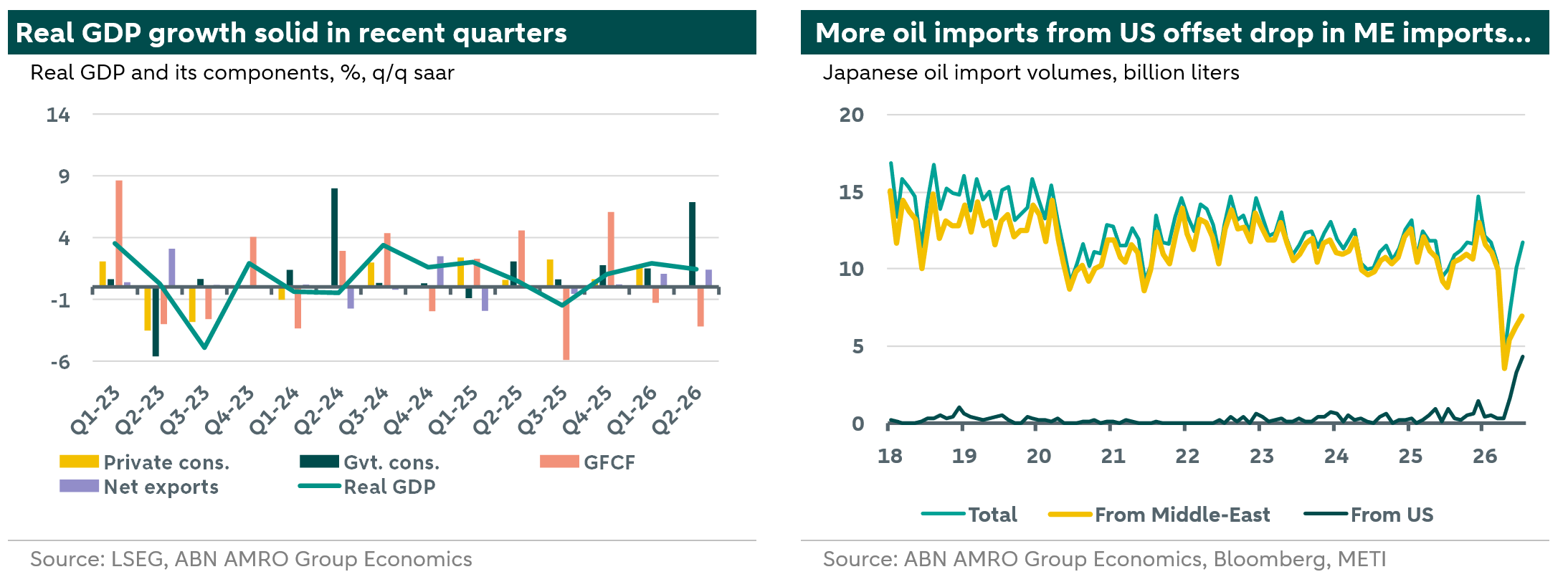
Public spending was the main contributor to quarterly growth in Q2 (+6.9% q/q saar), a reflection of the more expansive fiscal policies under Prime Minister Takaichi (see below). Net exports also contributed positively to growth in Q2, but although exports are benefiting from the ongoing global AI boom, that mainly reflected a 6.5% (annualized) drop in imports. This was driven by the plunge in energy imports, which are likely to bounce back in Q3. The contribution from private consumption was negligible, while gross fixed capital formation – a notoriously volatile component – contracted by 3.2% q/q saar. In its latest assessment (end-July), the Bank of Japan slightly upgraded its growth forecast for fiscal year 2026 (Q2-2026 until Q1-2027) to 0.6-0.7%, but this forecast may be raised further in their October assessment given the recent upward revision of Q2 GDP growth. The median consensus forecast for full-year growth in calendar year 2026 is currently 0.8% (2025: 1.2%), and has been moving up.
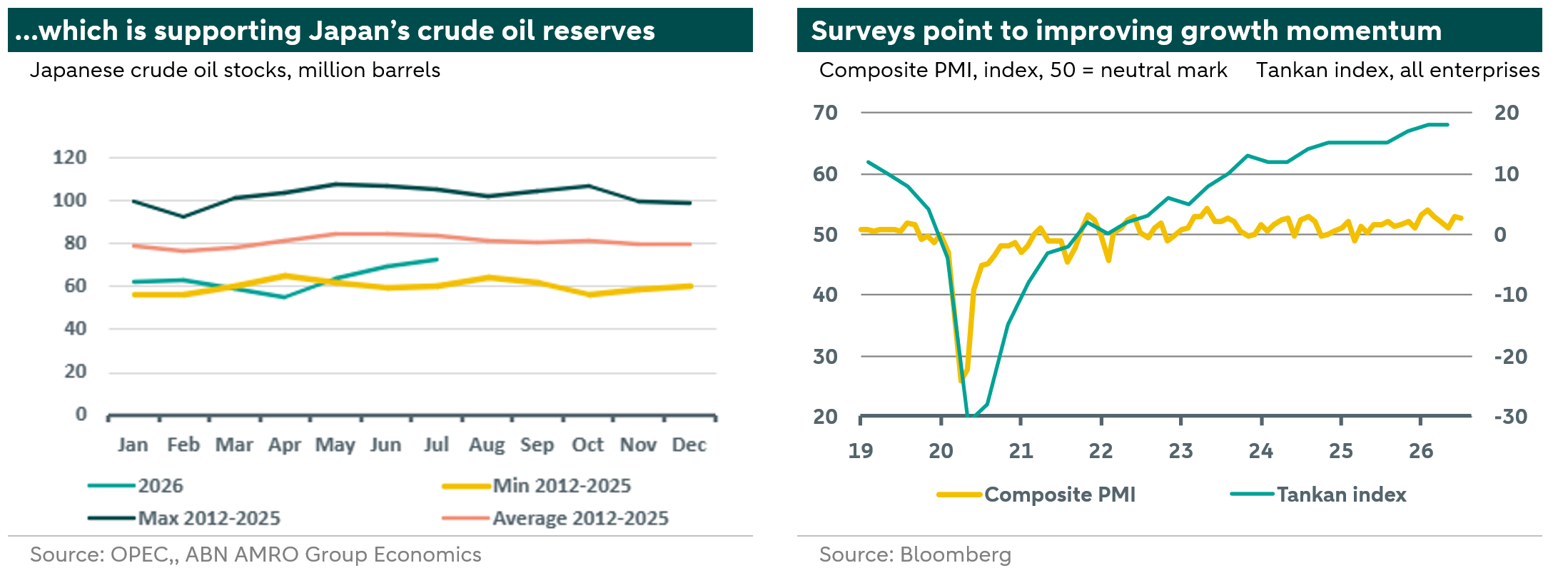
Recent monthly data also point to strengthening growth momentum
PMIs also point to strengthening momentum, despite the energy shock and other drags. The manufacturing PMI rose back to a four-month high in August (54.9), well above the neutral mark separating expansion from contraction. Industry is benefiting from the ongoing global AI boom: the manufacturing PMI’s export subindex rose to a six-month high of 53.5. The more domestically oriented services PMI rose by 1.3 points to 52.5 in August. The composite output index, which gives a picture for the whole economy, climbed back to a five-month high of 53.5, remaining well in expansion territory. The Tankan business survey points in the same direction, with the economy-wide index currently at a 35-year high. All in all, Japan’s growth outlook seems solid, but with considerable risks from the re-escalation of the Iran conflict, the sharp rise in global and Japanese bond yields, a slowing of the AI boom, and the rise of frictions with China, with for instance Chinese rare earth exports to Japan clearly coming down over the past half year.
Inflation driven up by the energy shock, AI boom and stronger wage growth
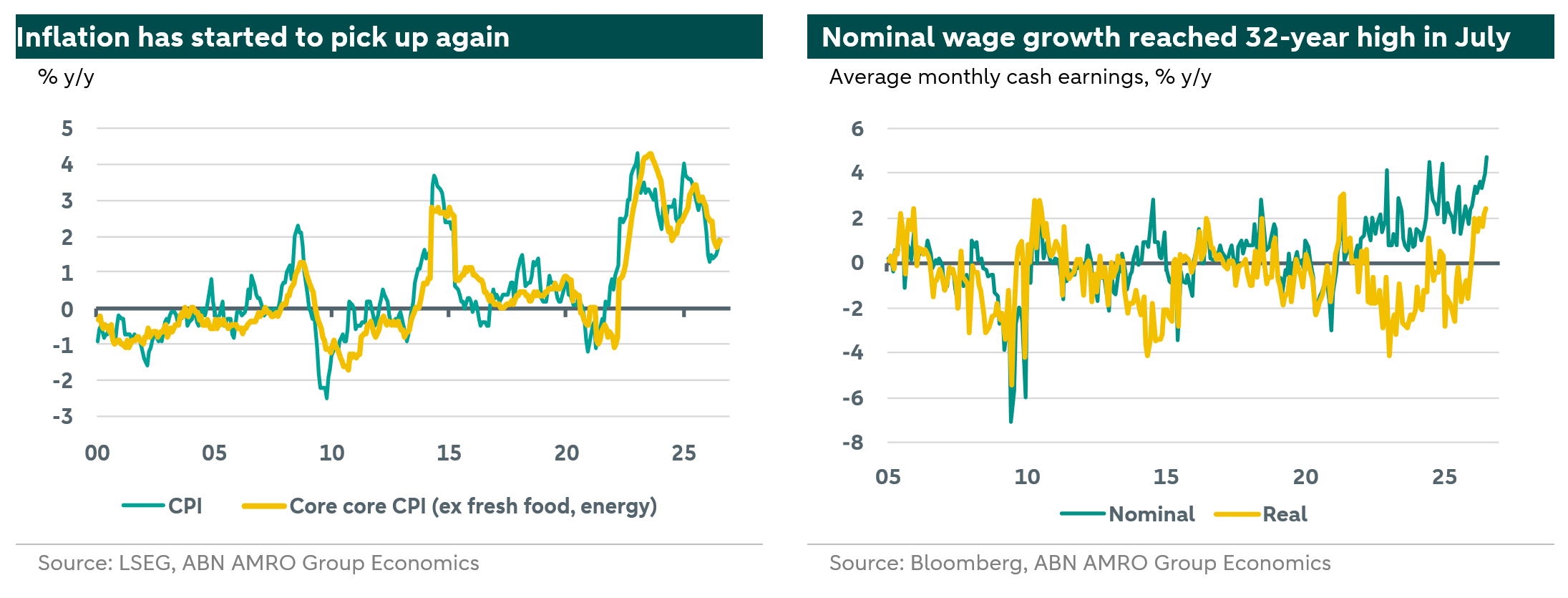
Considering that Japan comes from a long period of very low inflation and even deflation, inflation remains quite elevated. Having dropped from a cyclical peak of 4% y/y in early 2025 to a 4-year low of 1.3% y/y in February, headline CPI inflation has risen again over the past few months (to 1.9% y/y in July), driven by the energy shock. In its July assessment, the BoJ expects headline inflation to move above 2% in the course of this fiscal year, pointing to the pass-through of higher prices in energy, semiconductors and other AI related items, stronger wage growth, and (until recently) a weaker yen. Nominal wage growth reached a 32-year high in July, and real wage growth has also risen considerably during 2026. The BoJ’s median estimate for CPI inflation in the current fiscal year was reduced from 2.8% y/y to 2.5%, but that was before the renewed spike in energy prices seen over the past weeks. The BoJ expects CPI inflation to fall back to around target in FY 2027, assuming the energy spike to fade out (median estimate for FY 2027: 2.4%). Regarding core inflation, the FY 2026 median estimate for the BoJ’s reference measure – which excludes fresh food and energy – was cut marginally end-July, to 2.5% (from 2.6% in April), while the forecast for FY 2027 was kept at 2.6%. All in all, inflationary pressures are building, with no signs of an imminent easing in sight.
Regime shift 1: The Bank of Japan’s rate hike path that started in 2024 continues…,
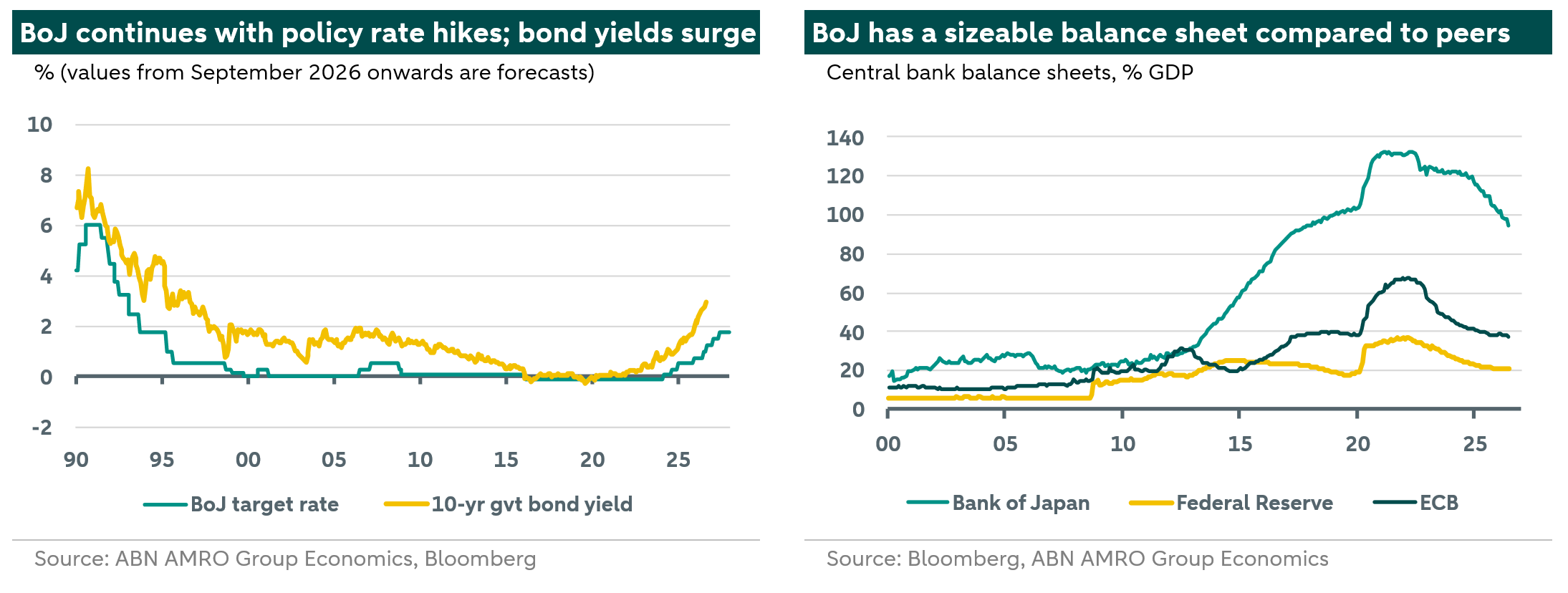
The rapid rise in Japanese bond yields (see fixed income part below) is driven by several factors, but the double regime shift in monetary and fiscal policy is certainly an important factor. Starting with monetary policy, the BoJ has followed a gradual rate hike path (in line with our view) since the central bank ended its negative-interest-rate policy in the spring of 2024. We expect the BoJ to remain on this rate hike path, with the target rate raised by 25bp, to 1.25%, on 18 September, given the resilience of growth, the pick-up in inflation and wage growth and the need to curb yen weakness. In our base case, we expect the next 25bp rate hike after September to follow around the turn of the year, and another one later in 2027, leading to a policy rate of 1.75% per end-2027. These three anticipated hikes are in line with the median consensus estimate, and a bit below what is currently being priced in by swap traders (almost four hikes per July 2027).
Why do we not expect a more aggressive rate hike path for the BoJ, even though we are now factoring in more rate hikes for the Fed and the ECB (see note here)? We think there are several reasons for this. First, given the low inflation/deflation period Japan is coming from, we think the BoJ will remain cautious with hiking too sharply, as that could jeopardize the hard-won gains in bringing inflation closer to the BoJ target. Second, it is likely that the BoJ will continue balancing their goal of normalising monetary policy with other financial stability related concerns, such as the high public debt and interest-rate sensitive consumer debt. Third, the BoJ is also unlikely to hike (much) more aggressively than market expectations, as that could lead to more disorderly currency and bond market moves. As we have seen in recent months, should periods of yen weakening occur once more, the authorities will likely resort to interventions again (possibly in coordination with the US) rather than by moving to an aggressive rate hike cycle, although market conditions could obviously determine the timing of the next rate hikes.
…although the BoJ has moderated the pace of “quantitative tightening”
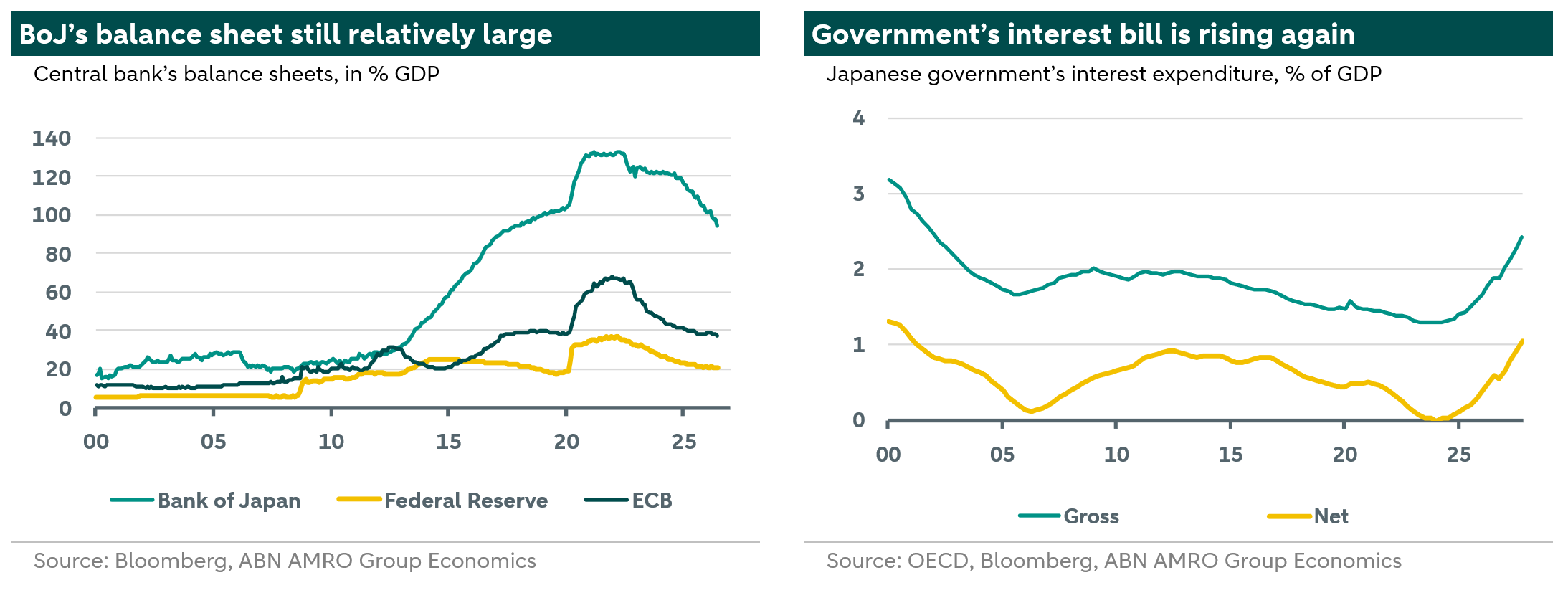
In 2024, the BoJ also ended its yield curve control framework and started with ‘quantitative tightening’ by introducing a gradual unwinding of its massive asset purchase programmes of JGBs (and other assets). The BoJ reduced its monthly purchases of Japanese government debt by JPY 400 billion per quarter, from JPY 5.7 trillion in August 2024 to JPY 2.9 trn in Q1-2026. In an interim assessment held in June 2025, also with a view to the rise in Japanese bond yields, the BoJ announced it would slow the pace of quantitative tightening (QT) from Q2-2026 onwards, with quarterly reductions of JPY 200 billion per quarter. In its June 2026 meeting, it was decided to halt the QT programme for JGBs per Q1-2027, and keep monthly purchases at around JPY 2.1 trillion per April 2027. All of this shows the BoJ’s longer-term goal is still to reduce its interference in the bond market over time, but to do so as far as possible in an orderly way. Nevertheless, so far, the combination of higher policy rates and the reduction of JGB buying by the Bank of Japan is a key factor driving Japanese bond yields higher. Despite the ongoing unwind of its balance sheet, the BoJ’s government bond purchases and its overall JGB holdings are still very large. Indeed, the BoJ’s balance sheet remains massive compared to the Fed and the ECB, although it has come down by almost 30pp in GDP terms since end-2023.
Regime shift 2: Fiscal policy more expansive under the Takaichi-government
Another “regime shift” in Japan that has pushed bond yields higher is the more expansive fiscal stance under prime minister Takaichi, in office since October 2025. Takaichi started with a pro-active fiscal approach aimed at boosting investment and growth, while introducing structural changes in the management of public finances. Already in November 2025, the Takaichi government approved a major JPY 21 trillion (± 3% GDP) fiscal stimulus package, including inflation compensation for households and incentives for investment in strategic sectors (eg. AI, semiconductors, defence, shipbuilding). In June 2026, the government launched its ‘Technology Growth Strategy’, aimed at mobilising around JPY 370 trn (± USD 2.4 trillion) in public and private investment by 2040 in 17 high-tech sectors, including AI and semiconductors. A new fiscal framework was introduced to finance these priorities. And in September 2026, it was reported that the Japanese government is considering a new-midterm defence spending target of 3.5% GDP. Expectations for Japan’s budget deficit are being revised upwards, with for instance the OECD forecasting an increase in the overall deficit from -1.1% of GDP in 2025 to -4.1% in 2031. Given that Japan already has a very high (although declining) gross public debt ratio (207% of GDP in 2025 according to IMF), the more expansive fiscal stance is another key factor pushing up Japanese bond yields.
JGB yields continued to increase, as the curve bear flattened in recent months
As a result of the shifts in both monetary and fiscal regimes, the JGB curve has moved through several phases, all with one common theme: yields have risen across all maturities. The 10-year JGB yield has risen by almost 190bp since the start of 2025. By Japanese standards, this represents a major shift, as interest rates had remained very low for years and volatility had also been tightly constrained by the BoJ’s yield curve control policy. Movements along the curve were sizeable too, broadly following the trend in other major bond markets. The JGB curve steepened significantly, particularly last year. Increases in yields at the short end remained limited because both actual and expected BoJ rate rises were relatively modest, anchoring the short end JGB levels, while long-end yields rose as term premium increased. Newly appointed Prime Minister Takaichi promised fiscal expansion, prompting expectations that Japan’s already substantial public debt would rise further. Investors consequently demanded greater compensation, resulting in a significant increase in the term premium and pushing up yields at the long end (see right graph below). A similar pattern has been evident in several other bond markets, including US Treasuries, French OATs and Bunds.
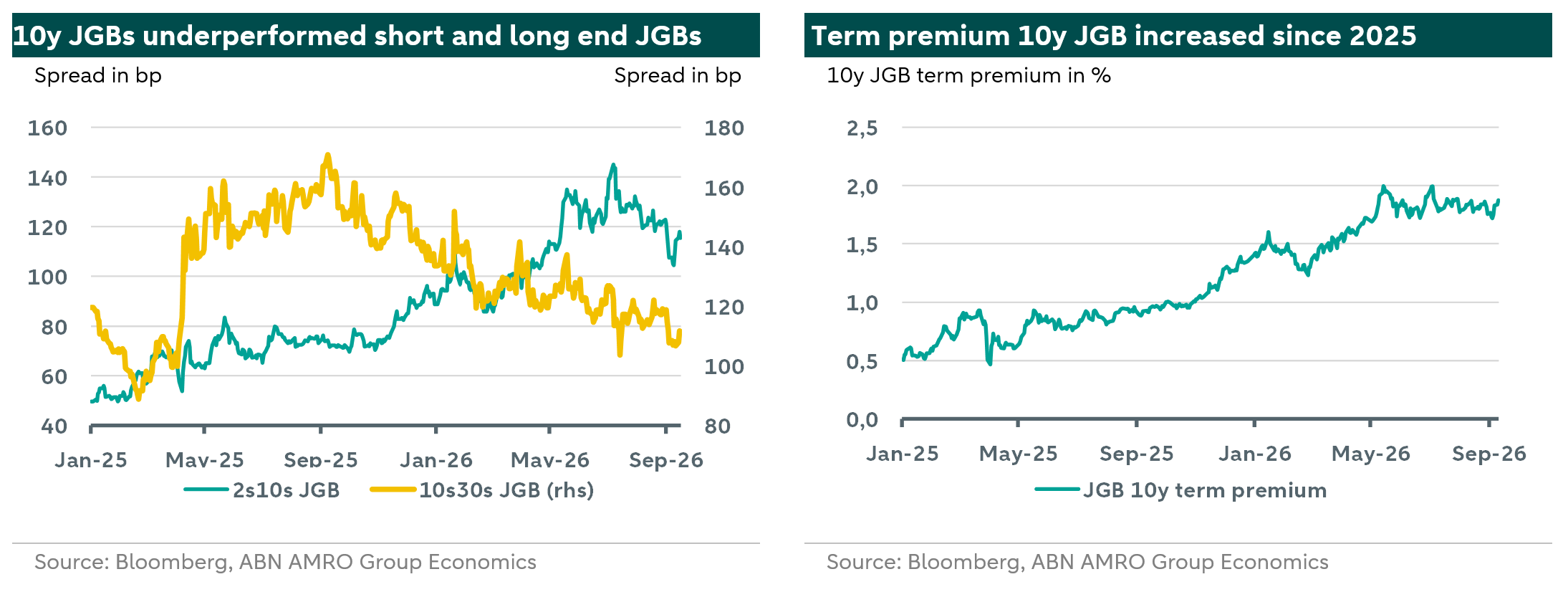
This year, the steepening of the JGB curve came to an end and the curve flattened. Yields continued to rise across the curve, but the increase was greatest at the short end, as the market began pricing in more BoJ rate rises in response to the further escalation of the war in Iran and the resulting increases in energy prices and inflation (see left graph below). This curve development has also been observed in other bond markets.
Lower hedging costs will only provide a small relief for OATs
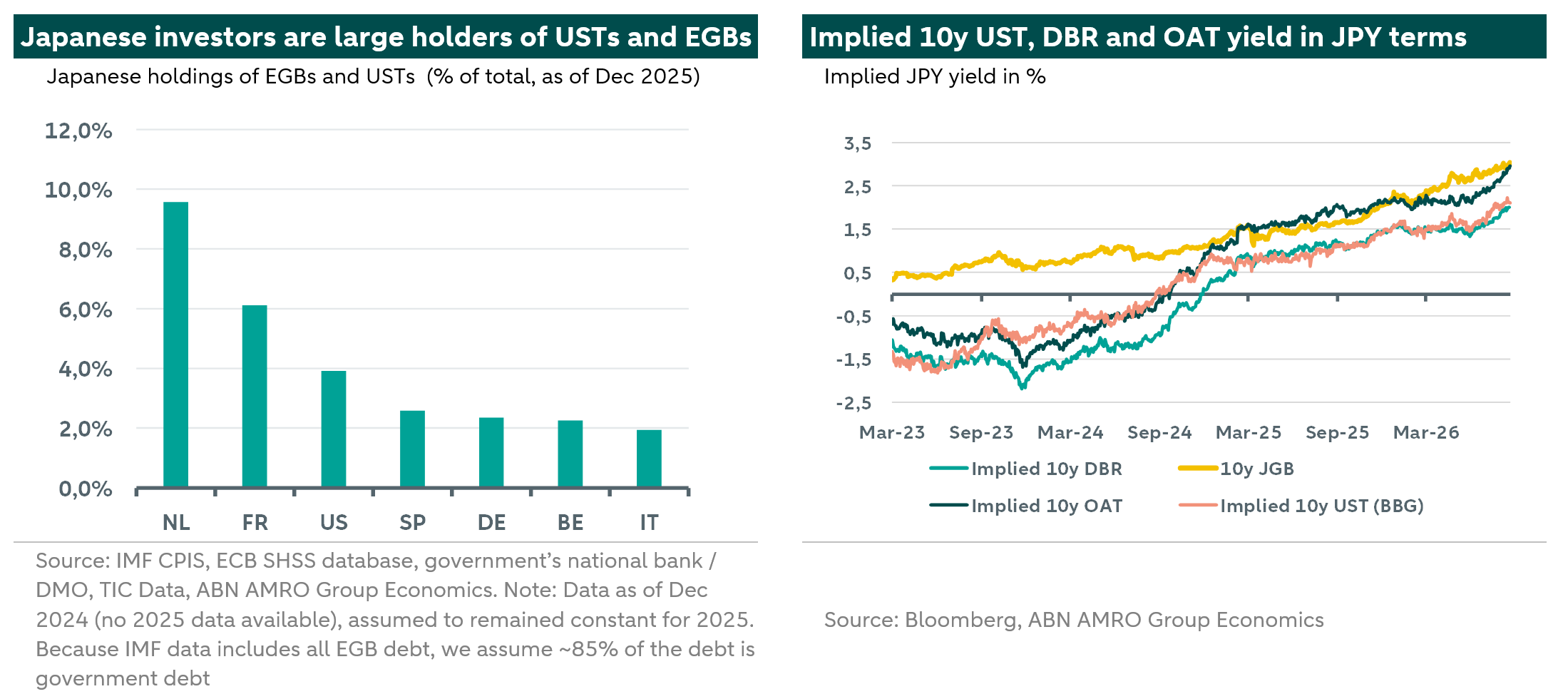
Now that JGB yields have risen to levels closer to those of USTs and EGBs, the question is how Japanese investors will respond in terms of their holdings in these government bond markets. As the left-hand chart below shows, Japanese investors hold relatively large positions in EGBs and USTs relative to the total amount of debt outstanding. A possible partial rotation out of these markets and back into JGBs could therefore have significant consequences, especially under current market conditions, in which the free float of government bonds continues to increase because of budget deficits and quantitative tightening by the ECB. A remark from the Finance Minister earlier this year, mentioning that Japanese pension funds should invest more heavily in domestic assets, increased speculation that this rotation could happen in the coming years, although the pension funds have not changed their asset allocation plans so far. A partial rotation by Japanese investors out of USTs and EGBs would add further pressure to these government bond markets. As we explained in , this could lead to a further rise in OAT yields in particular.
An important consideration for Japanese investors is the cost of hedging the foreign-exchange risk associated with overseas investments. In recent years, hedging costs have risen sharply as the gap between the Fed’s and ECB’s short-term interest rates and those of the BoJ has widened. As a result, the implied yields on USTs and EGBs in yen terms were for a long time lower than those on JGBs, even though nominal JGB yields were much lower than those on USTs and EGBs. Japanese investors are therefore assumed to have left a larger share of their investments unhedged. Since then, the gaps between the implied yields on 10-year USTs and EGBs and the 10-year JGB yield have remained wide (see the right-hand chart below), suggesting that hedge ratios have not increased.
It is notable, however, that the implied yield on the 10-year OAT is now almost the same as that on the 10-year JGB. Although this could lead to an increase in foreign-exchange hedging for these investments, we do not expect it to result in stronger demand for OATs from Japanese investors in the near term. This is because momentum in OATs remains unfavourable owing to France’s weak fiscal position and the political uncertainty surrounding the forthcoming French presidential election next year. The candidates leading in the polls have yet to present convincing plans to reduce the large budget deficit and reassure the market. We therefore expect OATs to remain under pressure in the period ahead, discouraging Japanese investors from increasing their exposure to them.
FX markets
Coordinated FX intervention supported the yen
In July 2026, USD/JPY reached its highest level since 1986, while EUR/JPY rose to a record high since the euro’s introduction. The yen is widely considered substantially undervalued, but its weakness is not simply a market anomaly. For many years, Japan’s very low interest rates have encouraged domestic investors to seek higher returns abroad. These interest-rate differences have also supported carry trades, in which investors borrow in yen to invest in higher-yielding assets. More recently, concerns about Japan’s economic policy have added further pressure on the currency.
Japan has intervened in foreign-exchange markets before, but coordinated action with the United States is rare. At the end of July, the two countries intervened together: Japan sold US dollars against the yen, while the United States sold euros against the yen. The US action was particularly notable. It may have been intended to limit the impact on the US Treasury market at a time when investors appeared to be questioning policy under new Fed Chair Warsh. Since the intervention, the yen has recovered considerably, supported by expectations of further Bank of Japan rate hikes and the closing of speculative short-yen positions.
A lasting yen recovery requires changes in interest rate spreads and investor behaviour
A lasting strengthening of the yen depends on three developments. First, confidence in Japan’s economic policy needs to improve and the interest rate gap between Japan and other major economies needs to narrow. Second, investors must become more confident that the yen will not weaken much further. The recent coordinated intervention appears intended to shape these expectations. Third, Japanese investors may eventually decide that domestic assets offer a better balance of risk and return than foreign investments, possibly supported by regulatory change. Such a shift could have significant effects on global financial markets because Japanese investors hold large amounts of foreign bonds, including US Treasuries. The United States is aware of this risk and has little interest in seeing Japanese investors sell substantial holdings of US government debt and moving these funds back to Japan.
Revised yen forecast
Following our recent revision to the Middle East scenario (see here), we raised our outlook for the US dollar and lowered our EUR/USD forecast. This also affected our yen projections. We expect higher energy prices to halt the yen’s recovery for now. USD/JPY is likely to remain around 154 until the first quarter of 2027, as we expect the Federal Reserve and the Bank of Japan to raise rates at a similar pace in the coming months. In the second half of 2027, however, we expect the Fed and the ECB to ease policy while the Bank of Japan continues to normalise. This should allow the yen to strengthen again against both the US dollar and the euro. The recovery could begin earlier if Japanese investors start favouring domestic assets.