Climate Economics & Energy Research - Forget about the Netherlands’ 2030 climate targets

The decline in greenhouse gas emissions in the Netherlands virtually stalled in 2024 and 2025. The new Jetten government aims to put emissions back on a downward trajectory, but its policy measures are unlikely to have a material impact before 2030, making a substantial overshoot of the 2030 target very likely. The EU’s 2040 target is also likely to be missed by a wide margin, as the pace of emissions reductions is expected to slow after 2030. Recent policy proposals, including the revision of the EU ETS and the Dutch plans for agriculture, nature and nitrogen emissions, are also likely to affect the emissions trajectory through 2040, with the balance of risks tilted towards higher emissions. The probability of meeting the binding EU targets for final energy consumption and renewable energy in 2030 is also very low.

Introduction
During the first seven years following the Paris Agreement, greenhouse gas (GHG) emissions in the Netherlands fell by an average of 4.5% per year. However, the decline virtually came to a standstill in 2024 and 2025. In late September, the Netherlands’ independent environmental assessment agency PBL published its annual Climate and Energy Outlook (KEV) 2026 (available in Dutch only, see ). In this report, PBL assesses the Netherlands’ progress towards its climate and energy targets and evaluates the expected impact of existing and planned policies on a range of climate and energy indicators.
In this note, we present an overview of the main findings. Since the cut-off date for the KEV, several policy measures have been announced at both the EU and Dutch level. We also discuss the potential impact of these measures
Meeting the targets for GHG emissions in 2030 and 2040 is highly unlikely
GHG emissions in the Netherlands increased by 0.2% in 2025, following a 1.2% decline in 2024. Emission reductions in industry and domestic mobility were more than offset by a sharp rise in emissions from the power sector. This increase was driven by stronger foreign demand for electricity, particularly from Belgium and Germany, which could not be met entirely by renewable power generation. Working in the opposite direction, a sharp rise in the share of electric vehicles in total new vehicle sales, to almost 86% in 2025 from 77% in 2024 (see ), contributed to lower emissions from the mobility sector. Finally, industrial emissions declined, although this was mainly due to lower production levels in certain sectors rather than a reduction in emissions intensity according to the PBL.
Total GHG emissions in 2025 were 36% below their 1990 level. Under European and Dutch climate laws, emissions should be reduced by 55% relative to 1990 by 2030, while net emissions should fall to zero by 2050, meaning that any remaining greenhouse gas emissions should be balanced by greenhouse gas removals. At the European level, the EU has set a legally binding target to reduce emissions by 90% by 2040 relative to 1990, with at least 85% of the reduction to be achieved domestically and up to 5% through international carbon credits. The Netherlands has no official 2040 target, but the current Jetten government states in its coalition agreement that the Netherlands will align its approach with that of the EU ‘as closely as possible’. Regarding the 2030 emissions target, the coalition agreement states that ‘achieving the 2030 climate target will be difficult, but we remain committed to that ambition’.
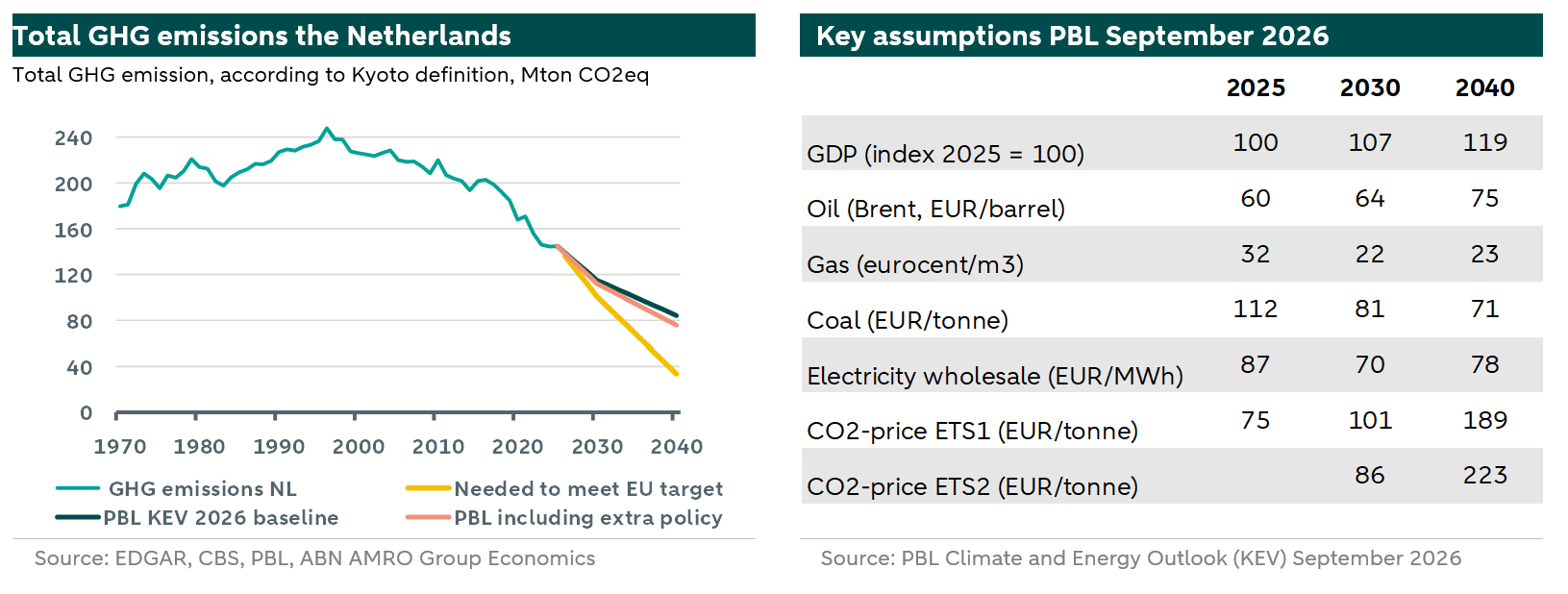
GHG emissions amounted to 145 megatonnes of CO₂ equivalent (MtCO₂e) in 2025. The KEV presents two projections for 2030 and 2040: a baseline projection that includes the effects of policies that had been adopted and planned by 1 January, and another projection that includes additional policies that had not yet been adopted by 1 May, the KEV’s cut-off date, but whose effects could already be estimated. Achieving the targeted 55% reduction relative to 1990 by 2030 would require emissions to fall by more than 30% over the next five years, which is highly unlikely (with a probability of less than 5%, according to PBL). Indeed, policies adopted and planned at the start of this year would result in an emissions reduction of 46% to 53% by 2030 relative to 1990. These 2030 estimates have hardly changed compared with a year ago. Including additional policy measures, the emissions reduction could be one percentage point higher (47% to 54%). This estimate is also not significantly different from a year ago. In this context, PBL notes that the additional policy measures announced by the Jetten government are unlikely to have a significant impact on emissions before 2030, although they are expected to affect emissions by 2040.
Looking further ahead to the 2040 target, PBL expects the pace of emissions reductions to slow after 2030. Based on adopted and planned policies, emissions are estimated to be 57% to 68% below 1990 levels by 2040. Including additional policy measures, the reduction could be four percentage points larger, at 61% to 72%, still well short of the 85% domestic emissions reduction target. That said, the 2040 estimates are subject to significantly greater uncertainty than the 2030 estimates, with the estimated range around 25% wider in 2040 than in 2030.
More recent climate policy proposals and economic factors could change the emissions pathway
Since the cut-off date of PBL’s KEV (1 May 2026), a number of climate policy changes have been announced that could have a significant impact on GHG emissions. The first one concerns emissions covered by the EU Emissions Trading System (EU ETS). On 17 July, the European Commission presented a proposal to revise the system. PBL has published an assessment of the proposal (see ), concluding that the changes could result in a 33% increase in EU GHG emissions covered by the ETS by 2050. ABN AMRO Group Economics has also published an analysis of the proposed changes to the EU ETS (see here). One of the main conclusions is that ETS prices are still expected to rise during the next decade, but at a slower pace. Dutch GHG emissions covered by the ETS amounted to almost 62 MtCO₂e in 2025, equivalent to around 43% of total Dutch emissions. Translating the potential impact of the proposed ETS changes into their effect on Dutch GHG emissions is subject to considerable uncertainty. Nevertheless, PBL’s estimates for the EU, combined with our own model-based estimates incorporating the expected impact of the reform on ETS prices, suggest that the proposed changes could increase Dutch emissions by around 5 to 8 MtCO₂e by 2040. This would reduce the projected decline in total emissions relative to 1990 by around 2 to 4 percentage points.
Another relevant change in climate policy is a package of measures relating to agriculture, nature and nitrogen emissions, which the Jetten government published at the end of June. PBL has published an assessment of this policy package (see ), concluding that it could result in an additional reduction in GHG emissions of 4 MtCO₂e by 2035 compared with the baseline scenario. All else being equal, this could increase the reduction in emissions by 2040 relative to 1990 by around 2 percentage points, partly offsetting the higher emissions resulting from the ETS revisions discussed above. Still, the balance of risks from the two announced policy changes appears tilted towards higher emissions
A final factor that could potentially change PBL’s estimates relates to the assumptions regarding economic growth and energy prices, particularly oil and gas prices in the short term (until 2030). PBL’s projections through 2030 are based on energy futures prices at the end of 2025. Since the start of this year, geopolitical tensions and other factors have pushed up oil, refined product (e.g. diesel, jet fuel and gasoline) and gas prices (for instance, see ABN AMRO’s latest oil and gas market monitors here and here). If fossil fuel prices were to remain elevated for longer, this could reduce fossil fuel consumption by businesses and households and, consequently, GHG emissions (for instance, see our publication on the impact of higher fuel prices on fuel consumption by Dutch drivers here). When it comes to projected average annual economic growth through 2030, the differences between PBL and ABN AMRO appear to be relatively small.

Probability of meeting the EU targets for final energy consumption and renewable energy also low
The binding EU target for final energy consumption in the Netherlands has been set at 1,609 petajoules (PJ) in 2030. No target has been set for 2040. Final energy consumption fell by more than 30 PJ to 1,673 PJ in 2025. The decline was mainly due to lower production levels in the basic chemicals industry. Energy consumption in the mobility sector also declined, partly due to the growing number of electric vehicles. PBL estimates that, based on adopted and planned policies, final energy consumption will reach 1,646 PJ in 2030, with a 35% probability that the Netherlands will meet the EU target. Additional policies that have not yet been adopted or planned but are sufficiently concrete to be evaluated could raise this probability to 40%. The estimate for final energy consumption in 2030 has been revised down compared with KEV 2025, mainly due to lower energy consumption in industry. Looking ahead, final energy consumption is expected to decline in industry, domestic mobility and agriculture between 2026 and 2030, while it is expected to increase in aviation and the built environment, with the latter reflecting higher electricity consumption by data centres.
Turning to renewable energy, the binding EU target for the Netherlands is for renewables to account for 39% of gross final energy consumption by 2030. In 2025, this share reached 23%, up 2.5 percentage points from 2024. The increase was mainly driven by higher solar power generation and greater use of biokerosene. According to PBL’s projections, based on adopted and planned policies, the share of renewables will reach 34% in 2030, with only a 5% probability of meeting the target. PBL estimates that around half of the increase in renewable energy production will come from wind power, particularly offshore wind. PBL’s estimate for the share of renewable energy in 2030 has increased compared with a year ago (32%), reflecting higher projected use of ambient heat from heat pumps and biodiesel in road transport, as well as higher offshore wind power generation. At the same time, projections for solar power, onshore wind and geothermal energy have been revised down slightly. A recent research report by ABN AMRO Group Economics (see here) provides an in-depth analysis of the growth potential of offshore wind, cost trends, grid infrastructure and financing conditions. The report mentions that slow planning processes, grid congestion, complex supply chains and financing issues make the feasibility of the EU targets uncertain.
Conclusion
The chances of the Netherlands meeting its European climate targets for 2030 now appear to have all but vanished. The 2040 targets also seem well out of reach, although the current government appears to be taking steps to put emissions back on the right trajectory. Still, the likelihood of a disorderly and shock-driven transition at a later stage rises, as the Netherlands remains obligated to meet the EU’s climate targets.