Key views Global Monthly April 2026
The Iran conflict is triggering a new global energy shock. It remains uncertain how long the disruptions to energy supplies will go on for, but our new base case assumes severe disruptions last until the end of May. The inflation shock will outweigh the growth shock, and this is leading to a hawkish pivot by central banks. The ECB is expected to hike rates while the Fed is expected to delay further rate cuts. Still, advanced economies are expected to stay resilient and to avoid recessions, and ultimately we expect central banks to lower rates again once the inflation shock has dissipated. Against this backdrop, US tariffs will remain a dampener on global trade, but the AI boom is continuing, German fiscal spending is driving a cyclical eurozone recovery, and China continues to take modest to lift demand while keeping its manufacturing growth model intact.

Macro
Eurozone
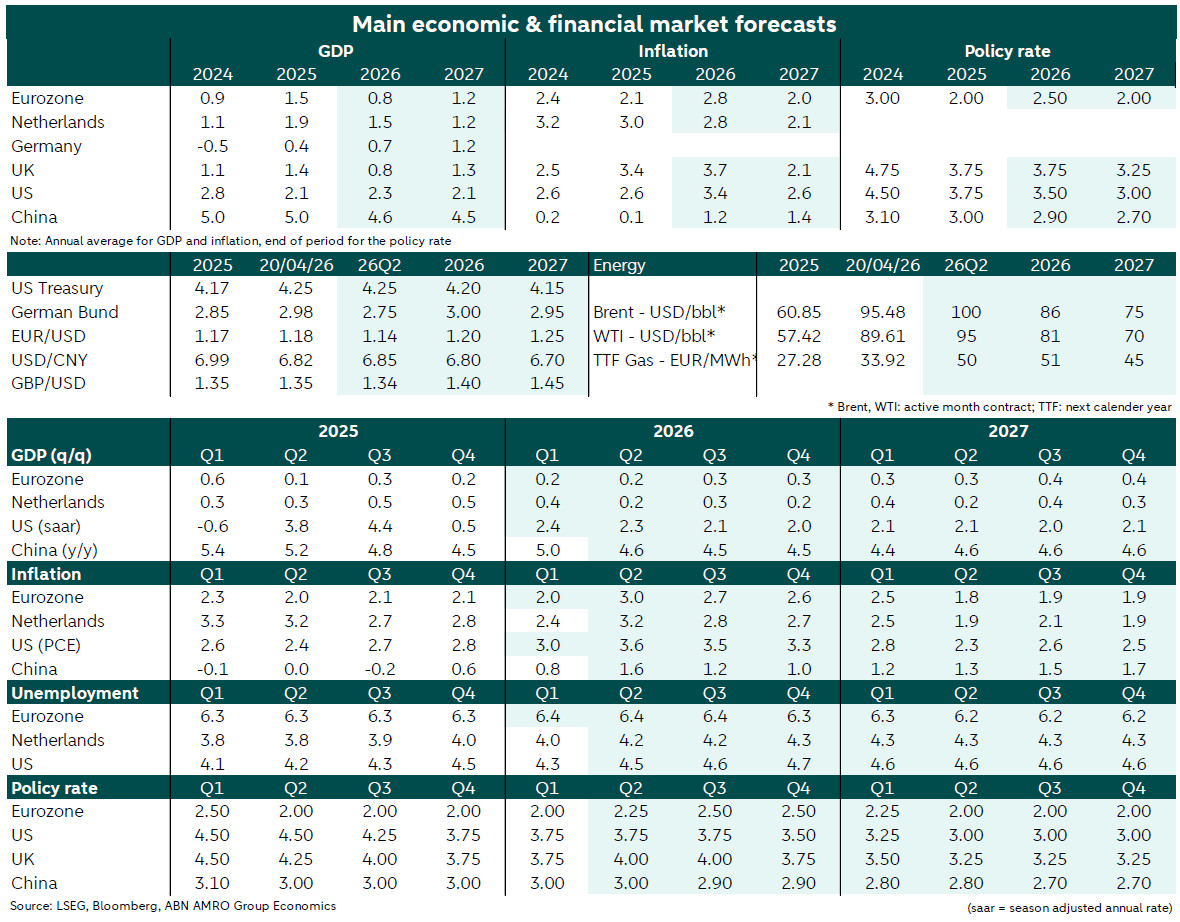
The inflation jump from the new energy shock will outweigh the hit to growth. However, we expect a much narrower and manageable rise in inflation compared to the 2022-23 shock. This is because the magnitude of gas price rises is much lower, but also because electricity markets have largely decoupled from gas. Still, because the ECB will need to get ahead of any second round inflation effects, growth will be dampened by a tightening of financial conditions. At the same time, the cyclical recovery is expected to broadly continue, helped by higher German fiscal spending.
The Netherlands
Similar to the eurozone aggregate, we expect the inflation jump to outweigh the hit to growth. The Dutch economy is, however, more prone to second-round effects on wages due to the starting point of inflation and the tight labour market. Still, the Dutch economy is resilient, in part because of recent economic momentum and because the private sector deleveraged and built considerable buffers over the past quarters. The Dutch cabinet proposed a tailored package to support households and companies.
UK
The energy shock will lead to a new inflation surge at a time when inflation expectations are already unanchored. Still, the labour market is much looser than it was when the last energy shock hit, and this should help to contain the second round effects. While we have downgraded our growth forecasts, the impact is expected to be manageable, and our base case sees the economy continuing to gradually recover over the coming year. This will be helped by reduced fiscal uncertainty, with government finances in a less precarious state.
US
The final quarter of 2025 saw some stalling momentum, partly due to the government shutdown. The recent oil shock increases (headline) inflation, but has a marginal impact on growth. We still expect decent headline growth figures due to the positive impulse of AI investments and monetary and fiscal easing. Core inflation remains elevated, due to the final pass-through of tariffs, and demand effects from stimulus. Unemployment continues a gradual, but not dramatic increase, as limited demand matches the strong decline in supply due to immigration measures.
China
Growth picked up a bit in Q1, with exports solid on the global tech cycle and investment returning to growth. Supply-demand imbalances remain and the property sector is not out of the woods yet. March data show some impact of the Iran conflict, with producer price inflation turning positive again. We adjusted our growth and inflation forecasts last month, and keep them unchanged for now. The Iran conflict is also putting US-China relations to the test, with a delayed Trump-Xi meeting scheduled for May. We still think both countries have incentives to extend their tariff/chokepoint truce, but risks are rising.
Central Banks & Markets
ECB
The Governing Council has shifted to a tightening bias, and we now expect rate rises at the June and July meetings, taking the deposit rate to 2.50%. For the second rate hike we have a lower conviction, given the uncertainty over how prolonged energy supply disruptions – and therefore the inflation rise – will be. Ultimately, we expect second round effects to be contained, and by early 2027 we expect the ECB to be confident enough in the inflation outlook to gradually bring rates back to its estimate of a neutral policy setting. We expect one rate cut each in Q1 and Q2 2027, bringing the deposit rate back to 2%.
Fed
The Fed held rates at the 3.50-3.75% target range in the March meeting. They signalled that the FOMC saw no consensus to ease before goods (i.e. tariff) inflation starts to abate. With the added impact of the oil shock on energy and headline inflation, we expect the Fed to remain on hold for longer than previously anticipated, waiting until December to convince themselves of limited second round effects. We then see a dovish Fed gradually easing, despite elevated headline, and elevated core inflation, with quarterly 25bps cuts to end up at 2.75-3.00% by the June of next year, the lower end of neutral estimates.
Bank of England
The MPC has struck a more dovish tone following its hawkish communication at the March meeting. We still expect the BoE to do an insurance rate hike at the June meeting, but with a lower conviction. Ultimately we expect the MPC to pivot back to a wait-and-see approach, assuming energy supplies gradually normalise from June. This reflects that rates are already in restrictive territory, and the MPC’s historically volatile but ultimately dovish bias. We expect rate cuts to resume from late 2026 onwards.
Bond yields
Yield curves drastically bear flattened following the onset of the war in Iran, driven by the pricing in of interest rate hikes (ECB) and the pricing out of rate cuts (Fed). However, rising expectations that the conflict might be resolved sooner rather than later provided some relief to markets. Markets now only fully price in one hike by the ECB, with 80% probability of an additional hike (vs. three rate hikes previously) and no rate cuts by the Fed, which is broadly aligned with our base case. However, the deteriorating fiscal situation in both Europe and the US underpins our view that curves will steepen – a correction that will mostly take place in early 2027.
FX
There have been hopes for a deal between the US and Iran. As a result, the euro has recovered and the US dollar has weakened. In fact, the EUR/USD exchange rate has rallied to around 1.18, which was its level when the conflict started. If investors keep hoping for a deal and oil and gas prices decline, the EUR/USD could perform relatively well. If the conflict gets worse again, the exchange rate could drop to 1.15. However, because speculators have already closed their net-long euro positions, it is less likely for EUR/USD to fall quickly. Since things can change fast, we are not changing our forecasts. We still expect the EUR/USD rate to be 1.20 by the end of 2026.