Global industry accelerates on stockpiling, rising delivery times

Global manufacturing PMI at four-year high in April, driven by ‘stockpiling’. Delivery times are lenghtening, particularly for developed economies. Our global supply bottlenecks index stays in ‘excess demand territory’. Inflationary pressures from global industry pick up further.

Global manufacturing PMI at four-year high in April, driven by ‘stockpiling’ …
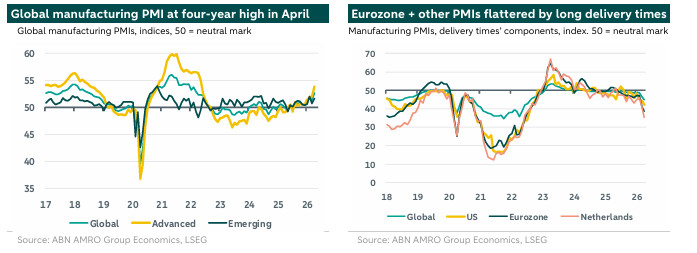
After having fallen a bit in March, the global manufacturing PMI jumped by 1.3 points to 52.6 in April. This marked the highest reading since March 2022, and the ninth consecutive month that the index stayed above the neutral 50 mark separating expansion from contraction. The improvement seen in April seems to reflect to a large extent stockbuilding practices, as production and purchases are being frontloaded given the expected supply disruptions and cost increases stemming from the Iran conflict. That could lead to some payback in the coming months.
The improvements were broad-based in terms of geography. The aggregate index for developed economies rose by 1.8 points to 53.8, the highest reading since May 2022, with particularly strong gains for Japan, the UK, and the US (S&P Global). The manufacturing PMI for the eurozone rose by 0.6 points to a four-year high of 52.2, with the Netherlands being one of the outperformers (see here). By contrast, Germany’s manufacturing PMI fell by 0.8 points, but remains in expansion territory and its 51.4 reading is still one of the highest seen over the past few years. Meanwhile, the aggregate index for emerging economies rose by 0.9 points to 51.6, the highest outcome since June 2024. This was led by China, with RatingDog’s manufacturing PMI rising by 1.4 points to 52.2, but also with countries like Brazil and India showing clear improvements.
… and rising delivery times, particularly for developed economies
Looking at the various components of the global manufacturing PMI, improvements were quite broad-based as well, with both the supply side and the demand side benefiting from frontloading practices. On the supply side, the global manufacturing PMI’s output component rose by almost 2 points to 53.4, the highest reading since July 2021. On the demand side, the global new orders component rose by almost two points as well, to a four-year high of 53.3. The global export sub-index picked up marginally (by 0.2 point, to 50.2), remaining in expansion territory for the third consecutive month despite the Iran conflict.
We already flagged last month (see here), that particularly for developed economies the strength in the headline manufacturing PMIs is flattered by a sharp, and ongoing drop in the delivery times subindex, which signals a lengthening of delivery times. The global delivery times subindex dropped further by 1.7 points to a fresh post-pandemic low of 44.9 (see chart). That is particularly true for the developed economies: the DM delivery times component fell by almost four points to 40.1, the lowest reading since July 2022. The delivery times subindex is now particularly low for the UK (34.9), the Netherlands (35.4), Japan (36.3), Germany (38.0) and the eurozone average (38.8), although the troughs reached during the pandemic are generally not in sight yet. If we correct for these lengthy delivery times, the eurozone’s manufacturing PMI is closer to the neutral mark than the headline figure suggests - 50.8 versus 52.2, although still an improvement compared to the March outcome corrected for delivery times (50.4).
Our global supply bottlenecks index stays in ‘excess demand territory’
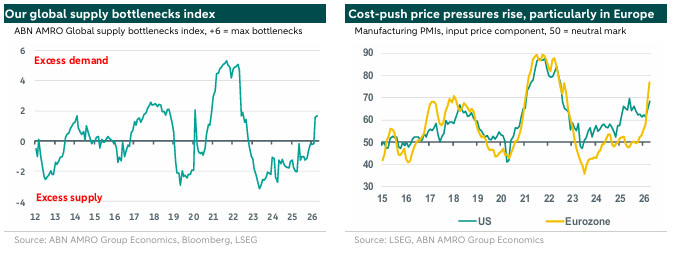
In normal times a lengthening of delivery times is seen as a sign of cyclical strength, and hence is driving up the manufacturing PMI. However, in the current circumstances, the sharp drop in this index will likely mainly reflect the increase in global supply bottlenecks stemming from the Iran conflict. The lengthening of delivery times is just one of the indications of supply disturbances stemming from the Iran conflict. These are so far obviously concentrated in energy-related areas. The global manufacturing PMI’s delivery times component for DMs is one of the ingredients of our global supply bottlenecks index, which has risen back to ‘dominant supply bottlenecks/excess demand’ territory. This is not only driven by the lengthier delivery times, but also by the index capturing global supply and demand conditions (the ratio between the EM output index and the DM domestic and export orders index).
Inflationary pressures from global industry pick up further
In line with this re-emergence of bottlenecks on the global supply side, the cost-price subindices included in the global manufacturing PMI (both input and output prices) have risen further in April, reaching the highest levels since July 2022, although remaining below the heights seen during the pandemic. It should be noted that the increase in these cost price components following the Iran conflict is clearly stronger for the eurozone than for the US so far (see chart for the input price component). All in all, recent developments in global manufacturing seem to fit to our view that the growth impact from the Iran conflict will likely be smaller than the inflation impact.