Mixed US labour market data suggests turn in the cycle

Labour market is still very strong, but rise in layoffs signals a turn in the cycle.

Very strong payrolls number, but unemployment rises 0.3pp
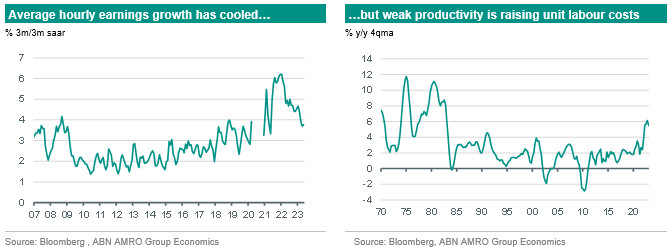
Payrolls expanded much more strongly than expected in May, by 339,000 vs the 195,000 gain expected by consensus, and unlike the April report, 2-month net revisions actually added 93k jobs. At the same time, the household survey showed the unemployment rate rising 0.3pp to 3.7%, despite labour force participation holding steady. The discrepancy is due to methodological differences - for instance, the establishment survey counts 'jobs' (so it counts as twice people who work two jobs), whereas the household survey looks at individual employment status. The takeaway is that the labour market remains both exceptionally strong on the demand side, as signalled by the jobs numbers, but we also see that layoffs are increasing, leading to a rise in unemployment. This is corroborated by the Challenger job cuts report for May, which shows layoffs somewhat on the high side, though by no means consistent with recession yet. Meanwhile, the JOLTS job vacancy report for April – also released this week – showed a rise in vacancies and an upward revision to previous months, suggesting a lower likelihood that excess demand for labour can be eliminated without a meaningful rise in the unemployment rate.
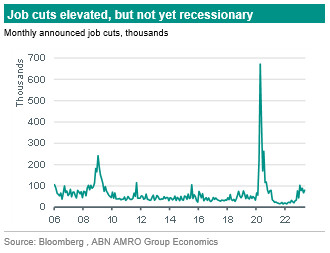
All told, these conflicting signals are something that one would expect at a turning point in the cycle, but are accentuated by the labour hoarding behaviour since the pandemic. Big picture, the labour market remains much stronger than the Fed would like given the risks around the inflation outlook. Although wage growth came in on the more benign side on this occasion (at +0.3% m/m, down from 0.4% in April), labour costs are still likely to become a bigger driver of inflation going forward, with weak productivity keeping unit labour cost growth elevated. We therefore see a heightened risk that the Fed raises rates somewhat further over the summer months, although our base case is that the Fed has reached a peak in this hiking cycle.