Oil Market Monitor - The ripple effects of Strait of Hormuz closure
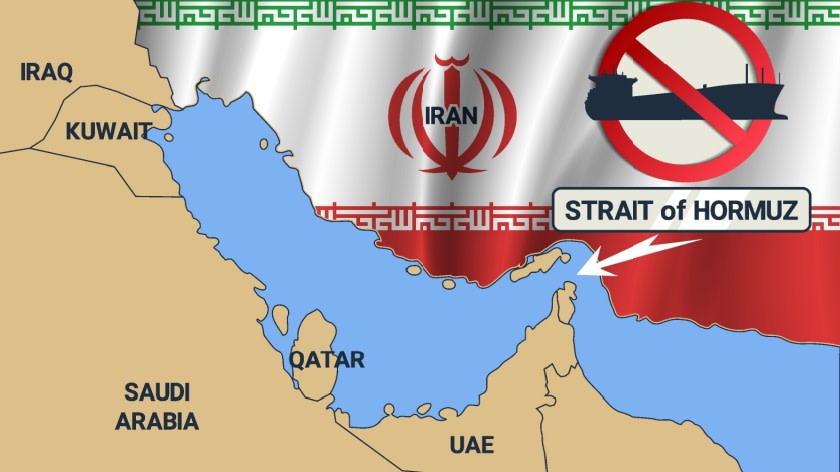
The war in Iran has significantly disrupted global oil and gas markets, with the effective closure of the Strait of Hormuz causing a shortfall of over 20 million barrels per day (mbpd) of crude oil and refined products from the Gulf region. This has stranded numerous cargos on either side of the passage, while escalating attacks on energy infrastructure threaten prolonged disruptions and a new wave of higher inflation globally. In response, countries linked to the IEA plan a coordinated release of 412 million barrels of emergency stocks. While efforts to reroute disrupted supplies and reduce demand provide some short-term relief, a prolonged disruption would have devastating consequences worldwide.

The conflict began with a US-Israel attack, prompting Iran to shut the Strait of Hormuz, halting crude flows of 16 mbpd
Asian countries, reliant on the Strait for 60–75% of crude imports, are hit hardest by the disruption
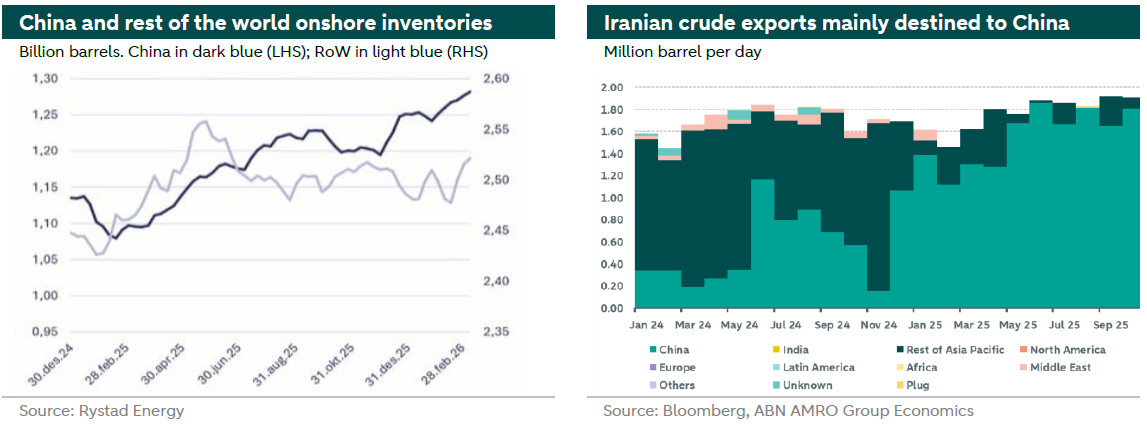
Global inventories stood at 2.58 billion barrels, with China’s reserves bolstered at 1.3 billion barrels from buying from sanctioned nations
The U.S. eased sanctions on Russian and Iranian oil, allowing stranded cargoes to marginally help global supply
IEA nations are releasing 412 million barrels from emergency reserves, but supply gaps persist despite coordinated efforts
Iran continues exporting through the Strait while utilizing floating reserves of 38 million barrels, but volumes remain limited
Despite emergency measures, the market would face an average daily supply deficit of 3 mbpd over the next two months
We revise our outlook assuming energy disruptions lasting through Q2, Brent is projected to average $100/barrel, easing to $80 by year-end
In this monitor we provide an overview of the conflict and major developments affecting crude oil market. We further dive into drivers that provide cushioning to the disrupted volumes and provide an overview on the market balance in the coming two months. We adopt a Q&A format for this monitor. We end with an update to our outlook.
How did it all start and where do we stand now?
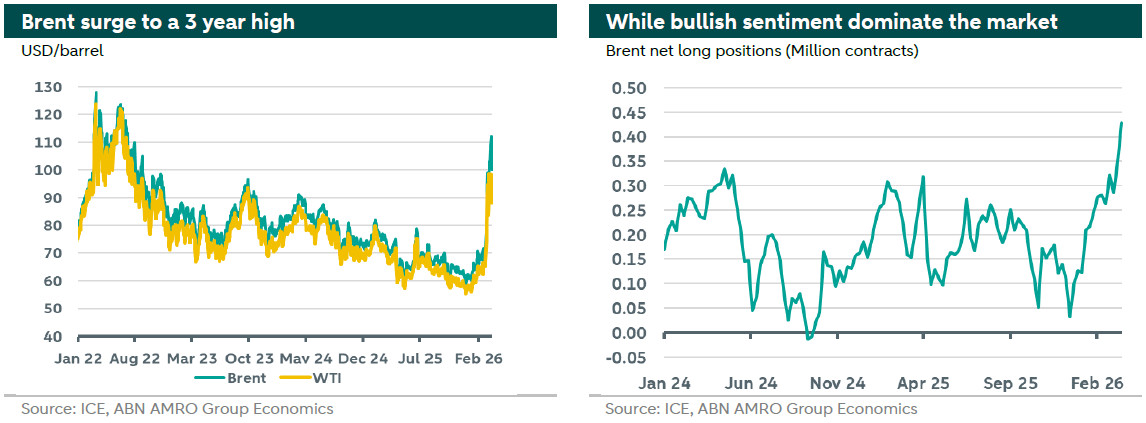
The conflict began on February 28th, when the United States and Israel launched an attack that killed Iran's supreme leader along with several high-ranking officials of the Iranian regime. In retaliation, Iran closed the Strait of Hormuz and has launched missile and drone strikes on Israel and several Gulf countries, some of which targeted critical energy infrastructure. As a result, storage facilities have reached capacity, and production has largely come to a standstill in key OPEC+ member countries, including Saudi Arabia, the UAE, Kuwait, Qatar, Iraq, and Bahrain. This has caused a severe disruption in supply, blocking the transit of 16 mbpd of crude oil through the Strait of Hormuz. The market has been highly sensitive to developments in the conflict, with Brent crude prices surging by an average of 50% since the war began. At one point, Brent crude reached USD 120 per barrel. Meanwhile, speculators in the futures market have been steadily increasing net long positions in Brent crude, starting from relatively low levels before the conflict. This shift has contributed to rising oil prices. The trend reflects growing market expectations of higher oil prices amid uncertainty over how long the conflict will last. As of now, it is trading around USD 100 per barrel.
Which countries are most affected by the closure of the Strait of Hormuz?
Asia has emerged as the epicentre of the crisis due to its heavy reliance on crude oil shipments passing through the Strait of Hormuz. Nations such as Singapore, South Korea, and Taiwan depend on the Strait for nearly 60% of their crude imports, while Vietnam, the Philippines, and Japan are even more vulnerable, with over 75% of their crude supply reliant on this vital passage. In comparison, Europe’s dependency on crude from the Strait of Hormuz varies, with countries like Spain, Italy, France, and the Netherlands relying on it for 10–13% of their imports. However, nations such as Lithuania, Greece, and Poland have higher dependency rates of around 40–45%.
What was the state of storage levels prior to the outbreak of the conflict?
Sizable floating and onshore storage has been helping to stabilize global oil prices. Global onshore inventories (excluding China) amount to 2.58 billion barrels (see left graph below). Meanwhile, China has taken advantage of discounted sanctioned oil from Russia, Iran, and Venezuela to build up massive reserves, now totalling approximately 1.3 billion barrels. The U.S. strategic petroleum reserves (SPR) stand at 415 million barrels, which is about 60% of their total capacity. Prior to the conflict, floating storage was estimated at 70 million barrels, with the majority of it sourced from Iran, Russia, and Venezuela, and destined primarily for China.
How has the US administration been working to address and manage the market disruption caused by the conflict?
The US Administration has made several strategic announcements to manage the ongoing crisis. To alleviate global supply shortages, the administration temporarily waived sanctions on Russian crude, allowing stranded cargoes to be purchased by buyers, including India, which has significantly increased its Russian imports in March. Additionally, the U.S. has signalled openness to easing restrictions on Iranian crude, enabling Tehran to sell its floating storage volumes of approximately 38 million barrels. While these measures aim to bring additional barrels into the global market, the impact remains marginal as much of these volumes were already reaching buyers through alternative channels despite sanctions.
What role can Strategic Petroleum Reserves (SPRs) play in the current crisis?
In response to severe supply disruptions, the release of strategic petroleum reserves (SPR) has become a key tool for stabilizing the market. Collectively, nations linked to the IEA plan to release 412 million barrels of emergency oil stocks. As part of this coordinated effort, Europe will release 107.5 million barrels, with 72% consisting of crude oil and the remainder being refined products. Starting on March 16, Japan plans to release 80 million barrels. The UK will contribute 13.5 million barrels, Germany about 19.5 million and France around 14.5 million. South Korea plans to release 22.5 million barrels. The United States is set to release 172 million barrels of crude at a rate of approximately 1.2 mbpd. Southeast Asian countries, facing critical shortages due to their reliance on imports, are expected to draw from their commercial inventories, which total around 129 million barrels and could provide about 1 mbpd for several months. Meanwhile, China, which holds the world’s largest reserves, may release between 0.5 and 1.0 mbpd to stabilize domestic refining and manage price fluctuations. However, its leadership remains cautious about significantly depleting strategic stocks. These announcements reflect an attempt to cushion the shock and stabilize energy markets, although the structural shortfall of 16 mbpd underscores the limitations of policy responses in addressing the full scale of the crisis.
How has the conflict affected Iran's oil exports through Kharg Island and its use of storage reserves?
Iran’s Kharg Island, the country’s central hub for crude exports, primarily handles shipments of Iranian Heavy and Light oil grades. In the ongoing conflict, Iran is the only Gulf nation still exporting oil through the Strait of Hormuz, with current flows at approximately 1-1.8 mbpd . However, these volumes are very low compared to pre-crisis levels due to the near-complete disruption of regional trade. Iran is also utilizing its floating storage reserves, which hold 38 million barrels of crude and refined products, potentially available for sale following U.S. measures to relax sanctions. Nonetheless, the ability to ramp up exports from Kharg Island remains highly dependent on resolving the regional conflict and restoring normal access to the Strait.
What would the market balance look like if the Strait of Hormuz remained closed for two months?
The closure of the Strait of Hormuz has created a catastrophic supply shock for oil markets where almost 16 million barrels per day (mbpd) of crude oil flow are disrupted. Despite aggressive mitigation efforts—including rerouting through pipelines, drawing from strategic reserves, and utilizing floating storage—the market would still face a 3.4-7 mbpd residual imbalance assuming the Strait remain closed for another two month. Even after exhausting the global "pre-war surplus buffer", the market remains in a net deficit of 1-4.9 mbpd, suggesting that significant demand destruction or further inventory depletion would be required to achieve true balance.
Our baseline assumption assumes 2026 crude exports are roughly 16-17 mbpd. The disruption removes 14.5-15.5 mbpd from the market under the assumption that ~1-1.8 mbpd (mostly Iranian) continues to transit, likely due to local geopolitical alignment or dark fleet operations that bypass official blockades. To soften the blow, the industry utilizes infrastructure that does not rely on the Strait. Most important route is Saudi Arabia's East-West Pipeline (Petroline) which redirects crude to the Yanbu port on the Red Sea (2.5-3.4 mbpd export capacity). Similarly, UAE’s Habshan–Fujairah Pipeline, which delivers crude directly to the Gulf of Oman, bypassing the chokepoint (1.5-1.7 mbpd). Also, we consider net refinery run cuts of 2.3 – 3 mbpd[1]. As briefly mentioned above, the IEA coordinated a massive release from Strategic Petroleum Reserves (like those in the US, Germany, UK, Japan, and others) of unprecedented 400 mbpd. However, there is uncertainty around a technical upper limit, noting that even if the oil exists, the deliverability (the speed at which it can be pumped into the system) is a major constraint. We estimate the rate of injection to range between 1-2 mbpd. Similarly, redirecting floating storage (0.7 mbpd), that is oil already sitting on tankers at sea provides a small, temporary cushion. There is also limited upside potential in non-OPEC output for the rest of 2026. If prices remain elevated, Non-OPEC+ countries could increase production by no more than 0.2- 0.3 mbpd. This is because most countries are already running at near maximum capacity and it would take more than two months to increase production to higher levels. After all immediate logistical and emergency steps are taken, the market is still short 3.4 -7 mbpd. Accounting for the Pre-war surplus of 2.4 mbpd, that is consumed entirely to bridge the gap, we are left with a final deficit of 1 - 4.9 mbpd. That is, after the surplus is gone, the market is on average still nearly 3 million barrels short every single day in the coming two months.
We note that this estimation is very sensitive to logistical fragility. That is the "Bypass" and "SPR" bars are theoretical thresholds. In reality, port congestion at Yanbu or Fujairah and the compatibility of different crude grades for specific refineries would likely make the actual recovery smaller. Furthermore, timing and deliverability are everything. If the SPR release is delayed by even a week, the "Residual Imbalance" spikes, leading to vertical price moves.
Oil market outlook
We are revising our base case amid extraordinary uncertainty. Our central scenario assumes severe energy supply disruptions will persist for two more months, extending into Q2, with limited further damage to energy infrastructure. We expect energy prices to normalize gradually but remain higher than pre-conflict levels. Accordingly, based on expected market balance and geopolitical premiums, we forecast Brent to average USD 100 per barrel in Q2, gradually declining to USD 80 per barrel by year-end, resulting in a yearly average of USD 86 per barrel. However, the forecast remains highly sensitive to unpredictable developments tied to the ongoing conflict, which are difficult to predict at this stage. We summarize below our outlook for Brent in the coming quarters.

[1] This represents a forced market rebalancing. As crude supply tightens, refineries—particularly across the Asia‑Pacific region—are compelled to reduce or halt operations. While this technically eases crude demand on paper, it shifts the stress downstream, triggering a more acute problem: a tightening global supply of refined products, notably gasoline and diesel, with significant implications for pricing and margins across fuel markets.