Transaction Trends - Higher energy prices; keeping a finger on the pulse

How is the war in Iran impacting Dutch households? In this publication, we analyse how quickly higher energy prices impact household finances, using anonymised transaction data from more than 1 million households. Higher gas prices feed through with a delay, meaning the average household energy bill payment has not yet increased. With regards to fuel spending, we see that rising oil prices filter through much quicker; this effect is already visible in March. We expect energy payments to continue increasing in the coming months, as was also the case in 2022. At that time, it took around a quarter for energy bill payments to increase noticeably. We will therefore monitor household energy payments closely in the coming months, particularly for households that are vulnerable to higher energy costs.


Introduction
Rising energy prices on the market and in household heating/electricity contracts are not immediately reflected in what households actually pay. By using aggregated and anonymised transaction data, we can provide insight into the energy payments households make in practice and assess the extent to which higher market prices are already feeding through at the consumer level. We observe that in March households did not spend more on their energy bills. This does not mean that no households are confronted with a higher bill. For instance, households that have signed new energy contracts since the outbreak of the war, or that have a dynamic contract. At the pump the impact of the war was already quick to see and households spent more on fuel on average than they did before the outbreak of the war. In our energy price projections publication we expect to see energy prices remain high for a while. We will therefore continue to closely monitor developments in the coming months and track the effects of higher energy prices. In doing so, we will pay attention particularly to vulnerable households that spend a large share of their income on energy costs.
The war in the Middle East is leaving its mark on energy markets
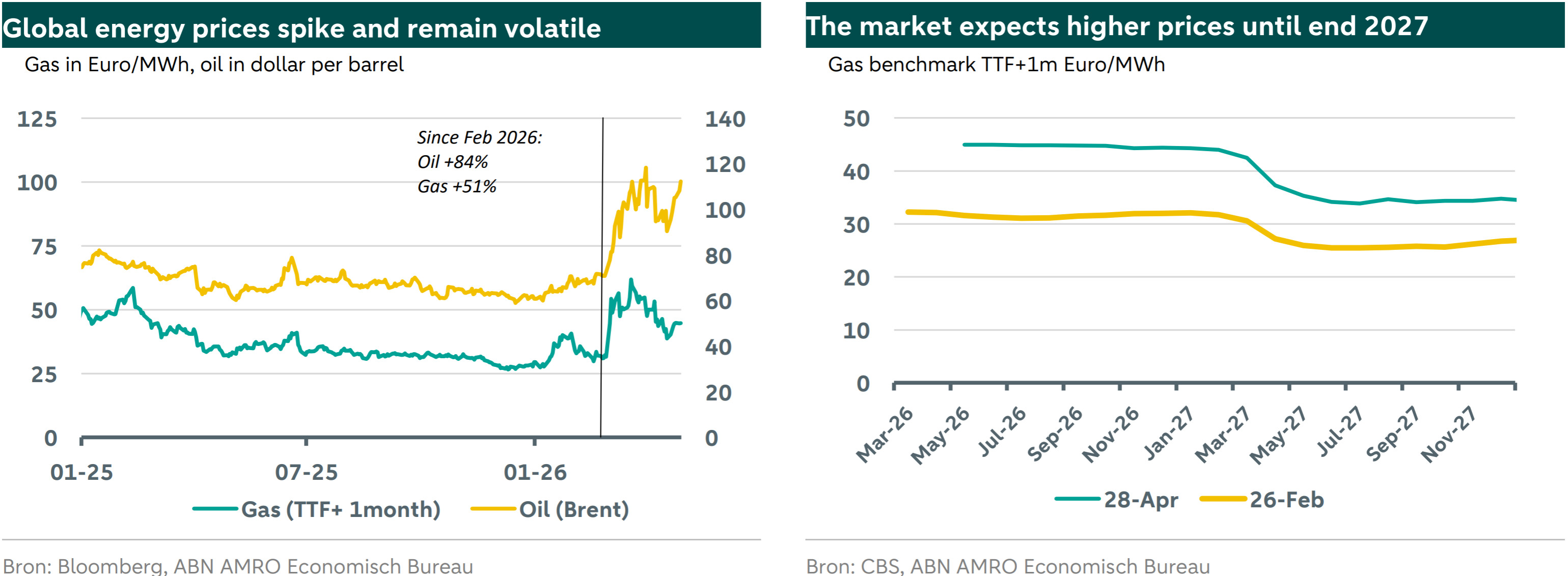
At the time of writing this article, oil prices are around 84% higher than at the beginning of this year, and gas prices about 51% higher.
In our energy price projections we expect that energy prices will remain elevated for some time. This is due to several factors. We expect significant energy supply disruptions from the Middle East to persist at least until the end of May. Even after that, prices are not expected to return immediately to pre-war levels, partly due to uncertainty about damage to energy infrastructure.
In addition, the gas storage filling season in Europe will begin shortly. During this period, reserves are replenished, but they are currently unusually low. This creates additional demand for gas, which is expected to keep prices high for an extended period. Financial markets are also taking this scenario into account (see chart on the right below).
Higher prices are feeding through into new energy contracts…
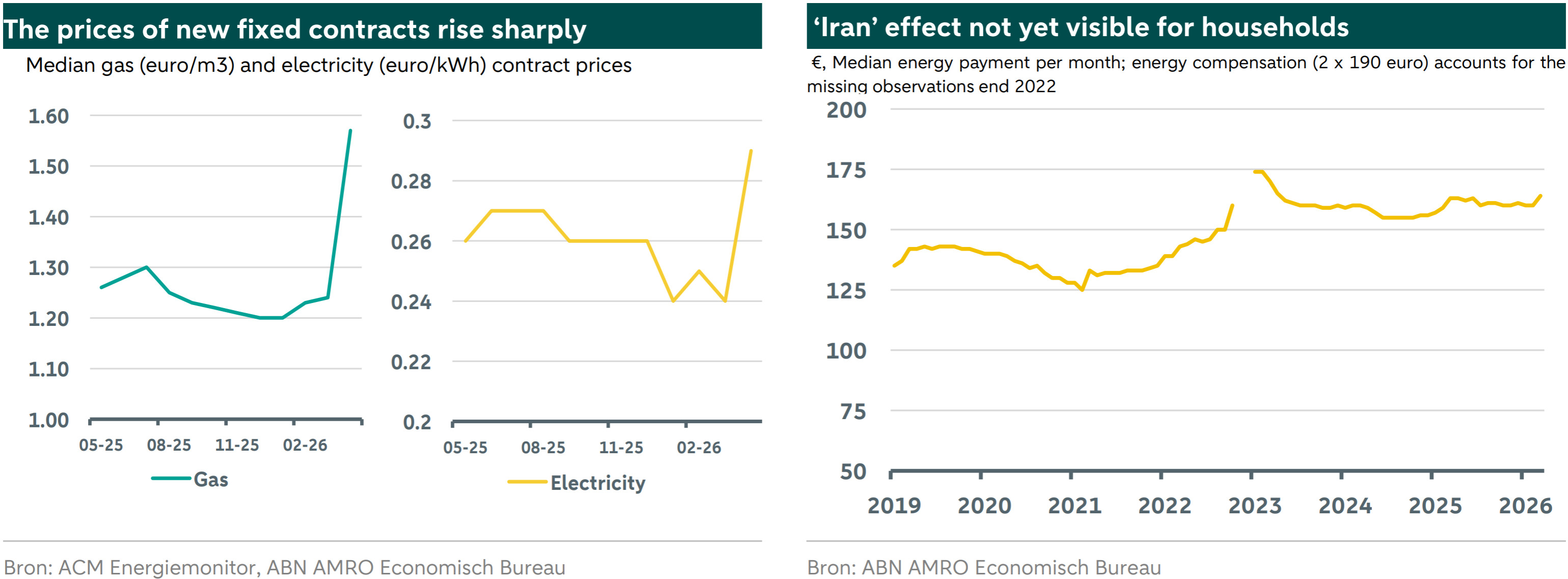
The expectation that energy prices will remain elevated for some time is also reflected in current prices for new gas/electricity contracts. Energy suppliers are passing on current and expected price increases to consumers. Households that took out a new one-year fixed contract for gas or electricity at the end of March faced costs that were 27% and 21% higher, respectively, compared with similar contracts taken out at the end of February (see left-hand figure below).
While these increases are smaller than those observed in wholesale energy markets, they are still significant. For fixed contracts with longer maturities, price increases were somewhat more moderate, but still substantial. As a result, households entering into fixed contracts now are exposed to higher energy prices.
As of March this year, around 54% of had an ongoing fixed contract, 38% had a variable contract, and approximately 7% had a dynamic contract.
… but energy payments for most households have not yet increased
With the help of anonymised and aggregated transaction data, we obtain a highly up-to-date picture of the impact of higher energy prices on household energy payments. We look at the median energy payments that households make to energy suppliers (see right-hand figure above). In doing so, we track around one million Dutch households. See the notes at the end of this publication for more details on the research design.
Although our data does not provide a precise picture of how much energy is consumed during a given month or the type of energy contract a household has, it does offer insight into what households actually pay. This allows us to observe when households are affected financially. This moment is, for example, relevant for potential spillover effects into other consumer spending.
In 2025, the median monthly energy payment was €161. This means that half of the households in our sample have an energy bill below this amount, while the other half pay more. The median may differ from the average amount households pay to their energy supplier. The advantage of using the median is that it reflects broad trends for the majority of households. As a result, monthly energy payments do not show fluctuations of tens of euros over time. However, there has been a clear increase in energy payments since the energy crisis in 2022. At the beginning of 2023, the median monthly energy payment peaked at €174. Later that year, an energy price cap was introduced, which ultimately brought payments down.
In March, the median monthly energy payment remained relatively stable. This is due to the large share of fixed contracts, meaning that most households have not yet been exposed to higher prices. In mid-2021, when energy prices began to rise, it took about a quarter before the median energy payment increased. This time, the increase is likely to occur more quickly, as the share of households with fixed contracts is now lower. We will therefore continue to monitor energy payments in the coming months, with particular focus on groups that spend an above-average share of their income on energy.
At the pump higher oil prices are already being felt
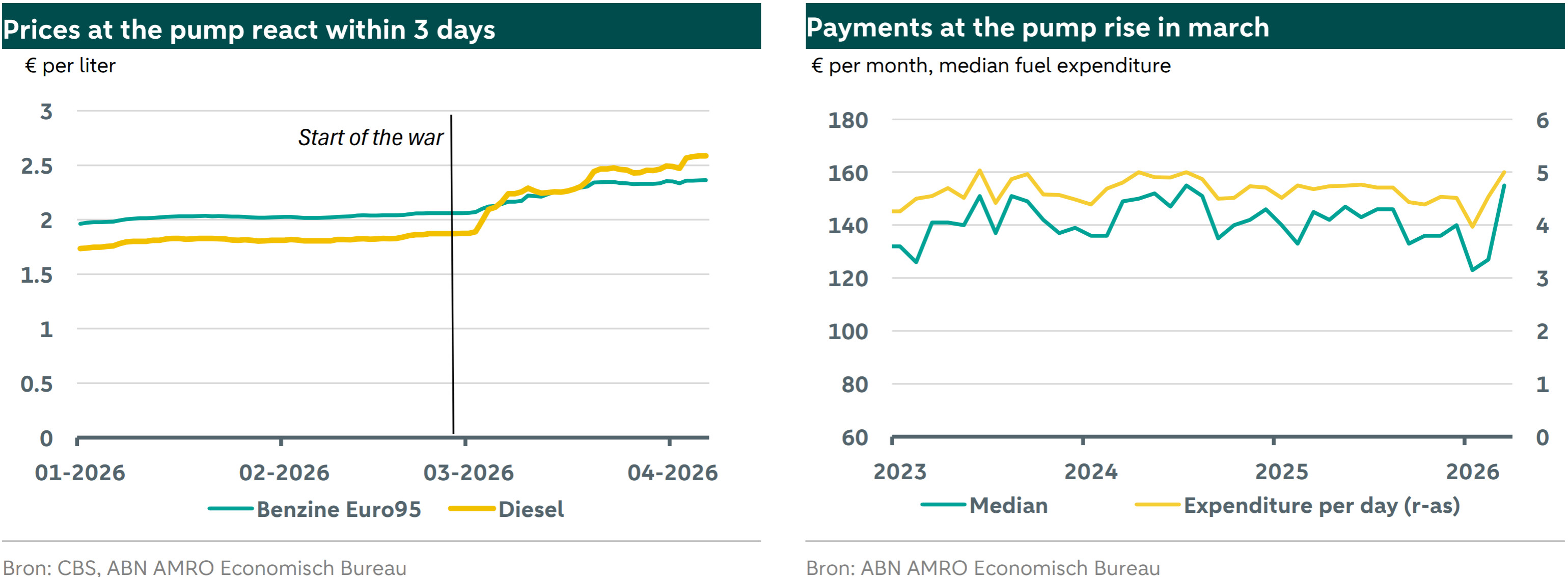
In addition to energy bills, households are also exposed to higher energy prices through fuel costs. Prices at the pump respond much quicker to increases in wholesale prices. For example, CBS daily fuel price data shows that pump prices began to rise just three days after the start of the war on 28 February (see left-hand chart above). The increase in diesel prices has been larger than that for petrol, due to differences in available refining capacity.
The chart on the right above shows the median monthly fuel expenditure of the approximately 700,000 households in our panel that actively use a car. This shows that the average monthly fuel spending rose to €155 in March. This is around €30 more than the previous month and €15 more compared with March 2025.
A few caveats are worth noting here. First, February has fewer days than March, which means that, all else being equal, there is always a month-on-month increase. However, even after adjusting for the number of days in the month, the increase in March remains visible (yellow line). Second, as with energy bills, both price and behavioural effects play a role. For example, car owners may have reduced their driving in response to higher prices in order to limit their monthly spending. This appears to have been the case in March: while median fuel expenditure increased, it did not rise in proportion to the increase in per-litre fuel prices. Third, we cannot observe which type of fuel households purchase, nor whether they are exposed to diesel or petrol prices.
Despite these caveats, it is clear that the average fuel expenditure of Dutch households is increasing as a result of higher fuel prices.
Conclusion
Although energy prices have risen considerably, many households are currently experiencing this mainly at the pump rather than in their energy bills, as is also reflected in the inflation figures. However, households that have had to take out a new energy contract since the outbreak of the war are already seeing their bills increase. The same applies to households with dynamic contracts.
In the coming months, we expect energy prices to remain structurally higher. As a result, an increasing number of households will face higher energy bills when entering into new energy contracts. We will therefore continue to monitor how these price increases feed through to consumers using anonymised and aggregated transaction data. In doing so, we will focus in particular on vulnerable households that spend a large share of their income on energy.