Real estate issuers which printed ESG bonds face a higher refunding drag

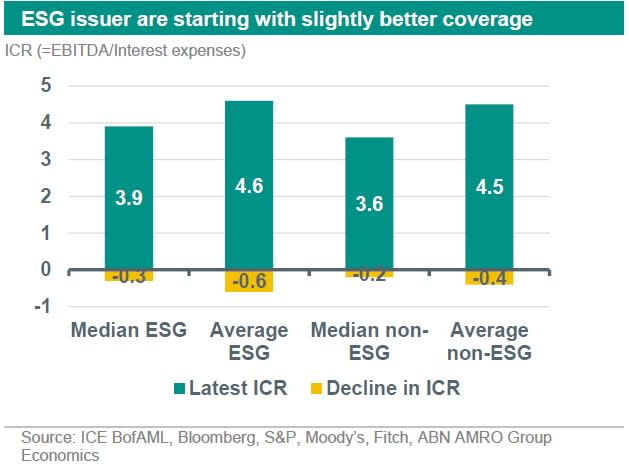
We assess whether interest coverage at issuers which have printed ESG bonds will end-up being more affected than the interest coverage at non-ESG issuers. We find that the effects on coverage seem to be more severe for the ESG issuers. However, these ESG issuers have a slightly better coverage to begin with and therefore the higher interest rates are only equalizing the aggregate ICR between ESG and non-ESG real estate issuers.

Higher interest rates are affecting the cost of debt for all types of real estate issuers
We assess whether interest coverage at issuers which have printed ESG bonds will end-up being more affected than the interest coverage at non-ESG issuers
As this could potentially put ESG real estate bonds on the back foot, given that these also trade at a lower credit spread than their non-ESG equivalent
Based on the refinancing of the issuers’ 2023 and 2024 maturities at today’s yield on a 4 year maturity bond of that same issuer, the effects on coverage indeed seem to be more severe for the ESG issuers
However, these ESG issuers have a slightly better coverage to begin with and therefore the higher interest rates are only equalizing the aggregate ICR between ESG and non-ESG real estate issuers
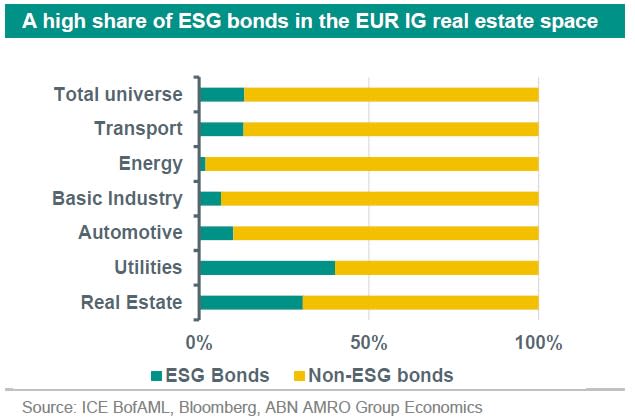
The real estate sector has been a large issuer in the ESG bond space, largely through use of proceeds green bonds. Indeed, many issuers already have or are willing to invest in properties which meet the required demands in terms of energy label for example. The chart below shows that out of all the energy intensive sectors, real estate ranks second (after utilities) in terms of share of ESG bonds in the total EUR IG bond mix.
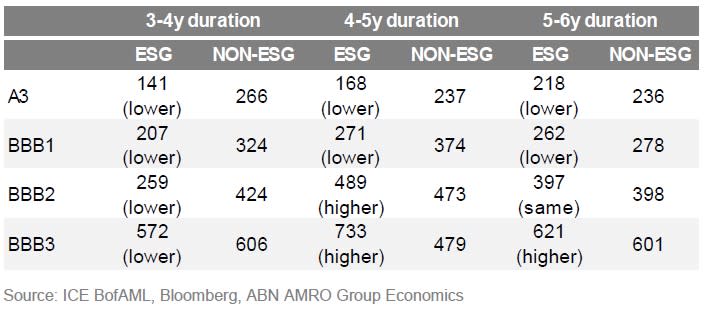
ESG bonds issued by real estate companies tend to trade at a lower spread than their same issuer non-ESG equivalent in the secondary markets. Also on aggregate level this trend is confirmed as shown in the table below where we split bonds into ESG or non-ESG and calculate the average credit spread for 4 most occurring credit rating cohorts on three different duration buckets. The table shows that in the majority of cases the average ESG bond spreads sits lower than the average non-ESG bond spread.
But could this lower credit spread not be compromised in case the ESG real estate bond issuers are facing higher refinancing risks than the real estate issuers, which have not issued ESG bonds? Investors could then perhaps start to put the environmental features on the back-burner and focus on traditional credit fundamentals, especially given the sharp rise in interest rates.
The refinancing drag is indeed larger at ESG real estate bond issuers
We first split the EUR IG real estate bond universe into issuers which have at least 1 ESG bond outstanding (any currency) and issuers that have not issued ESG bonds. We then capture each issuer’s total 2023 and 2023 maturities and associated cost of debt on these maturities through the DDIS function in Bloomberg as this allows us to be as comprehensive in terms of upcoming maturities by also including different currencies and also the issuer’s bank- or privately arranged debt. Assuming that the issuer refinances these 2023 and 2024 maturities at the yield quoted today on the issuer’s 4 year maturity bond, we get to the change in cost of debt. This increase is tagged on to the existing cost of debt in in the denominator of the issuer’s latest EBITDA based interest rate coverage (ICR - we take the latest available rating agency calculated ICR as our base). The charts below (ESG issuers) and on the next page (non-ESG issuers) show the existing ICR and the pro-forma decline in ICR on the back of refinancing at today’s higher interest rate.
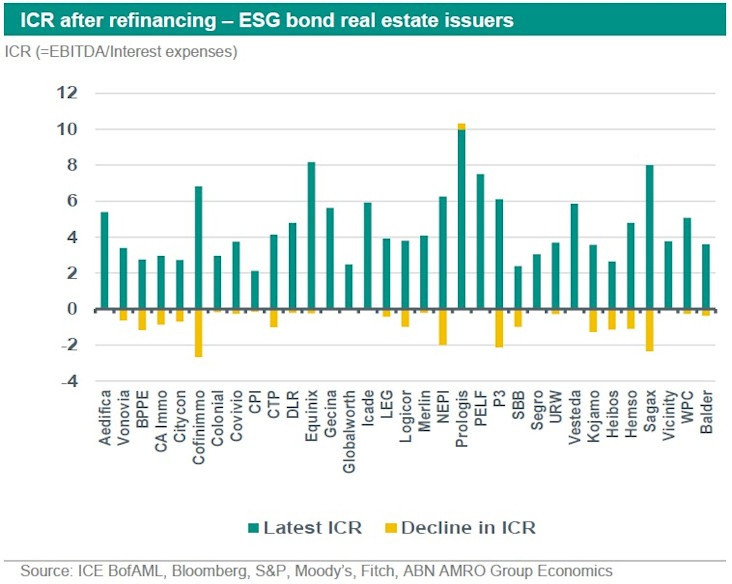
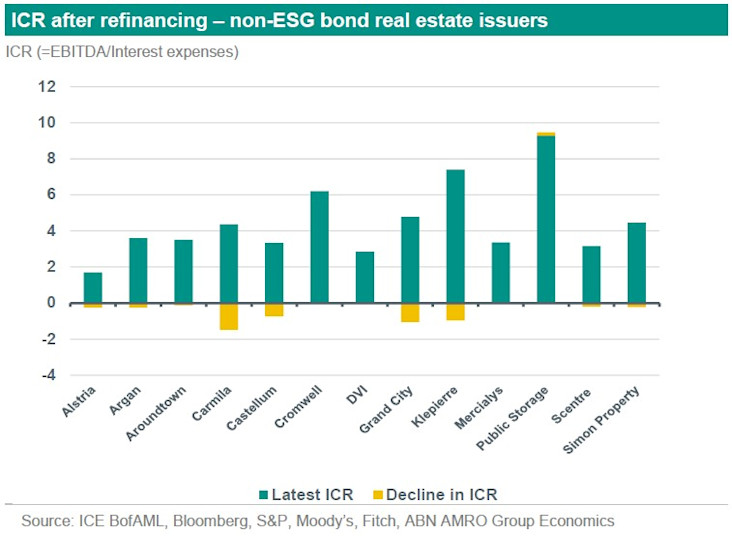
This analysis does have caveats. We have, for example, taken trailing EBITDA and not forecasted EBITDA on issuer level. But the purpose is to purely isolate for refunding effects, which therefore allows us to be rudimentary in our approach. Upon comparing the two charts above, we note that for 78% of the ESG issuers there would be a drop in ICR, whilst the decline would take place at 69% of the non-ESG issuers. The drag also seems to be larger at ESG issuers; a 2 points or more drag in ICR is visible at Cofinimmo, NEPI, 3P and Sagax.
But real estate’s ESG issuers are starting with slightly better coverage
Does this higher refinancing drag mean that the lower credit spread achieved on bonds by ESG issuers could be compromised? Not necessarily, since the ESG issuers are luckily blessed with a higher ICR to start with. The chart on the next page shows the latest median and average ICR for both ESG and non-ESG issuers and it seems under both measures the ESG issuers have a slight advantage in their latest ICR (so before refunding). Indeed, the likes of Prologis, Equinix and Sagax have one of the highest starting ICR’s in the full universe. On a median level the ESG issuer ending ICR is slightly superior to non-ESG after the theoretical refinancing burden, while on average level the non-ESG ICR would become slightly superior. Overall it seems then that some degree of equality is reached between ESG and non-ESG issuers should they refinance upcoming maturities . With ESG issuers (and specifically their underlying bonds) still benefiting from a larger investor base, the spread difference shown in the first table should therefore still remain in favour of ESG issuers.
This article is part of the SustainaWeekly of 5 June 2023